
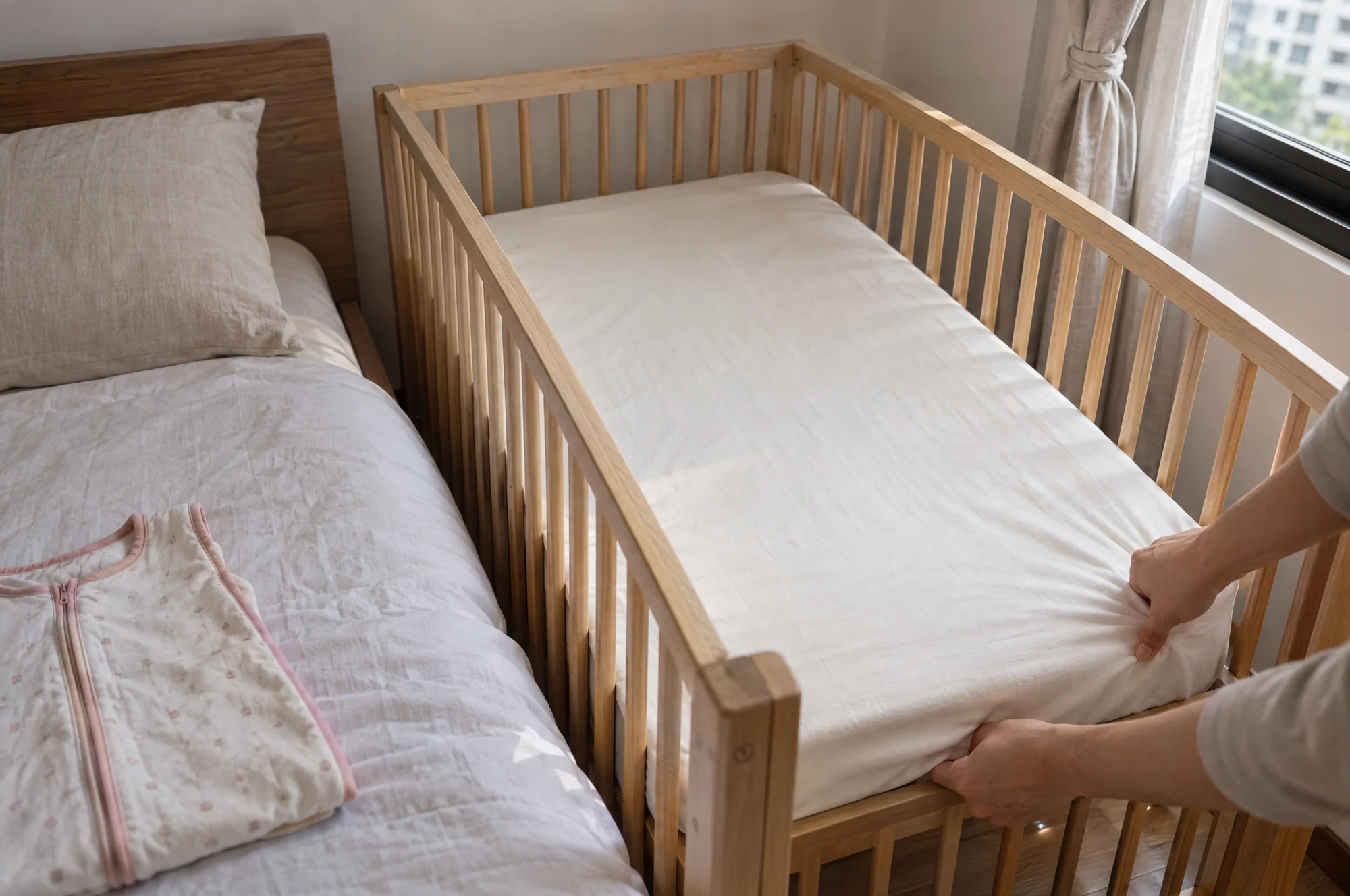
Infant
Safe sleep for babies: where and how your baby should sleep
Safe sleep for babies, the rules health bodies give for where and how a baby sleeps, comes down to a few habits…
Infant
ISOFIX is a set of fixed anchor points a car maker builds into the car itself, so a child seat clips straight onto the body of the car instead of being held in by the adult seat belt. Whether your car has them is a question about that exact model, and in Singapore the answer…
ISOFIX is a set of fixed anchor points a car maker builds into the car itself, so a child seat clips straight onto the body of the car instead of being held in by the adult seat belt. Whether your car has them is a question about that exact model, and in Singapore the answer depends on which distributor you ask.
Nissan Singapore publishes it on its specification pages, down to the row of seats. Honda Singapore prints an ISOFIX line in the specification table of eight of its models, and six Kia models carry the line too.
Toyota, the make with the most cars on the road here at the end of 2024, says nothing at all. It names no child anchor point on any of the seven passenger model pages listed further down.
Below is every model we found stated in writing on a Singapore distributor page we could read, as of September 2026. Several makes are missing altogether, and the section on empty specification sheets says which and why. If your car is not on the list, that is not the same as a no, and the three routes below say what to do instead.
Each row is what the distributor publishes on its own Singapore page or specification sheet. Where it prints a phrase, the phrase is quoted. Where it prints only a table entry, the cell describes the entry rather than quoting words nobody wrote.
| Make | Model | What the Singapore distributor publishes |
|---|---|---|
| Nissan | X-Trail | “Isofix with Top Tether for Second Row Seats” |
| Nissan | Serena | “Isofix with Top Tether for 2nd Row Seats” |
| Nissan | Ariya | “Isofix with Top Tether for Second Row Seats” |
| Honda | HR-V | ISOFIX row, marked “Yes” in both variant columns |
| Honda | CR-V | ISOFIX row, marked “Yes” in both variant columns |
| Honda | Civic | ISOFIX row, marked “Yes” in both variant columns |
| Honda | Freed | ISOFIX row, marked “Yes” in both variant columns |
| Honda | STEP WGN | ISOFIX row, marked “Yes” |
| Honda | ZR-V | ISOFIX row, marked “Yes” |
| Honda | Super-ONE | ISOFIX row, marked “Yes” |
| Honda | Jazz | ISOFIX row, filled with “Child Seat Anchors x 2” |
| Kia | Sorento Hybrid | ISOFIX, one line in the safety and security block |
| Kia | Carnival Hybrid | ISOFIX, one line in the safety and security block |
| Kia | EV9 | ISOFIX, one line in the safety and security block |
| Kia | EV5 | ISOFIX, one line in the safety and security block |
| Kia | EV4 | ISOFIX, one line in the safety and security block |
| Kia | Niro Hybrid | ISOFIX, one line in the safety and security block |
| BYD | Seal | “ISOFIX-ready rear seats” |
| Toyota | Hilux | ISOFIX, in the brochure’s feature list |
Sources, in order: Nissan Singapore’s specification pages for the three Nissans, Honda Singapore’s model pages, Kia Singapore’s specification sheets, BYD Cars Singapore’s page for the Seal, and Borneo Motors’ brochure library for the Hilux.
Four distributors state it for their passenger cars, and no two of them state it the same way. Toyota is the fifth make in the table, and its one entry is a pickup.
Nissan says where. Its Singapore specification pages, published by Tan Chong, do not stop at yes: they read “Isofix with Top Tether for Second Row Seats” on the X-Trail and the Ariya, and the same line with “2nd Row” on the Serena.
It is the only one of the four that names which row. It also names the top tether, a further anchor point that a child seat may need on top of the ISOFIX ones.
The brochure Tan Chong links from the X-Trail’s specification page goes further still, and describes the layout in full: “Child restraint anchorage (ISOFIX second row, outboard seats/tether second row, all seats)”. Read that one with care. The file sits on Nissan’s Australian path, and the brochure itself says the specifications shown “are based on overseas models”, so it shows you what a complete answer looks like rather than settling the Singapore car.
Honda says it twice, and neither time says where. Its Singapore publisher, Kah Motor, prints an ISOFIX row in the specification table of eight models, and seven of those rows hold the single word “Yes”. Only the Jazz row says more, and what it says is “Child Seat Anchors x 2”.
Seven of those same eight pages also carry a short ISOFIX feature block beside the photographs. Five of them read “The ISOFIX child seat can be easily connected to all seat anchor points and be attached securely on all sides for optimal stability”, and the Freed and the STEP WGN put “Connect child seats with ease for optimal safety and stability” under a heading reading “ISOFIX System”. Neither sentence tells you which seats.
Kia Singapore lists ISOFIX as one line in the safety and security block of its specification sheets, with a bullet for it in every trim column beside it. Across the six sheets that is ten columns, and all ten are filled, so each sheet answers for every trim it lists rather than for one of them. Ask the showroom to confirm the sheet is the current one for the car you are buying.
One thing to watch on those sheets: Kia’s plain Sorento address serves the Sorento Hybrid specification page, which is why the table above names the hybrid.
BYD makes the narrowest claim of the four: one phrase, on one car, where the other three print a specification line across a range. Vantage Automotive, which publishes BYD’s Singapore pages, calls the Seal’s rear seats “ISOFIX-ready”, in a sentence listing three safety features, and the Seal is the only BYD in the table because it is the only one where that phrase turns up.
Toyota had more cars registered in Singapore at the end of 2024 than any other make. The Land Transport Authority’s own count put 141,447 Toyotas on the road then, against 103,061 Hondas and 32,042 Nissans, out of a car population of 660,339 (LTA annual car population by make, end 2024).
Borneo Motors, which publishes Toyota’s Singapore pages and brochures, has pages for the Corolla Altis, Corolla Cross, Yaris Cross, Sienta, Noah, RAV4 and Harrier, each with a safety features section. Not one of those sections names ISOFIX, a top tether, a lower anchor or a child restraint of any sort. Those sections are curated highlights rather than full specification tables, so read the silence as silence and nothing more.
The full passenger-car brochures are locked behind an enquiry form. Of the four Borneo Motors brochures published in the open, all four are commercial vehicles, and the one that lists ISOFIX is the Hilux. That is the pickup.
Mazda’s Singapore specification sheets come from Trans Eurokars. The one for the CX-80 is stamped “Updated as of 26 Dec 2025” and runs through airbags, the driver’s knee airbag, lane keeping and driver monitoring. There is no child anchorage line on it.
Nissan is not uniform either. The Qashqai’s specification page lists its safety equipment in the same format as the X-Trail’s and carries no ISOFIX line, while its three stablemates do.
A distributor that does not publish something has not told you it is missing. It has told you nothing. The gaps in the table above are gaps in what is published, and a model’s absence from it is not a finding about the car.
Seven makes are missing for a different reason again. Mercedes-Benz, BMW, Hyundai, Volvo, Tesla, Subaru and Mitsubishi would not give us a readable Singapore specification page at all, so this list says nothing about them either way. If you drive one of those, go straight to the manual.
The reverse trap is worth naming too. A model listed here can be sold in more than one specification, so the sheet for the exact car in front of you is the one that counts. Nissan’s wording is the standard to hold the others to, because it says which row.
Three routes, cheapest first.
Be aware that the word may not be ISOFIX. American-market guides say lower anchors and LATCH, which stands for Lower Anchors and Tethers for Children, and our guide to installing a child car seat in Singapore covers that naming problem in full.
In the X-Trail and the Serena the second row is the middle row rather than the back, so do not start at the rearmost bench. If you are unsure what you are looking at, take the child seat to the car before you buy the seat, not after.
Whether to fit a seat on the anchor points or with the seat belt is a question about the seat, not about the car. The guide that comes with your seat decides it, and it is worth reading before you choose.
No. Singapore’s rule is written about the child restraint, not about the car. A passenger below 1.35 m has to be properly secured by an approved child restraint suitable for that height and weight, and approved here means a type the Deputy Commissioner of Police has approved.
The rule allows one alternative: a belt built to restrain both the upper and lower body and worn so that it does, used with a booster cushion or in a seat with an adjustable belt approved by the Registrar. That is a different office from the one that approves the restraint itself.
The rule also carries carve-outs. It does not apply to a child riding in the rear seat of a taxi, or on a bus, unless that bus is a small bus carrying children to or from school.
So whether a car has ISOFIX is a fitting question, not a legal one. What the law asks of you is an approved child restraint, properly secured, or the belt-and-booster route above. We have set out the rule, its exemptions and the approved standards in our guide to fitting a child car seat and the standards it has to meet, and the safety rules for baby car seats in Singapore covers the same ground from the seat’s side.
If your car is in the table, you have the maker’s own published line and the date on the table. If it is not, spend ten minutes with the manual before you spend anything else.
Then work through the fitting itself, which is the part the seat’s own manual governs: our guide to rear-facing car seats and the rest of the Infant hub pick up from there.
If a stroller pairing is part of the same decision, our guide to child car seat and stroller combos sets out when the combo is worth paying for in Singapore.
We check every specification on this page again when we update it, and the table carries the date it was last checked. If a distributor has since added or changed a line, that date is your warning that ours may be the older reading.

Infant
Safe sleep for babies, the rules health bodies give for where and how a baby sleeps, comes down to a few habits…

Infant
Infant care in Singapore is licensed care for babies from 2 months up to 18 months, full-day or half-day. At a centre…
Infant
A travel system is an infant car seat paired with a stroller, so the seat lifts out of the car and clicks…