

Infant
Safe sleep for babies: where and how your baby should sleep
Safe sleep for babies, the rules health bodies give for where and how a baby sleeps, comes down to a few habits…
Infant
The list of foods to avoid while breastfeeding is short. Alcohol and caffeine both pass into breast milk. That includes the rice wine in confinement dishes, the food served in the weeks after birth while your body recovers. The Singapore Food Agency (SFA) asks you to limit fish high in mercury, a toxic metal, such…
The list of foods to avoid while breastfeeding is short. Alcohol and caffeine both pass into breast milk. That includes the rice wine in confinement dishes, the food served in the weeks after birth while your body recovers.
The Singapore Food Agency (SFA) asks you to limit fish high in mercury, a toxic metal, such as shark and batang (king mackerel). Herbal tonics are worth checking first with a registered physician of traditional Chinese medicine (TCM). Even these come down to how much and when.
KK Women’s and Children’s Hospital (KKH) advises no alcoholic drinks in the first week after birth, and a wait of at least three hours after a drink before you breastfeed. For coffee or tea, its limit is two cups a day.
Many other confinement food rules come from custom. The Health Promotion Board (HPB) writes health advice for HealthHub, the Ministry of Health’s health site. It says most confinement practices rest on tradition and often have “little or no solid scientific basis”.
KKH says no evidence shows that ginger or sesame oil gives a baby jaundice, which turns the skin and eyes yellowish. Nor, it says, does the evidence support cutting out peanuts, eggs or shellfish to lower your baby’s risk of allergy.
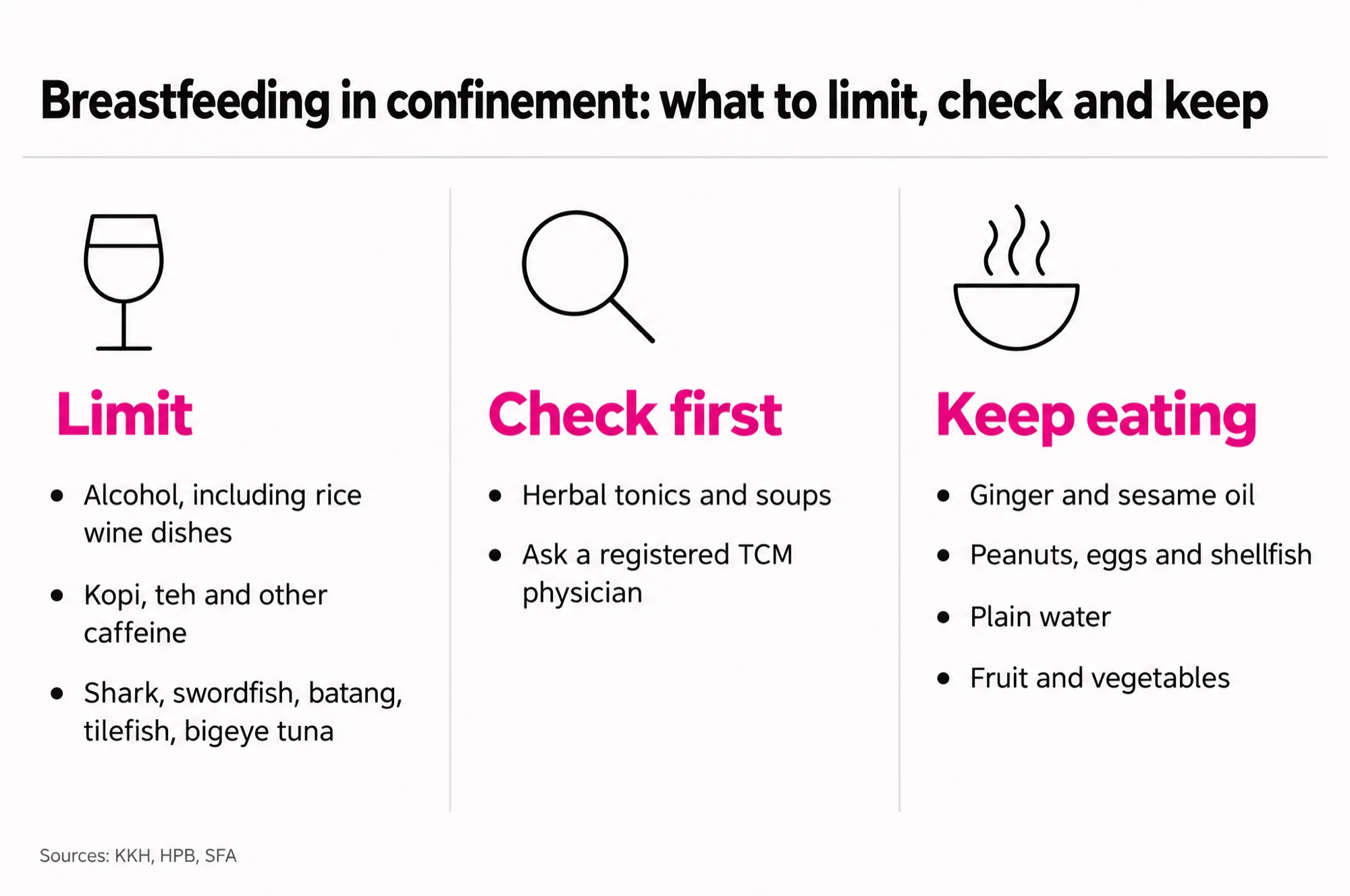
Breastfeeding in confinement: what to limit, check and keep.
Limit: alcohol, including rice wine dishes; kopi, teh and other caffeine; shark, swordfish, batang, tilefish, bigeye tuna.
Check first: herbal tonics and soups. Ask a registered TCM physician.
Keep eating: ginger and sesame oil; peanuts, eggs and shellfish; plain water; fruit and vegetables.
Sources: KKH, HPB, SFA.
Confinement lasts 30 days for Chinese mothers, 40 for Indian mothers and 44 for Malay mothers. Our guide to how long postpartum confinement lasts walks through it week by week. These are the foods you are most likely to be served in that time, with the Singapore line on each.
| Food | Why it is on the list | What the Singapore advice says | What you can do |
|---|---|---|---|
| Rice wine chicken and other dishes cooked with wine | Some alcohol can stay after cooking, and alcohol passes into breast milk | HPB: breastfeed or pump at least 3 hours after eating it. KKH: small amounts are fine in a dish simmered at least 30 minutes with the lid off | Breastfeed or pump just before the meal |
| Tonic wine and other drinks with alcohol | Alcohol passes into breast milk | KKH: none in the first week; from the second week, up to 30 ml of alcohol a day. HPB: breastfeeding mothers should avoid alcohol altogether | Skip it in the first week. After that, wait at least 3 hours before you breastfeed |
| Kopi and teh (local coffee and tea), cola and energy drinks | Caffeine passes into breast milk and may disturb your baby’s sleep | KKH: keep to 2 cups of coffee or tea a day | Cut caffeine out if your baby sleeps badly or is irritable |
| Shark, swordfish, batang (king mackerel), tilefish and bigeye tuna | These fish build up more mercury | SFA: limit them, and keep eating other fish | Pick oily fish such as salmon or sardines instead |
| Herbal soups and tonics, and the Malay herbal drinks jamu (believed to keep the body warm) and air akar kayu (a tonic made from medicinal plants) | Some substances in herbs are not fully known, and they might pass into breast milk | HPB: check with a registered TCM physician before any traditional herbal preparation | Show the recipe or packet to the physician before you drink it |
| Sesame oil and ginger dishes | Often believed to give a baby jaundice | KKH: no evidence that they do | Keep them, in moderation |
| Peanuts, eggs, shellfish and other common allergens | Often believed that avoiding them prevents allergies | KKH: the evidence does not support avoiding them | Keep them, in moderation |
| Plain water | Some Chinese confinement customs avoid it | KKH: drink enough fluids, at least 8 to 10 glasses a day | Drink more if you are thirsty or your urine is dark |
| “Cooling” fruit and vegetables | Custom holds that a new mother must keep her body warm, so confinement diets in all three communities avoid them | HPB: fruit and vegetables should be part of your diet | Choose neutral ones, neither heaty nor cooling, such as carrots or papaya, if you follow TCM |
Yes, with care over how the dish is cooked and when you feed. One way to meet both the HPB and KKH lines is to breastfeed or pump just before the meal. Then wait 3 hours before you breastfeed again.
Rice wine is in confinement food for a reason. The National Heritage Board (NHB) records birthing traditions as part of Singapore’s intangible cultural heritage, the customs a community passes down rather than buildings or objects.
NHB notes that Chinese mothers commonly eat food with vinegar, ginger, pig trotters, pig liver, Chinese herbs and Chinese wine, meant to help them recover from blood loss during delivery.
The catch is that cooking does not always remove the alcohol. HPB says some can be left behind, depending on how the dish is cooked and for how long. Alcohol levels can then stay high in breast milk for a few hours.
HPB’s advice is to breastfeed, or pump milk to store, at least 3 hours after eating food prepared with rice wine or other alcohol.
KKH’s dietitian is less strict about cooked food. You may eat food with small amounts of alcohol added during cooking, the dietitian says. The dish must be simmered for at least 30 minutes with the lid off, so the alcohol vaporises.
A dish with a lot of wine, or wine splashed in near the end, falls outside that allowance.
KKH says to avoid alcohol in the week after delivery, while your milk supply is being established. A newborn’s liver is not fully mature yet, so it may not cope with alcohol that passes through your breast milk.
From the second week, KKH allows up to 30 ml of alcohol a day, about 2 tablespoons. Wait at least 3 hours before you breastfeed, or express milk first, meaning pump or hand-squeeze it out and store it for later.
HPB is stricter. It says TCM practice holds that tonic wine expels cold and helps circulation after childbirth, but new mothers should not see alcohol as essential to recovery. Its advice is that breastfeeding mothers avoid alcohol altogether, though it adds that occasional light drinking has not been shown to harm babies.
Alcohol also affects how your milk flows. HPB says it can hold back the let-down reflex, the reflex that releases milk from the breast when you breastfeed.
There is one more reason for care in the first weeks. KKH warns that alcohol and other substances in confinement food might pass into breast milk, affect a newborn’s liver and worsen jaundice if it is already there. Our guide to jaundice in newborns covers the signs to watch.
You can keep your morning kopi. KKH says you may still drink coffee or tea while breastfeeding, kept to 2 cups a day, because caffeine passes through breast milk and may interfere with your baby’s sleep.
HPB is more cautious, saying caffeine shows up in breast milk soon after you take it, and there is not enough data to say exactly how much is safe. Caffeine can make babies irritable, fretful and restless, with trouble falling asleep. If your baby is not sleeping well or is generally irritable, HPB’s advice is to cut it out altogether.
Count every source, not only the cup at breakfast. HPB lists strong tea, cola and energy drinks beside coffee.
The fish to limit are big fish that eat other fish. SFA advises limiting swordfish, shark, king mackerel (known locally as batang), tilefish and bigeye tuna, because they build up more mercury. SFA says mercury is toxic, particularly to infants and children, and high levels can affect how the nervous system develops.
SFA gives this advice to everyone and names pregnant women, not breastfeeding mothers in particular. It adds that cooking does not lower mercury and the other heavy metals in fish, so the kind of fish you choose is what counts.
Fish is still one of the foods HPB wants on your plate. It recommends oily fish such as salmon, sardines, trout or mackerel for the fats called EPA and DHA, which it says are key to your baby’s brain development. HPB suggests at least 2 servings a week, each about the size of your palm, or 90 g.
Watch for shark in confinement food. Indian confinement menus can include shark cooked in herbs, and shark is on SFA’s list. And if you buy mackerel for its oils, make sure it is not batang.
Neither HPB nor KKH gives a verdict on dang gui, or Chinese angelica root. So if your tonic contains dang gui, or a herb you cannot name, check first. Take the recipe or the packet to a registered TCM physician or your doctor before you drink it.
Herbs run through Chinese, Malay and Indian confinement food alike. Dang gui is one that TCM counts as an important herb after birth.
A Chinese confinement tonic may be brewed from 10 herbs, and a drink of herbs and preserved dates may be taken instead of water. Malay mothers may drink jamu, believed to keep the body warm, or air akar kayu, a tonic made from medicinal plants. Indian mothers may take herbs to keep the body warm too.
KKH says there are substances in herbs that are not fully known, and that alcohol and other substances might pass into your breast milk. Taken in moderation, it says, wine, sesame oil and herbs do no harm, but in excess they may affect you and your baby.
HPB’s advice is to consult a registered TCM physician before you take any traditional herbal preparation, so that it is safe during breastfeeding. For herbal products and supplements, it says to ask a healthcare professional, as they may not always be safe or effective.
Ginger and sesame oil can stay. KKH’s dietitian says there is no evidence that ginger, sesame oil or other “yellow” foods such as lentils and lemons give a baby jaundice. KKH explains that jaundice comes from a build-up of bilirubin, a by-product of the body breaking down red blood cells.
Peanuts, eggs and seafood can stay too. KKH names eggs, cow’s milk, fish, peanuts, tree nuts, wheat, soy and shellfish. It says the evidence does not support avoiding them to lower your baby’s risk of an allergy later, so you can eat them in moderation.
Some Indian confinement customs rule out seafood other than shark, and chilli too. KKH’s doctors note that many confinement beliefs come from culture, “with little or no scientific backup”.
Plain water is one rule KKH turns around. Some Chinese families avoid plain water during confinement and drink a brew of herbs and preserved dates instead, to reduce water retention. KKH advises enough fluids, especially when breastfeeding, and its dietitian suggests at least 8 to 10 glasses of fluids a day, with water as the best thirst quencher.
“Cooling” fruit and vegetables are avoided in all three communities’ confinement diets. HPB says fresh fruit and vegetables should still be a core part of your diet, for the vitamins and minerals that help wounds heal. If you follow TCM, it suggests neutral picks, neither heaty nor cooling, such as carrots, spinach, broccoli, papaya, apples and red dates.
NHB adds that confinement diets also avoid “windy” foods, such as fruit juices, cucumbers, cabbage and eggplants. Clearing “wind” from the body after birth is one aim of confinement custom.
KKH’s dietitian takes a different line on strong flavours. If you think a food such as garlic or onions is upsetting your baby, leave it out for several days and see if it helps.
HPB adds that herbs and spices give your breast milk a variety of flavours, so your baby meets them before starting solid food.
Use KKH’s test first: leave the food out for several days and see whether your baby settles. If the fussing keeps coming back, or your baby seems unwell, see your doctor or a lactation consultant, a specialist who helps with breastfeeding problems. Our guide to lactation consultants in Singapore lists where to find one.
Family and confinement nannies usually serve these dishes out of care. KKH’s doctors put it plainly: “Your elders mean well, but do discuss your preferences with them.” The checklist above is one way to start that talk.
This page covers what to limit. For the other side of the plate, read our tips to increase breast milk supply. They cover what raises supply, how weak the fenugreek evidence is, and when to call a lactation consultant.

Infant
Safe sleep for babies, the rules health bodies give for where and how a baby sleeps, comes down to a few habits…

Infant
Infant care in Singapore is licensed care for babies from 2 months up to 18 months, full-day or half-day. At a centre…

Infant
A travel system is an infant car seat paired with a stroller, so the seat lifts out of the car and clicks…