
Infant
Foods to avoid while breastfeeding: a Singapore confinement checklist
The list of foods to avoid while breastfeeding is short. Alcohol and caffeine both pass into breast milk. That includes the rice…
Infant
Weaning is the move from milk alone to solid food. Start weaning when your baby is about six months old and shows the signs of being ready, but never before four months. The Health Promotion Board (HPB), which writes the health advice on HealthHub, and KK Women's and Children's Hospital (KKH) both draw that line.…
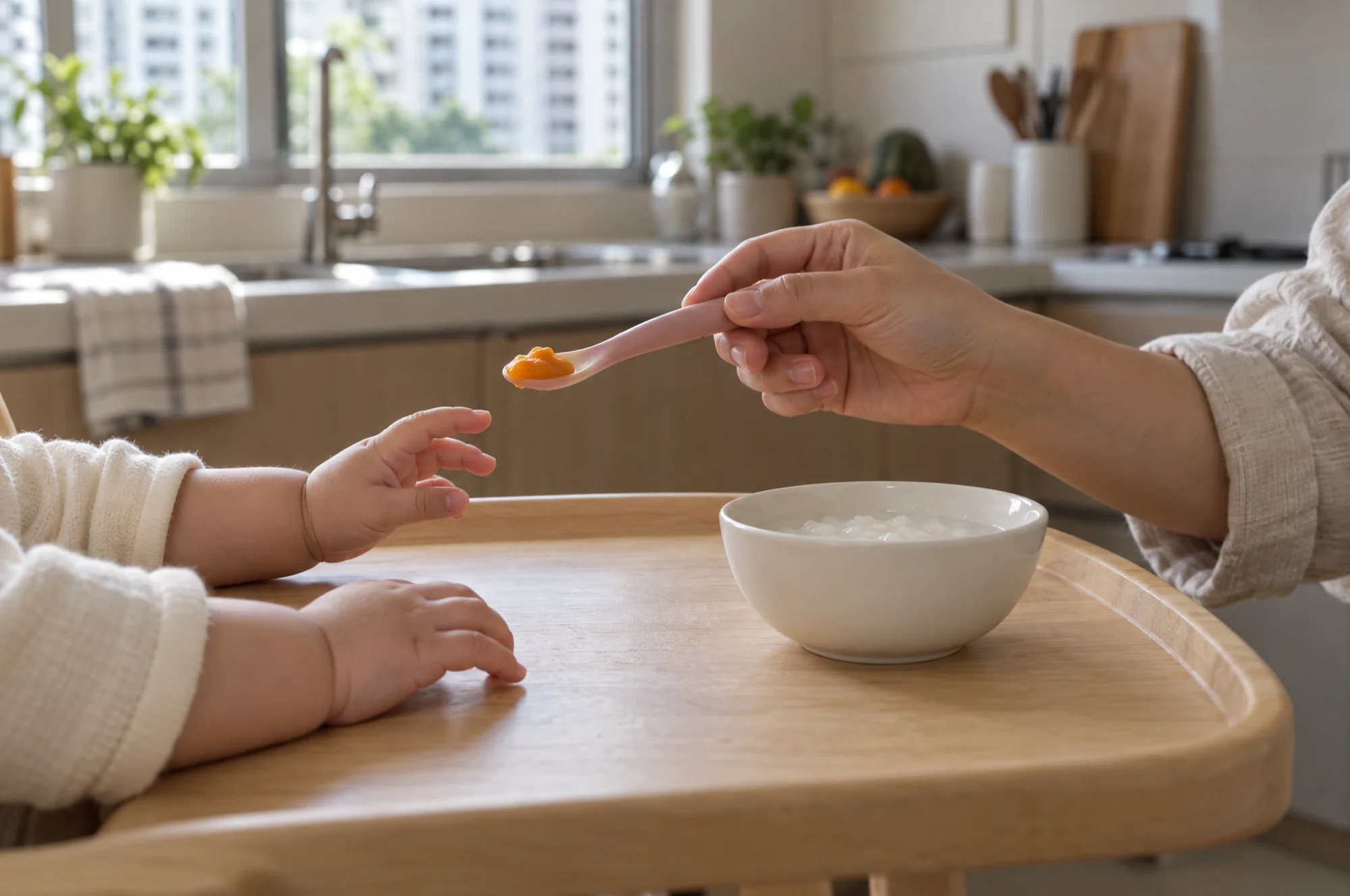
Weaning is the move from milk alone to solid food. Start weaning when your baby is about six months old and shows the signs of being ready, but never before four months. The Health Promotion Board (HPB), which writes the health advice on HealthHub, and KK Women’s and Children’s Hospital (KKH) both draw that line.
Singapore’s 2024 feeding guideline, led by KKH, is the country’s first set of advice on feeding babies and children up to age two. It sets the window for weaning at around four to six months, with food given in addition to milk. Weaning before four months may raise the risk of food allergy and too much weight gain, it says.
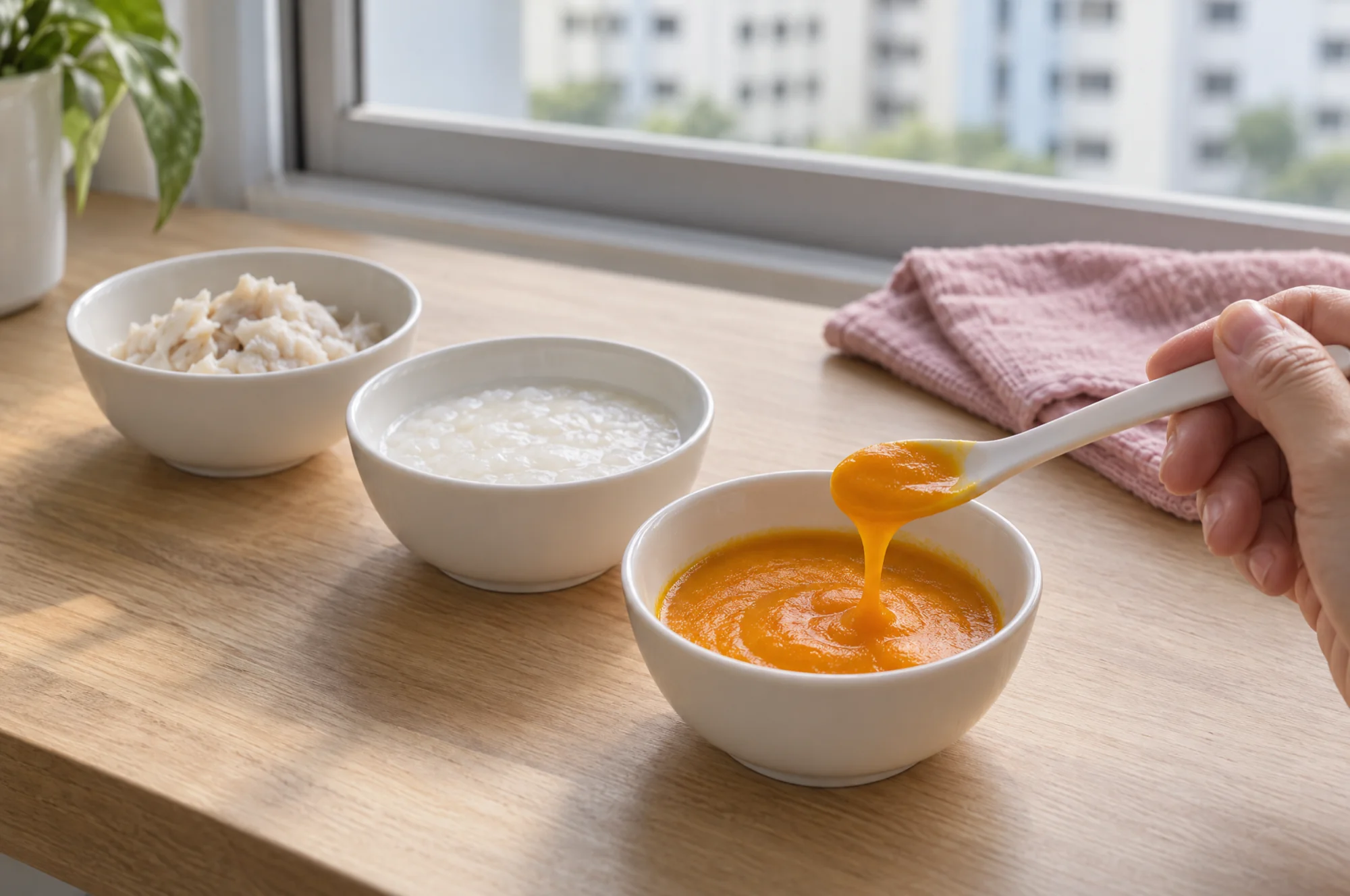
The first spoonfuls can come from your own kitchen: smooth plain rice porridge, mashed pumpkin or sweet potato, and finely flaked steamed fish with every bone taken out. The 2024 guideline suggests a vegetable as the very first food.
Egg, peanut and the other common allergens, the foods that most often cause an allergy, can start at about six months, one at a time. Singapore General Hospital (SGH) advises not to delay them.
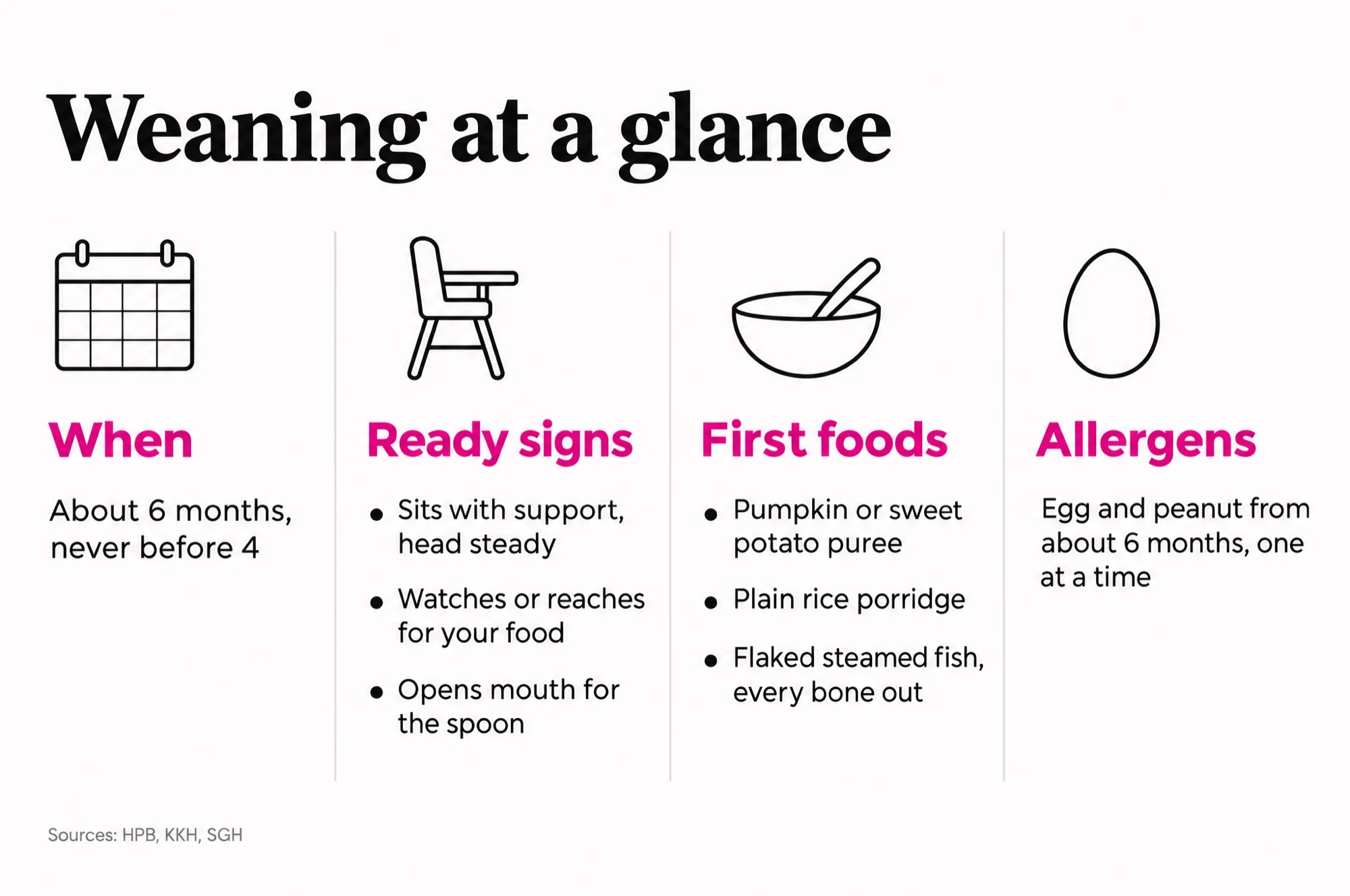
Weaning at a glance.
When: about 6 months, never before 4.
Ready signs: sits with support, head steady; watches or reaches for your food; opens mouth for the spoon.
First foods: pumpkin or sweet potato puree; plain rice porridge; flaked steamed fish, every bone out.
Allergens: egg and peanut from about 6 months, one at a time.
Sources: HPB, KKH, SGH.
The date is only half the answer. HPB says your baby is the best person to tell you when to start. KKH’s dietitians, its food and nutrition specialists, agree that the cue should come from the baby.
Your baby is ready when you see these signs together:
If your baby keeps pushing the spoon out with the tongue, or struggles to swallow, HPB says it is not time yet. Try again in a week. Food spilling out at the sides of the mouth is normal at first, and it eases as your baby gains control.
A baby who is not growing well, or who has iron deficiency anaemia (too little iron in the blood), may start weaning earlier on a doctor’s or dietitian’s advice. Even then, KKH’s dietitians say not before four months. By that age, they explain, the kidneys and gut are usually mature enough to handle food.
Waiting too long has a cost too. KKH’s dietitians advise against waiting past six months to start weaning, because milk alone may no longer give enough nutrition and feeding difficulties become more likely later on.
The 2024 guideline sets nine months as the outer limit. Weaning that starts after nine months has been linked with food refusal and picky eating later in childhood, it says.
Not sure your baby is ready? Ask at the next check-up. A paediatrician is a doctor for babies and children, and our guide to choosing a paediatrician in Singapore sets out where to go.
Up to six months, breast milk or formula alone gives a baby enough nutrition. After that, KKH’s dietitians say, solid food is needed for a growing baby’s changing needs, iron above all.
HPB names the iron-rich choices: iron-fortified infant cereal (cereal with iron added), dark green vegetables such as spinach and broccoli, and finely minced or flaked chicken, fish or red meat. Vitamin C from vegetables and fruit helps your baby take in that iron, HPB adds.
KKH’s dietitians recommend iron-fortified plain rice cereal as the first weaning food. The 2024 guideline recommends a vegetable instead, because a vegetable-first start helps a child accept vegetables.
You can meet both in one bowl. HPB suggests porridge mixed with pumpkin, sweet potato or carrot puree, which is the cooked vegetable blended smooth. It also says there is no “correct” order for new foods.
Cook without oil: steam, boil or bake, and leave stir-frying and grilling for later. Skip sugar, salt, soy sauce and other seasoning. HPB suggests freezing purees in an ice cube tray for up to a month, each labelled with the day you made it.
| Food | How to make it smooth | Why it earns a place |
|---|---|---|
| Pumpkin, sweet potato or carrot | Steam until soft, then puree. Thin with breast milk, formula or water | A vegetable to start, as the 2024 guideline suggests |
| Plain rice porridge, white or brown rice | Cook until very soft, then blend | A bland base you can stir each new food into |
| Iron-fortified infant cereal | Mix a teaspoon or two with breast milk or formula | Most infant cereals have iron added, HPB says |
| Spinach, broccoli or chye sim (choy sum, a leafy green) | Cook soft, then puree, or chop very finely into porridge | Dark green vegetables carry iron. The slightly bitter taste may take several meals to accept |
| Steamed fish | Take out every bone and the skin, flake finely, then blend with a little water or broth | Iron. Pick a low-mercury fish (see the box below) |
| Chicken or red meat | Steam or boil, cut small, then blend with broth or water until smooth | Iron |
| Soft tofu | Mash with a fork | HPB puts it in the same food group as fish and meat |
| Banana, papaya or pear | Mash ripe fruit, or scrape it with a spoon | Fruit brings vitamin C, which helps with iron |
From about six months, once weaning has started. SGH’s advice, on the government’s Ask Gov question site, is to start the common allergens cautiously at six months and not to delay them. Early exposure “may actually help prevent allergies or lessen the severity of a reaction”, it says.
The common allergens SGH names are eggs, peanuts, tree nuts, fish, shellfish, soy, wheat and dairy. Give one at a time and watch for a reaction. If your family has a history of severe allergies, talk to your baby’s doctor before you start.
Two kitchen rules keep this safe. Serve egg well-cooked, as KKH’s dietitians do in their sample menu, since HPB lists uncooked food among what not to feed. Never give peanuts whole or in pieces: whole nuts are a choking hazard, so any peanut must be as smooth as the rest of your baby’s food.
After any new food, HPB asks you to watch for:
Bring your baby to a paediatrician straight away if any of these appear, HPB says. Difficulty breathing and fainting are rarer but serious. For those, call 995: the Singapore Civil Defence Force (SCDF), which runs Singapore’s 24-hour emergency medical service, lists breathlessness and loss of consciousness as emergencies.
There is a reason an older relative may tell you to hold egg and peanut back. In the GUSTO study, a Singapore study that followed 1,152 mothers and their children, about half the babies first had egg after 10 months. About nine in ten first had peanut and shellfish after 10 months.
Food allergy stayed rare in that group between ages one and four. At most 1.8 percent had an egg allergy (fewer than 2 children in 100), and at most 0.3 percent a peanut allergy (3 in 1,000). The researchers, from the National University Hospital (NUH), KKH and the Agency for Science, Technology and Research (A*STAR), found no link between when these foods started and allergy.
That explains the habit, but it is not today’s advice. SGH says not to delay allergens, and the 2024 guideline sets four months as the earliest start for weaning, to reduce the risk of food allergies.
Yes, three to four days. KKH’s dietitians advise one new food at a time, with 3 to 4 days before the next, so you can watch for a bad reaction. HPB gives the same gap.
The wait also tells you which food caused a rash or an upset tummy, if one appears. Once a food has gone down well, keep it on the menu while you try the next. HPB’s aim is a variety of food from all the basic food groups, built up slowly.
Do not read a refusal as a dislike. It may take more than 15 tries before your baby accepts a new taste, HPB says, so offer it again on another day.
This is one example, not a prescription. It follows HPB’s and KKH’s rules, so you can swap any food for another from the table above. Your baby’s pace counts for more than any day on it.
Keep to one meal a day for now, and give the milk feed first so your baby is not too hungry to try. Start with 1 to 2 teaspoons and build slowly toward 1 to 2 tablespoons. Make the food smooth and a little thicker than milk: if it holds its shape on the spoon, it is too thick.
| Days | New food | What goes in the bowl |
|---|---|---|
| 1 to 3 | Pumpkin | Smooth pumpkin puree, thinned with breast milk or formula |
| 4 to 7 | Rice porridge | Plain rice porridge blended smooth, with pumpkin stirred in |
| 8 to 10 | Spinach | Cooked spinach pureed into the porridge |
| 11 to 14 | Steamed fish | Fish with every bone out, flaked finely and blended into the porridge |
| 15 onwards | Egg, then the other common allergens | Well-cooked egg, mashed smooth. Then one allergen at a time, 3 to 4 days apart |
Sit your baby upright in a high chair and stay at the table for the whole meal. Expect mess: KKH’s dietitians say not to fuss about neatness or wipe your baby too often. A wide bib helps, and our guide to baby bibs for feeding time compares five.
From 7 to 9 months, your baby can move to two or three meals a day, with soft lumps and thicker textures. Finger foods, soft pieces your baby picks up and eats by hand, can start at about eight months to build chewing and self-feeding. From nine months, food can be roughly chopped or minced instead of blended.
Milk stays the main source of nutrition until about 10 to 12 months, HPB says. After the first birthday, your baby can join family meals cooked without extra salt, seasoning or sugar. Our guide to superfoods for toddlers picks up from there.
The risky foods are small and hard, round, sticky or bony. HPB, KKH’s dietitians and SGH name these:
With steamed fish, take out every bone before you flake it, then flake it finely.
How you feed matters as much as what you feed. HPB’s and SGH’s safety habits:
If choking keeps worrying you at mealtimes, SGH suggests asking your baby’s care team for help. One person to ask is a paediatric feeding speech therapist, who helps children who struggle to eat and swallow.
Baby-led weaning means skipping spoon-fed purees and letting your baby pick up and eat soft finger foods from the start. HPB and KKH’s dietitians describe spoon-feeding first, with finger foods from about eight months.
The 2024 guideline does ask parents to encourage a child to feed themselves, and to let the child set the pace of feeding. If you want to offer finger foods earlier, SGH’s choking habits above apply in full. Talk it over with your baby’s doctor first.
For the cooking, HPB lists a steamer, a hand blender or food processor, a sieve and a fork. For the eating, our baby feeding must-haves covers the suction plates (plates that grip the table), cups and bibs worth having at your baby’s first meals.

Infant
The list of foods to avoid while breastfeeding is short. Alcohol and caffeine both pass into breast milk. That includes the rice…

Infant
Safe sleep for babies, the rules health bodies give for where and how a baby sleeps, comes down to a few habits…

Infant
Infant care in Singapore is licensed care for babies from 2 months up to 18 months, full-day or half-day. At a centre…