
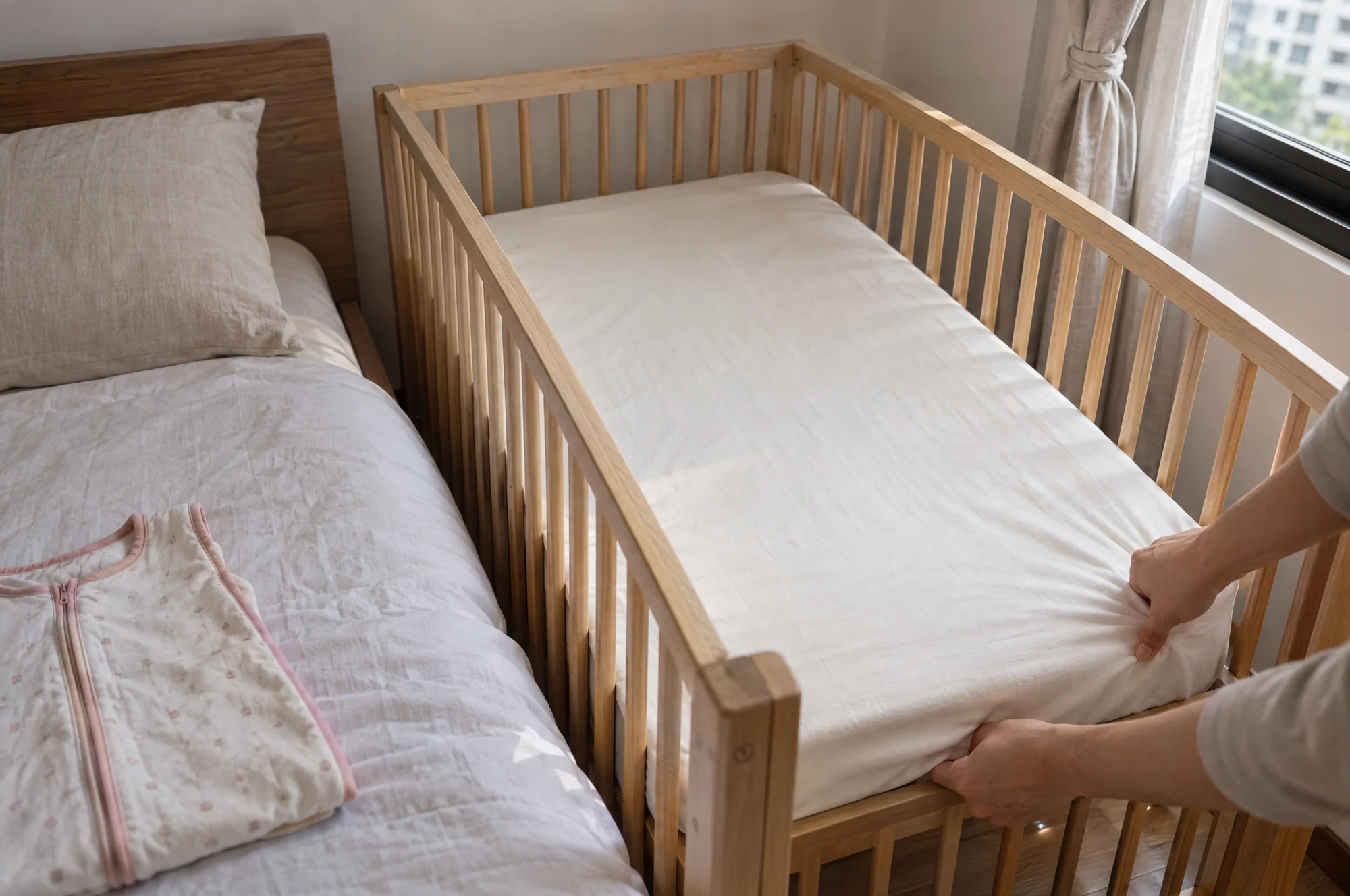
Infant
Safe sleep for babies: where and how your baby should sleep
Safe sleep for babies, the rules health bodies give for where and how a baby sleeps, comes down to a few habits…
Infant
A harnessed child seat, the kind with its own built-in straps, is fitted to the car one of two ways: with the car's own seat belt, or with the car's lower anchor points, the fixings a car maker builds in for exactly this job. The guide that came with your seat names which method to…
A harnessed child seat, the kind with its own built-in straps, is fitted to the car one of two ways: with the car’s own seat belt, or with the car’s lower anchor points, the fixings a car maker builds in for exactly this job. The guide that came with your seat names which method to use, and it may tell you not to use both at once.
A booster is a different animal, and this is the thing most worth knowing before you read any further. On a booster the car’s adult belt is what holds your child.
Lower anchors, where a booster has them, only steady the empty seat. The Skyline 2 Stage booster guide is blunt about it: its lower anchor system “does not restrain your child. You must use the lap-shoulder belt to properly secure your child.”
Then you test the fitting, at the belt path, the slot the seat belt runs through. The One4Life and B-Safe Gen2 guides we host both set the same limit there, no more than 2.5 cm of movement front to back and side to side, and Britax’s Singapore site gives “about one inch at the belt path” for an infant seat. Neither number is a law, so check the figure your own guide prints.
In Singapore the law is set by height, not by age. A passenger below 1.35 m has to be secured by an approved child restraint, or by a booster cushion with a belt that restrains both the upper and lower body, or by an approved adjustable belt, with two narrow exceptions we come to below. The Traffic Police publish the list of safety standards that count as approved.
That list is below, along with what Britax’s own guides instruct, because the guide that came with your seat outranks every article about car seats, this one included.
In brief: Below 1.35 m, a passenger must be secured by an approved child restraint, or by the car’s lap-and-diagonal belt on a booster cushion or a Registrar-approved adjustable-belt seat, with two narrow exceptions below. Fit a harnessed seat as its own guide names; on the Skyline booster we host, the belt holds the child either way. Push the fitted seat at the belt path: the two guides below cap movement at 2.5 cm. Never put a rear-facing seat in front of a passenger airbag. Six standards are approved as of August 2026; the British and Japanese entries stop on 1 January 2031.
One rule covers it. Rule 8(1) of the Road Traffic (Motor Vehicles, Wearing of Seat Belts) Rules 2011 says that where a passenger below 1.35 m in height is in a vehicle the Rules apply to, nobody may use that vehicle unless the passenger is properly secured by one of two things:
“(a) an approved child restraint appropriate for a person of that height and weight; or (b) a body-restraining seat belt in the manner set out in rule 4(2) when seated on a booster seat cushion or when using a seat with an adjustable seat belt approved by the Registrar.”
Read that as two paths rather than one. A proper child seat is path (a). A booster cushion that lifts your child so the adult belt sits correctly is path (b), and so is a built-in adjustable belt where a car has one.
Height is the only threshold in the rule. No age appears in it anywhere, so two children of the same age can sit on opposite sides of the line. Measure your child against 1.35 m rather than working from their birthday.
Two carve-outs sit in rule 8(2), and they are narrower than they sound. The rule does not apply to a child below 1.35 m riding in the rear of a taxi, and it does not apply on a bus unless it is a small bus carrying children to or from school. A private hire car is not a taxi: rule 3 lists private hire cars among the vehicles the Rules apply to, alongside motor cars, light goods vehicles and taxis themselves.
The penalty is in rule 10. Contravening rule 8(1) carries a fine of up to S$1,000 or up to three months in prison, and up to S$2,000 or six months for a second or later offence. Those are the maximums the Rules set, not what a first offence typically costs.
The Rules contain no flat fine, so we are not printing one.
The rules on who must be restrained, and the penalties, are laid out in more detail in our guide to Singapore’s baby car seat safety rules.
“Approved” has a precise meaning here, and it is worth knowing before you buy secondhand or bring a seat back from a trip. Rule 2 defines an approved child restraint as one “of a type approved by the Deputy Commissioner of Police”, and section 76(3) of the Road Traffic Act 1961 requires each approved type to be published in the Gazette.
In practice, what you are checking is the standard printed on the sticker on the seat. The Traffic Police reviewed and published the list on 13 June 2025. As of August 2026 it holds six standards:
| Approved standard | Where it comes from | Status |
|---|---|---|
| FMVSS 213 | American | Approved |
| AS 1754-1975, including AS 1754.1-1989 Part 1, AS 1754.2-1989 Part 2 and AS 1754.4-1989 Part 4 | Australian | Approved |
| B.S. 3254: Part 2: 1988, B.S. AU 202a: 1988, or B.S. AU 185: 1983 | British | Approved until 31 December 2030 |
| ECE R44 | European | Approved |
| ECE R129 | European | Approved, added 13 June 2025 |
| JIS D0401-1990 | Japanese | Approved until 31 December 2030 |
The names are codes rather than words, and the Traffic Police list does not explain them. FMVSS 213 is the American standard, and Britax’s guides expand it as one of the Federal Motor Vehicle Safety Standards. The rest carry their origin in the table above, which is as far as the source takes them.
Source: Singapore Police Force, “Review Of Standards For Child Restraints”, 13 June 2025. On that page the list is published as an image rather than as text, which is worth knowing if you go looking for it. The release adds that the standards are reflected in the Road Traffic (Approved Seat Belts) Notification 2024.
Two things in that table matter to a parent this year. ECE R129 is new to the list, added with immediate effect on 13 June 2025, so a seat bearing that standard is on the current list. And the British and Japanese standards are on a timer: the Traffic Police say they cease to be approved from 1 January 2031, that seats bearing them remain safe to use, and that drivers currently using one have until 31 December 2030 to switch.
The Traffic Police name three ways to check what your seat carries: look for the sticker bearing the standard, ask the retailer, or check the manufacturer’s own information. The sticker is the fastest. On a hand-me-down seat with a faded or missing label, the manual for that model is the next place to look.
The short answer is that your seat’s own guide decides.
Take the Britax One4Life ClickTight, an all-in-one seat whose user guide we host. Its contents page lists three ways to fit it rear-facing, and the first, “Installation with Vehicle Lap-Shoulder Belt”, is labelled “Preferred Method”. The lower anchor route is listed second.
So on that seat, the belt is the method Britax itself prefers.
The same guide then caps the anchor route by weight. Its rear-facing lower anchor section opens with a plain instruction: “Do not install by this method for a child weighing more than 30 pounds (13.5 kilograms).” That seat’s rear-facing range runs to 50 lb (22.7 kg), so on this model the anchors run out well before the seat does, and a parent who never opened the guide would have no way of knowing.
Then there is the mistake that feels like extra safety. The B-Safe Gen2 infant carrier guide tells you to secure the seat “with the vehicle’s child restraint anchorage system if available or with a vehicle belt”, and adds: “Using both methods is not approved and may cause the child seat not to perform as intended.”
Belt and anchors together is not double protection. On that seat it is a fitting the maker has not approved.
So the sequence is: open your seat’s guide, find which methods it lists for the direction you are fitting, use the ones it names, and check whether it allows you to combine them.
The One4Life and the B-Safe Gen2 guides set the same test, in almost the same words. It is the one worth memorising, because it takes a moment and it is where a loose fitting shows up.
Fit the seat. Neither guide says where to take hold for this check, so take hold at the belt path, the slot the seat belt runs through, and push it front to back and side to side.
The One4Life checklist asks that the seat “cannot be moved front to back or side to side more than 1 in. (2.5 cm) at the belt path”. The B-Safe Gen2 base is judged the same way: “The base is secure when it moves less than 1 inch (2.5 cm) front-to-back or side-to-side at the vehicle belt path.”
Both guides measure at the belt path, which is why that is where to test rather than up at the head end.
Three more checks the guides ask for, all easy to miss:
The back seat, and the guides are blunt about it. The One4Life and the B-Safe Gen2 carry the same warning, near enough word for word: “DO NOT place child seat REAR-facing in the front seat of a vehicle with a passenger air bag. DEATH or SERIOUS INJURY can occur.”
Both add that the back seat is the safest place for children aged 12 and under, and point owners of cars with front passenger airbags to their vehicle’s own manual.
The Skyline booster’s version of that rule is worth knowing if a booster is what you are fitting, because it is conditional where the other two are absolute: “DO NOT place a booster seat on the front seat with an air bag unless it is deactivated. DEATH or SERIOUS INJURY can occur.”
Two smaller constraints decide which back seat. All three guides say the seat has to go on a forward-facing vehicle seat, so the side-facing and rear-facing seats some cars have cannot be used. And the position of the car’s own belt buckle can stop a seat sitting stably: the One4Life guide says that if the buckle lands in the wrong place when the belt is tightened, try another seating position, and if the correct buckle position cannot be reached, another position must be used.
Your car’s handbook is the other half of this. The Skyline guide sends you to it directly, to learn whether the car has lower anchors, where they are, and which seating positions are approved for use with a child seat. Two manuals, two jobs: the car’s manual tells you where the seat may go, and the seat’s manual tells you how to fit it there.
Rear-facing for as long as the seat allows is a separate decision from fitting, and we have written it up in our guide to rear-facing car seats in Singapore. Britax’s own position, in the One4Life guide, is that children should ride rear-facing until they exceed the weight or height limits set for the seat.
This one catches people out, and it is a difference in wording before it is anything else.
Britax Singapore describes ISOFIX on its own blog as “an internationally recognized standard that provides a way to secure child seats in cars without utilizing the seatbelt of the vehicle”. On that description the seat slots into “two (three) fixed anchorage points integrated into the vehicle chassis”, usually in the crease where the seat bottom meets the seat back. The same page says “[i]n the United States, the corresponding system is called LATCH (Lower Anchors and Tethers for Children).”
That is the maker’s own description on its Singapore site, not a regulator’s, and it is worth reading as such.
Now the part that catches people. All three of the Britax guides we host state that they conform to FMVSS 213, one of the American Federal Motor Vehicle Safety Standards, and all three are written for the North American market.
They call the route “lower anchors”, and the One4Life and Skyline guides pair that with the term LATCH, which the One4Life spells out the same way Britax Singapore does: Lower Anchors and Tethers for Children. The word ISOFIX does not appear in any of the three, not once.
The recall route gives the market away as well. The One4Life and B-Safe Gen2 guides ask you to register the seat with Britax Child Safety, Inc. at a post office box in Allentown, Pennsylvania, and send recall queries to a United States government hotline; the Skyline guide’s English registration section gives a Canadian address instead. None of the three is a Singapore channel.
Here is the honest limit of what this page can tell you. Britax Singapore calls LATCH the system that corresponds to ISOFIX, and “corresponding” is the maker’s word, not ours.
We cannot show you the regulation that would settle whether the two are the same fitting, so we are not going to guess for you. Your car’s handbook tells you which fittings your car has, and your seat’s guide tells you what that seat takes. Where those two agree you have your answer, and where they do not, the answer is not in an article.
What that means in practice is simple, if slightly unsatisfying. The three manuals quoted here use North American terms, and a manual written for another market may not match yours. Limits are set per model and per edition, so use the guide that came in the box with your seat, or the one for your exact model in the market you bought it in.
If your seat’s sticker carries one of the six standards above, the sticker is not what would stop the seat being legal here, though the British and Japanese entries stop being approved on 1 January 2031. Rule 8 also turns on the restraint being an approved type, on it being appropriate for your child’s height and weight, and on your child being properly secured in it.
Manuals go missing. They come out of the box, get read once, and end up in the drawer under the takeaway menus, or the seat arrives secondhand with no paperwork at all.
We keep a set of them online, free to download. If you know your model, search the Britax manual library and go straight to it. If you would rather scroll, the full document library lists the manuals we hold.
For Britax specifically, our roundup of Britax car seat manuals puts the popular families up front, the Grow With You, Marathon, One4Life ClickTight and B-Safe, and lists the full collection below them.
The three quoted here are there too: the One4Life ClickTight all-in-one, the B-Safe Gen2 infant carrier, and the Skyline 2 Stage booster. Be aware of what the library is, though: every manual in it today is a Britax one, and those three are North American editions.
Treat it as the place to find a manual when yours has vanished, not as a substitute for the one that came with your seat.
Two last things the guides ask, and both are easy to let slide. The first is registration, which all three guides put the same way: “Child restraints could be recalled for safety reasons. You must register this restraint to be reached in a recall.” Use the channel your own guide gives you.
The second is retirement. The One4Life guide says to stop using the restraint if it is older than ten years, and to stop using it after a moderate or severe crash. For the age it points you to the serial number and manufactured date label on the seat, which is worth photographing now while you can still reach it.
If you have not bought the seat yet, and a stroller pairing is part of the choice, our guide to child car seat and stroller combos weighs the bundle against buying the two halves separately.
If you are still setting up for a new arrival, the rest of our infant stage guides are here.

Infant
Safe sleep for babies, the rules health bodies give for where and how a baby sleeps, comes down to a few habits…

Infant
Infant care in Singapore is licensed care for babies from 2 months up to 18 months, full-day or half-day. At a centre…
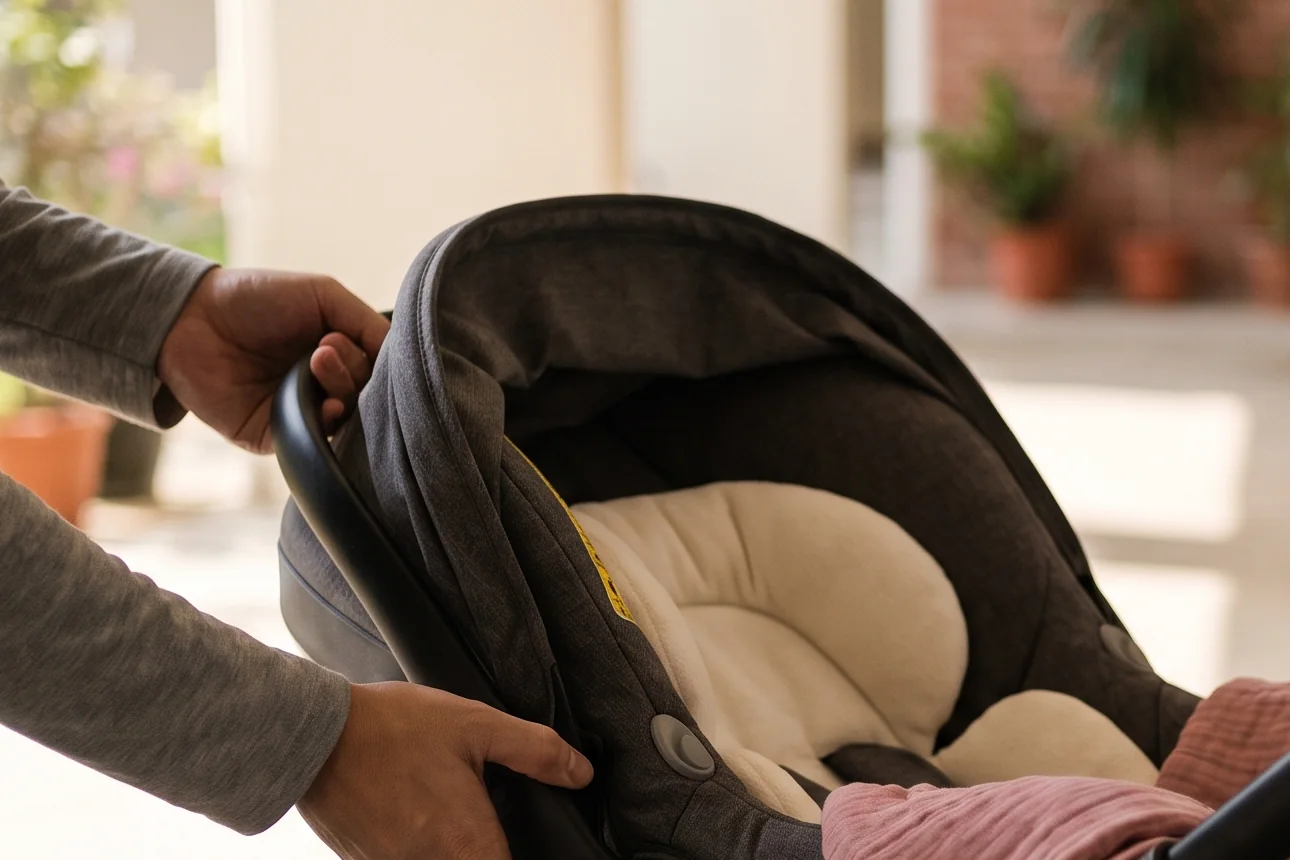
Infant
A travel system is an infant car seat paired with a stroller, so the seat lifts out of the car and clicks…