

Infant
Safe sleep for babies: where and how your baby should sleep
Safe sleep for babies, the rules health bodies give for where and how a baby sleeps, comes down to a few habits…
Infant
Worries about low milk supply are commonly a misread of normal newborn behaviour. Soft breasts after a feed, a baby who wants the breast every two hours, a nappy change that feels too quiet: none of those measures anything. HealthHub, the Health Promotion Board's own health site, names three signs that do, and asks for…
Worries about low milk supply are commonly a misread of normal newborn behaviour. Soft breasts after a feed, a baby who wants the breast every two hours, a nappy change that feels too quiet: none of those measures anything. HealthHub, the Health Promotion Board’s own health site, names three signs that do, and asks for a fourth thing you can count the same way.
Your baby passes clear urine. Your baby has bowel movements two to five times a day or more. Your baby’s weight is climbing again after the normal drop in the first days, at about 150 to 200 grams a week.
The fourth is HealthHub’s own feeding instruction rather than a sign: at least eight feeds in 24 hours through the first four to eight weeks. Count all four for 24 hours before you change anything.
If the numbers fall short, one thing carries real weight behind it, and HealthHub says it plainly: frequent and effective milk removal. That means a good latch, enough feeds in 24 hours, and a pump filling in where your baby cannot.
Lactation teas, cookies and fenugreek capsules are weak evidence at best, and we show you how weak below. There is also a point where the honest answer stops being another tip and becomes a phone call, and Singapore has routes at very different prices, including a hotline with no fee listed.
Run the count before you change anything. It takes one day, it costs nothing, and it decides everything after it.
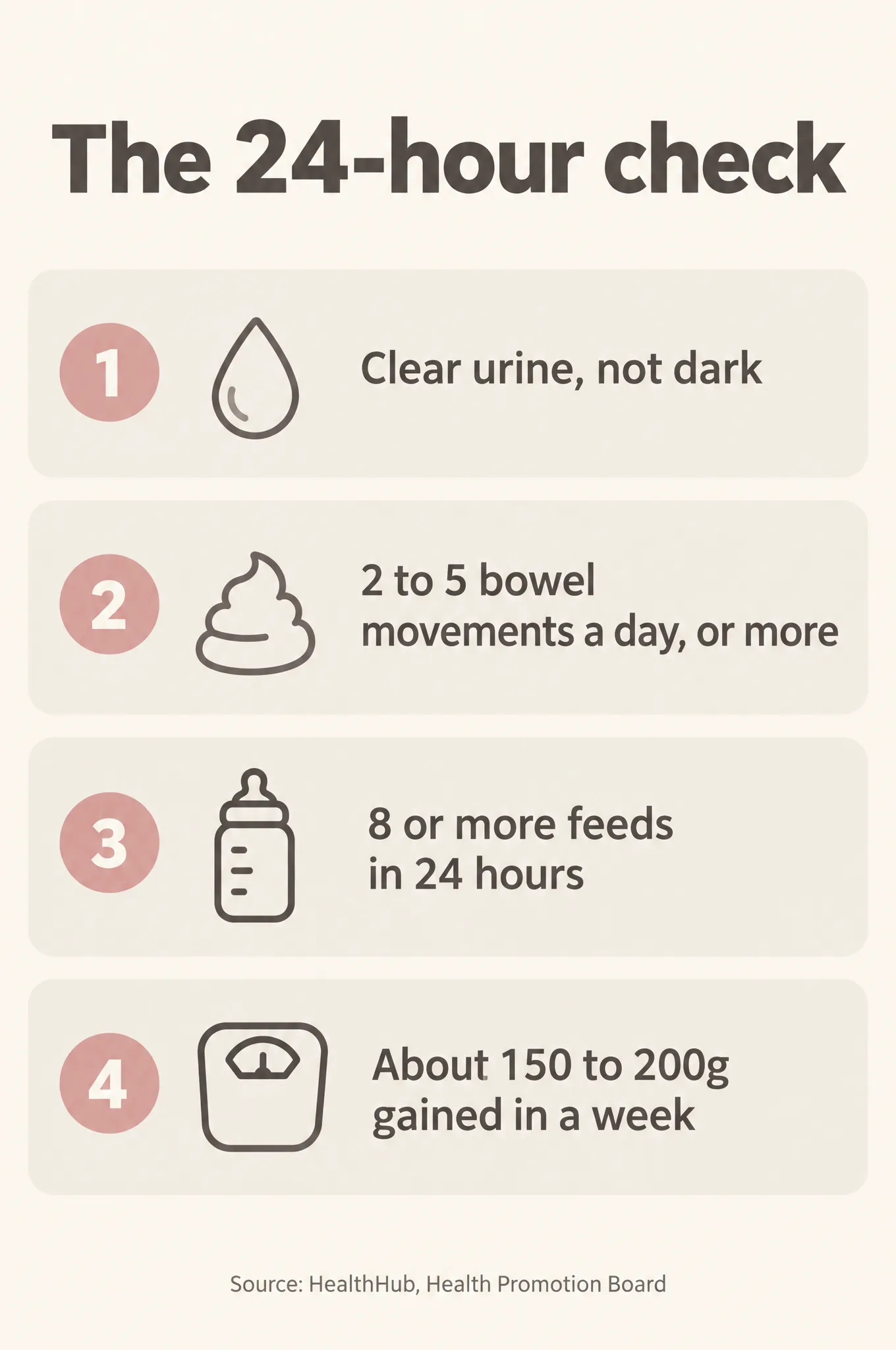
The 24-hour check
Source: HealthHub, Health Promotion Board
A 2024 paper in the journal Nutrients put the problem in one line: the Lancet Breastfeeding Series named a mother’s own perception that her milk is not enough as a major reason parents introduce formula and stop breastfeeding earlier than they meant to. The same paper points at a systematic review of 120 studies in which crying, unsatisfied hunger, fussiness and short gaps between feeds were all, in its words, commonly and hastily attributed to inadequate milk supply. It adds that health professionals may make the same misreading.
Two things are worth saying plainly, because they send a lot of mothers to the supplement aisle at 2am.
Soft breasts after a feed are not a warning sign. HealthHub lists them under the signs your baby has had enough, alongside a baby who seems contented. Breasts also settle down as supply matches demand, which is the system working.
A sudden run of constant feeding is also not proof of anything. HealthHub describes growth spurts, short stretches when a baby wants the breast much more often, and places them around two to six weeks, three months and six months. It says the extra feeding is what raises supply to meet the new demand, and that it lasts a few days.
We come back to the evidence for those fixed timings further down, because it is thinner than the confidence with which it is repeated.
HealthHub asks its own question, will I have sufficient milk, and answers it in one sentence: frequent and effective milk removal is important to ensure a good supply. Everything below is a way of doing that one thing.
Nipple pain is the item on that list to act on. HealthHub says you may feel an initial tug when your baby suckles, but you should not have nipple pain or discomfort. Pain usually means the latch needs fixing, and HealthHub says a good latch should not hurt.
Our guide to getting the latch right goes through the positions one at a time.
On the feed itself, HealthHub is specific. Let your baby stay on one breast until satisfied, which it puts at roughly 20 to 30 minutes, so he reaches the fattier hindmilk at the end. Offer the second breast if he wants more, and start the next feed on the other side.
Feed on demand, every two to three hours, around the clock. Watch the swallowing rather than the clock.
The supporting cast is smaller than the internet suggests: rest, eat well, drink plenty of fluids, cut back on caffeine, and avoid alcohol and tobacco, which HealthHub says can hold back the let-down reflex. These help. None of them replaces a removal that did not happen.
If you want the mechanism itself, we have a separate piece on how milk is produced in the breast.
A pump is not a separate strategy. It is the same strategy when your baby is asleep, in the special care nursery, at home with your mother, or simply not draining the breast well yet.
HealthHub’s own instructions are short enough to fit on a sticky note.
If your baby is not feeding well, or the two of you are separated, expressing and storing is the specific thing HealthHub tells you to do.
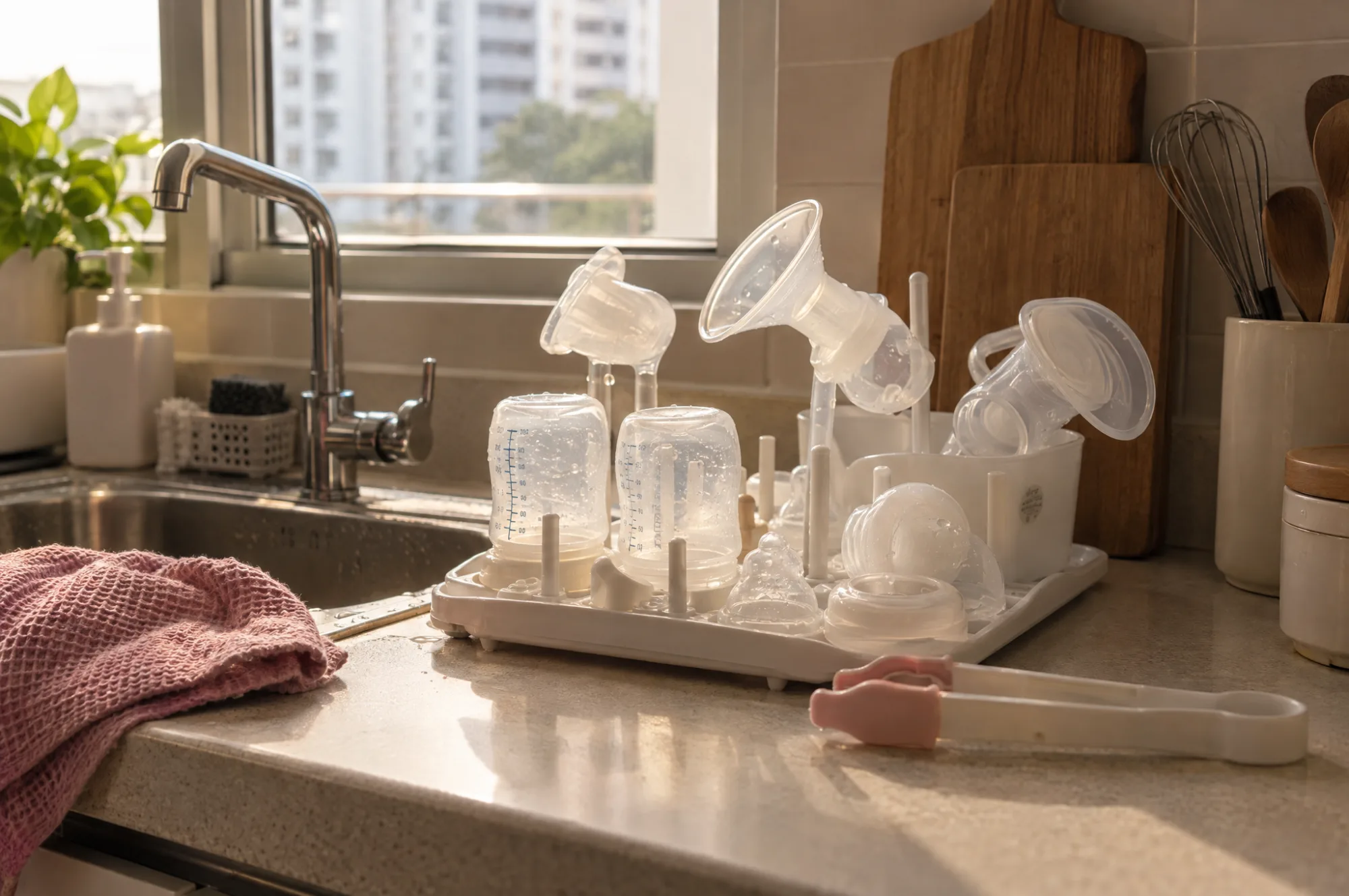
Two practical notes. HealthHub warns about nipple confusion, where a baby offered both breast and bottle starts refusing the breast, and suggests a cup, a spoon or a syringe for expressed milk in the early weeks if you can manage it. And if you are building a freezer stash, our guide to how long frozen breast milk keeps has HealthHub’s storage times in one table.
A galactagogue is anything taken to try to raise milk supply: a herb, a tea, a cookie baked with one, or a prescription drug. It is the part of this subject with the most shops attached to it and the least evidence behind it, and those two facts are related.
The most useful recent read is a systematic review published in the European Journal of Clinical Nutrition in 2025. It pooled ten randomised trials covering 856 mothers, each trial testing a different herb or mixture, and graded how confident anyone should be in each result. Here is what it found.
| What was tested | What the trial found | How certain the reviewers called it |
|---|---|---|
| Fenugreek seed capsules | No increase in milk volume at day 10 (one trial, 26 mothers) | Very low certainty |
| A fenugreek, nettle, fennel and blessed thistle tincture | No increase in milk volume at day 7 (one trial, 9 mothers) | Very low certainty |
| Garden cress (Lepidium sativum) seeds | No change in milk volume at day 7 (one trial, 46 mothers) | Low certainty |
| Barley malt with lemon balm | 149 ml more milk at day 7 (one trial, 80 mothers) | Low certainty |
| Milk thistle with phosphatidylserine and Galega | 105 ml more milk at day 7 | Low certainty |
| Anise seed tea | 98 ml more milk at day 7 | Low certainty |
| Lettuce syrup | 82 ml more milk at day 7 | Low certainty |
Two of those trials reported again at day 28. Garden cress seeds increased milk volume by 67.2 ml at day 28, which the reviewers graded low certainty. A different milk thistle preparation, micronised silymarin, did not increase milk volume at day 28, at very low certainty.
Read the third column before the second. “Low certainty” and “very low certainty” are the reviewers’ own grades, and they mean the next decent trial could move the number a long way or reverse it.
Two of the ten trials scored high for risk of bias; the other eight scored “some concerns”. Nothing here scored well.
Fenugreek deserves its own line, because it is the one most often sold and most often recommended. The single trial of fenugreek capsules in this review, 26 mothers, found no increase in milk volume, and the reviewers rated even that finding very low certainty.
A survey of 82 American healthcare workers in the same review found 70.4 per cent recommending galactagogues, with fenugreek the one recommended most often. The recommending is running well ahead of the evidence.
The reviewers also plotted their studies and concluded the published record leans positive: five trials with a positive result reached print against only two with a negative one. So even this thin evidence is probably flattering.
The Academy of Breastfeeding Medicine’s position, quoted in the same review, is the sensible one to borrow. Herbs have a long history of use, which is reassuring as far as it goes, but there is little scientific evidence on either their safety or their effect, and doses are not standardised.
If a lactation cookie helps you sit down and eat something at 3am, eat the cookie. Just do not let it stand in for a feed.
Domperidone comes up in Singapore parenting groups, so it is worth being clear about what it is. In the Netherlands and many other countries it is registered as an anti-emetic, a drug for nausea and vomiting.
Using it to raise milk supply is off-label, meaning outside what it was approved for. In the United States it is not approved for any use at all, on safety grounds.
The figure that circulates, a 74.72 per cent rise in daily milk production, comes from a review that leans mostly on a single trial criticised for not being randomised and not being blinded, and for a skew caused by very low starting output in three of its seven placebo participants. That is a weak foundation for a number quoted that precisely.
On safety, a population-wide study of postpartum women found 21 cases of ventricular arrhythmia, an abnormal heart rhythm, and 16 of those 21 women already had a history of one. The risk estimate for the women taking domperidone did not reach statistical significance, so the honest summary is that serious events look rare and the picture is unsettled.
Mother & Baby Singapore is a magazine, not a clinic. We give no dose and we are not going to tell you whether this drug is right for you. That conversation belongs to your doctor, who can weigh your heart history and the rest of your medicines.
If someone in a chat group is passing on a dose, that is not the same conversation.
It will not ruin it. It does work against it, and HealthHub says why in plain terms: avoid supplementary feeds as far as possible, because a baby who has been topped up has no desire to suckle enough to keep production and flow going.
Follow that reasoning and the answer falls out. A top-up is a removal that did not happen, and removals are the whole signal.
Three things follow from that.
If a doctor or a nurse has told you to top up because of your baby’s weight, do it. That is a medical instruction about a baby who is not gaining, and nothing on this page outranks it.
Ask at the same visit how to protect supply while you do. Replacing the missed removal with a pump session is one way to do that, and HealthHub’s expressing instructions are above.
If you are topping up out of worry rather than instruction, go back to the 24-hour count at the top of this page first. Worry is the thing this whole page exists to measure.
And where you do top up, replace the missing removal with a pump session close to the same time, using HealthHub’s method: low pressure, switching sides after about 20 minutes. That is the difference between a top-up that costs you supply and one that does not.
HealthHub puts no number on how fast supply responds to more frequent removal, and we are not going to invent one for the sake of a tidier page.
What can be said is what the nearby evidence uses as its window. HealthHub says a growth spurt’s extra feeding lasts a few days and does its work in that time. The supplement trials above measured milk volume at day 7, day 10 and day 28.
So days to a few weeks is the window the nearby evidence works in. Watch the nappy count rather than the calendar. If it has not moved after several days of more frequent removal, that is one of the triggers below.
Now for those growth spurt timings. That same 2024 Nutrients paper went looking for the research behind them and found very little. Its search turned up six relevant papers in total, and it reports that the studies tracking infant growth did not manage to identify a periodicity or an approximate age for a spurt.
Its own conclusion is worth quoting for how unusually blunt it is. Growth spurts in the first year, it says, seem to be inadequately supported by current scientific knowledge and have to be considered a simple compelling theory.
That does not make the advice wrong. A few days of much more frequent feeding still raises supply, because removal is still the signal. It means the calendar around it is folklore, so do not conclude anything from your baby feeding constantly in a week nobody labelled a spurt.
Here is a threshold you can act on. Call someone when any one of these is true.
The person to ask for is an International Board Certified Lactation Consultant, or IBCLC. That is a specific qualification with an international exam behind it, not a job title.
The register is how you check that the person you are calling holds the credential, because the title on its own does not tell you. You can check a name yourself on the public registry run by the International Board of Lactation Consultant Examiners, by name or by credential number.
Singapore has several routes, at very different prices. The table below is taken from the Breastfeeding Mothers’ Support Group’s own directory of lactation hotlines and hospital services, read on 22 September 2026. The fees are what BMSG lists, not what each hospital publishes on its own price page, so treat them as a guide and confirm when you call.
| Where | What it is | Fee listed | Contact and hours |
|---|---|---|---|
| Breastfeeding Mothers’ Support Group (BMSG) | Singapore’s breastfeeding charity. Volunteer counsellors, themselves experienced breastfeeding mothers, trained under the Australian Breastfeeding Association syllabus | No fee listed | Phone and WhatsApp 6339 3558, 9am to 9pm daily |
| Joyful Parenting and Breastfeeding (Family Life Society) | Charity helpline | No fee listed | 6488 0286, Monday to Saturday, 10am to 5pm |
| KK Women’s and Children’s Hospital (KKH) | Lactation Clinic. Phone counselling, tele-consultation or an in-person appointment after discharge | No fee listed | 6225 5554, 8.30am to 4pm. Ask the operator for Lactation Services |
| National University Hospital (NUH) | Breastfeeding hotline and lactation clinic, 1pm to 4pm on weekdays. BMSG’s listing says NUH patients only | S$120 a session | 9722 0376, 8am to 5pm |
| Singapore General Hospital (SGH) | Lactation clinic for recently discharged patients, inside the O&G department | No fee listed | Counselling room 6326 5923 |
| Gleneagles Hospital Parentcraft Centre | Private hospital parentcraft service | S$88 an hour | 6470 5852, weekdays 9am to 5pm, Saturday 9am to 12pm |
| Mount Elizabeth (Novena and Orchard) | Private hospital parentcraft. The consultant calls back between 9am and 5pm | S$107 per 1.5 hours | 6731 2180 / 82, enquiries line open 24 hours |
| Mount Alvernia Hospital Parentcraft Centre | Private hospital parentcraft service | No fee listed | 6347 6641 |
| Thomson Parentcraft Centre | Private hospital parentcraft service | No fee listed | 6251 4090 |
| Raffles Hospital | Lactation consultant on duty 7am to 4pm. Breastfeeding workshop daily at 11am before discharge | No fee listed | 6311 1516 / 7, enquiries line open 24 hours |
Two things to take from that table. If money is the reason you have not called, BMSG’s hotline runs until 9pm every day and its directory names no fee for it.
And if you delivered at a public hospital, its lactation clinic already has your notes. Confirm the fee when you call.
Start the count. Wet nappies and their colour, bowel movements, feeds, and the last two weights, over 24 hours, written down where you can see all four together.
If the numbers meet HealthHub’s markers, your supply is doing its job and the thing to fix is the worry, not the milk. If they fall short, read our guide to lactation consultants in Singapore and book one, instead of trying a thirteenth tip.

Infant
Safe sleep for babies, the rules health bodies give for where and how a baby sleeps, comes down to a few habits…

Infant
Infant care in Singapore is licensed care for babies from 2 months up to 18 months, full-day or half-day. At a centre…

Infant
A travel system is an infant car seat paired with a stroller, so the seat lifts out of the car and clicks…