
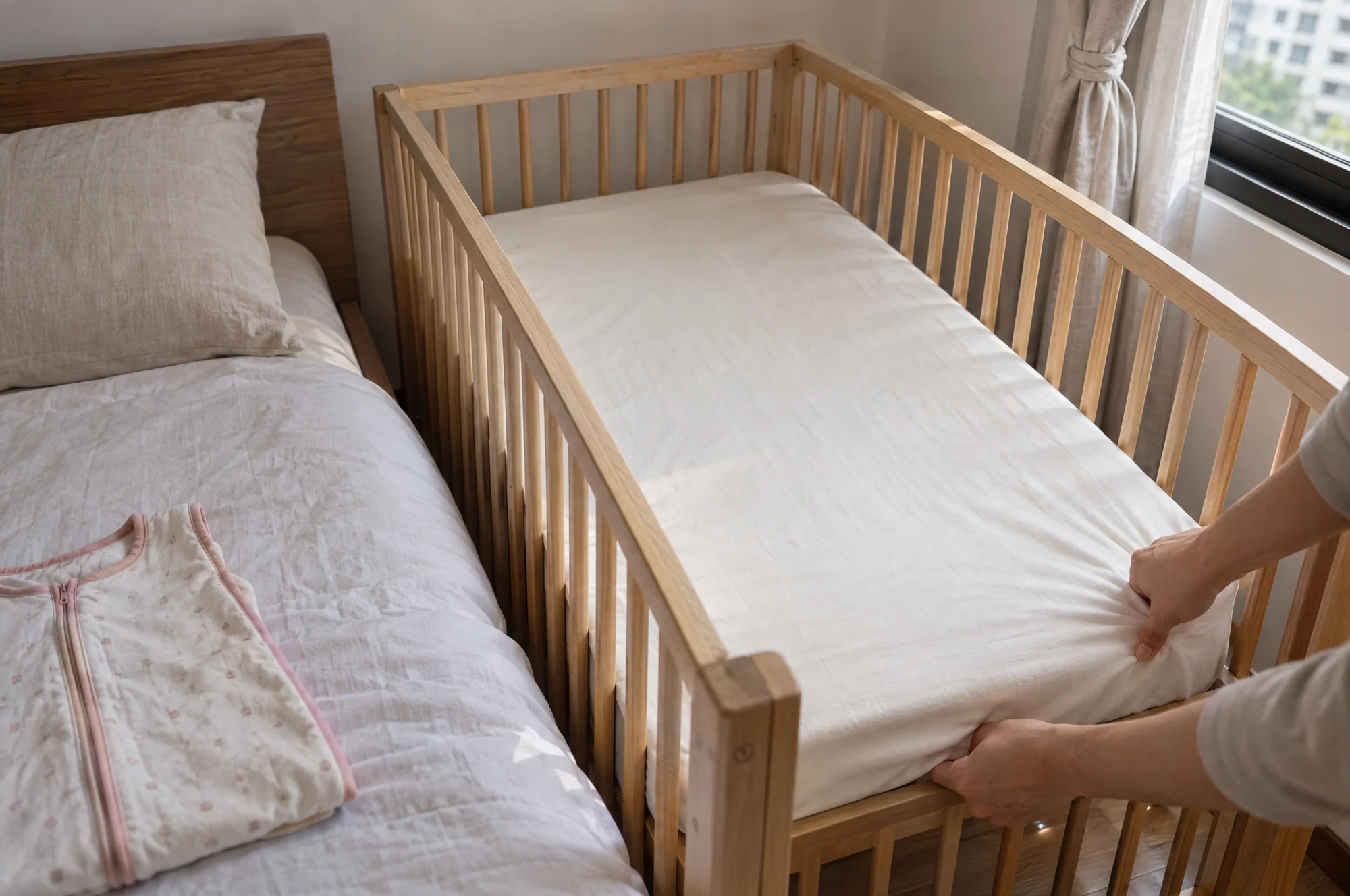
Infant
Safe sleep for babies: where and how your baby should sleep
Safe sleep for babies, the rules health bodies give for where and how a baby sleeps, comes down to a few habits…
Infant
A playpen sold in Singapore has to meet a safety standard, and the Consumer Product Safety Office (CPSO) names two for it: EN 12227, the European playpen standard, or ASTM F406, the American one. There is no sticker on the box that proves it. The SAFETY Mark you may have been told to look for…
A playpen sold in Singapore has to meet a safety standard, and the Consumer Product Safety Office (CPSO) names two for it: EN 12227, the European playpen standard, or ASTM F406, the American one. There is no sticker on the box that proves it. The SAFETY Mark you may have been told to look for covers household electrical, electronic and gas appliances, and a playpen is none of those, so its absence on a playpen means nothing at all.
What you can check is the playpen in front of you. Canada publishes its playpen rules as free law, and they put numbers on the things a parent can actually measure: a floor pad no more than 38 mm thick, and no gap wider than 30 mm between that pad and the sides when you push it firmly against one of them.
Those are Canadian requirements, not Singapore ones. We use them because they are published in full, and because they turn “make sure the mattress fits” into something you can hold a ruler against.
Then there is the part no measurement covers. Nothing soft goes in beside your baby, nothing with a cord goes near the playpen, and you stop using it when your child can climb out.
In brief: Singapore’s Consumer Product Safety Office lists EN 12227 or ASTM F406 for playpens, and no SAFETY Mark exists for one, so do not hunt for a sticker. Canada’s published rules give numbers you can measure: pad no thicker than 38 mm, gaps no wider than 30 mm, sides at least 508 mm high, single-end cords under 188 mm. Keep pillows, quilts, extra padding and anything on a cord out. Stop when your child can climb out, or at the 90 cm Canada’s rules use. Your playpen’s own manual can be stricter, and where it is, it wins.
EN 12227 or ASTM F406. Those are the two the CPSO lists for playpens, and they sit in a booklet anyone can download and read.
The office is the government body that checks consumer products sold here are safe. It is part of the Competition and Consumer Commission of Singapore. Its Consumer Protection (Consumer Goods Safety Requirements) Regulations 2011, the CGSR for short, are the rules that cover ordinary consumer goods: toys, children’s products, apparel, furniture, mattresses and bedding.
Goods under the CGSR have to comply with two things. First, at least one applicable safety standard from the International Organization for Standardization, the International Electrotechnical Commission, the European Committee for Standardisation or ASTM International. Second, the additional requirements in section 5.2 of the office’s own information booklet.
The table in section 5.1 of that booklet starts on page 9, and the playpen row is on page 10. It reads across three columns, European, American and International, and for playpens it gives:
| Product | European | American | International |
|---|---|---|---|
| Playpens | EN 12227 | ASTM F406 | (none listed) |
| Children cots/cribs | EN 716 | ASTM F1169, ASTM F406 | ISO 7175 |
Source: Consumer Product Safety Office, CGSR Information Booklet, section 5.1, page 10. The download link sits on the CGSR overview page above, and the file moves when the office republishes it, so go through that page rather than bookmarking the PDF. The booklet says of the whole table that “the list serves as a guide and is non-exhaustive, and suppliers are to ensure that the latest versions of test standards are used”.
Playpens are not handed to some other agency. The CGSR overview page lists what sits outside these regulations: food goes to the Singapore Food Agency, cosmetics and medical devices to the Health Sciences Authority, motor vehicles to the Land Transport Authority, pesticides to the National Environment Agency, and motorcycle helmets and children car seats to the Traffic Police. Playpens are on none of those lists, so they stay under the CGSR with the rest of the children’s products.
And meeting the standard is the supplier’s job, not something you can verify by eye. The office describes its own role as post-market surveillance: it watches the market, and where it finds goods that do not meet the applicable standards it can order suppliers to stop selling them and tell the public what the danger is. The penalty for non-compliance is a fine, imprisonment, or both.
No, and this is worth settling before you go hunting for one.
The SAFETY Mark is real, but it belongs to a different set of rules. The Consumer Protection (Safety Requirements) Regulations, the CPSR, require “33 categories of household electrical, electronic and gas appliances & accessories also known as Controlled Goods, to be tested to specified safety standards, registered with the Consumer Product Safety Office, and affixed with the SAFETY Mark before they can be sold in Singapore”.
That definition covers things that plug in or run on gas. A playpen is not an electrical, electronic or gas appliance, so it is not a Controlled Good, so it carries no SAFETY Mark.
That matters in a practical way. If somebody has told you to check for the SAFETY Mark, you will turn the box over, find nothing, and wonder what is wrong with the playpen.
Nothing is. You are looking for a mark that was never meant for it.
Where the mark does apply, checking it takes three steps, and they are worth knowing for the electrical items in your nursery. Go to the Register of Registered Controlled Goods at go.gov.sg/safety-mark, key in the product model number or the 8-digit registration number printed on the mark, and check that the result matches the product in front of you.
For a playpen, here is what to do instead:
It failed, once, in 2017. That single episode is what turns EN 12227 from a line in a table into a standard Singapore has actually tested a playpen against.
An alert effective 24 April 2017 covers a playpen sold in Singapore, the Bonbijou Playpen, described in the alert as “a red playpen with mesh on the front and back”. The sample was taken from Infantino Enterprise Pte Ltd. The office’s finding, in its own words, was that “the playpen did not meet the requirements of EN12227”.
The alert gives that standard’s full title too: it is the European standard for playpens for domestic use, covering safety requirements and methods. Then the sentence that reframes everything: “The playpen failed the structural and labelling requirements.”
The office also recorded that “no reports of incidents or injuries related to the use of this product have been received to date”. Its instruction to owners was still the strict one: “Consumers who have bought the product are advised to stop using it immediately.”
That alert is from 2017, it concerns one product tested from one supplier at that time, and no injuries were reported. It is not a warning about anything on sale today.
What it does tell you is that the label is a safety feature. A regulator tested a playpen, and the labelling was part of what it tested and part of what failed.
So when you look at a playpen and see no maker’s name, no model number and no date, you are not looking at missing paperwork. You are looking at the thing a safety standard has requirements about.
Seven things, and a tape measure does most of them.
The numbers below come from the Playpens Regulations, SOR/2018-186, made under the Canada Consumer Product Safety Act. These are Canadian requirements. They are not Singapore law and nothing here says they are.
We use them because Canada publishes its playpen rules in full and for free, with the measurements written into the law itself, so you can check the source yourself.
| What to check | The published requirement | Section |
|---|---|---|
| Floor pad thickness | No more than 38 mm, so under 4 cm. This applies to the pad supplied with the playpen and to any pad designed or advertised to be used with it | s.16(a) |
| Gap around the pad | Push the pad firmly against one side. No gap wider than 30 mm, so 3 cm, between the pad and any part of any other side | s.16(b) |
| Height of the sides | Top rail at least 508 mm, just over 50 cm, above the surface your child actually sits on, with the floor pad in place and nothing pressing down on it | s.18 |
| Posts | A post must not stand more than 1.5 mm above the top rail beside it, measured within 76 mm of the post’s outermost surface. Effectively flush | s.9 |
| Cords and straps fixed at one end | No longer than 188 mm, about 19 cm, when pulled taut | s.14(1) |
| The label | Manufacturer or importer name and principal place of business, model name or number, and the word “DATE:” followed by the year and the month or week it was made. On the playpen and on the packaging | s.41 |
| Height of the child | The regulations define a playpen as being for a child 90 cm or less | s.1 |
Three more requirements are lab tests rather than home checks, and they are still worth knowing, because they tell you what to look at even when you cannot test it.
The mesh. A tester presses a probe with a 6.3 mm rounded tip, about the width of a pencil, against the mesh at ten spread-out points, with a force of 22 N, about what a little over 2 kg presses down with. The tip must not go through. You cannot repeat that at home, but you can look: a hole you can push something into, or a tear pulled open in a panel, is damage, and this Canadian regulation treats mesh openings and torn mesh as two separate requirements.
Openings anywhere in the sides or floor. A solid block measuring 60 mm by 100 mm by 100 mm, roughly the size of a small brick, is pressed against the sides at 90 N, then pushed at any completely enclosed opening in every direction. It must not pass through. The regulation files that test under entrapment, which is the word for a gap that a child’s head or limb can get into and not back out of.
The latches. A folding playpen must have a catch that stops it folding or collapsing on its own when it is set up as the maker intends. And every latch or lock on any playpen, folding or not, must either take a single action to lock plus at least 45 N to release, or need at least two separate, deliberate and simultaneous actions to release.
So the home version of all this: measure the pad and the gap, run your hand along the top rail and the corners, look through the mesh at a lamp for tears and thin patches, and set the playpen up and shove it. If a side folds, stop.
Canada’s regulator has already written this list, and it did not write it as advice.
Section 44 of the Playpens Regulations sets out the warning, or its equivalent, that must appear on every playpen sold there. Equivalent wording is allowed, which is why your own label may not match this word for word. Under the heading WARNING, it reads:
“Do not use this playpen if you cannot exactly follow the instructions that come with it.
Do not use this playpen for a child who can climb out of it or who is taller than 90 cm.
Do not place any cord, strap or similar item in or near this playpen that could become wrapped around a child’s neck.
Do not place this playpen near a window or patio door where a child could reach the cord of a blind or curtain and be strangled.
Check this playpen regularly before using it, and do not use it if any part is loose or missing or if there are any signs of damage. Do not substitute parts. Contact the manufacturer if replacement parts or additional instructions are needed.
Children can suffocate on soft bedding. Do not place pillows, comforters or an additional floor pad in this playpen.
Do not leave a child unattended in this playpen.”
Folding playpens carry one more line, or its equivalent, under section 45: “Ensure that the sides of this playpen are properly latched or locked in the appropriate position before placing a child in it.”
Three of those deserve unpacking, because they are the ones parents talk themselves out of.
“An additional floor pad” means the one you were about to add. A folded quilt to soften the base, a second mattress because the first felt thin, a sheepskin. The pad that came with the playpen is the one the maker tested. Anything on top of it is soft bedding, and soft bedding is what the warning is about.
Toys strung across the top are a Singapore rule too. The Consumer Product Safety Office’s Safety Tips on Baby Cots page carries one line that names a playpen, and this is it: “Remove all toys strung across the cot/playpen when your baby is able to stand to avoid being caught in them.” The trigger is standing, not age. The week your baby pulls up is the week the mobile comes off.
Large soft toys are a foothold before they are a comfort. The cot page makes the same point about cots: stuffed toys and extra pillows can be used “as a foothold to climb out”. A big plush toy in a playpen is a step, and the sides stop being 50 cm high the moment your child can stand on something.
One caveat on all of this. Those warnings are Canadian label text and the cot line is Singapore guidance written for cots. Neither replaces the manual that came with your playpen, and where your manual is stricter, your manual wins.
Yes, and if your baby will nap in it, treat it as a sleep surface rather than as a play space.
The Health Promotion Board’s HealthHub baby sleep guidance sets out seven safe sleeping tips. They are written for a cot, but nothing in them turns on the cot: they are about the sleep surface and what is on it. Four of them decide what a playpen looks like at nap time:
That third bullet points the same way Canada’s section 44 does. The lists are not identical, HealthHub adds blankets, bumper pads and stuffed toys and Canada adds the extra floor pad, but pillows are on both, and both are about bedding: HealthHub’s loose bedding, Canada’s soft bedding.
If your playpen came with a bassinet insert, a raised sleeping platform that clips inside, treat it as its own product with its own limits. Canada’s regulations set separate requirements for these: the sleeping surface must not tilt more than 7 degrees off horizontal, its sides must sit at least 191 mm, about 19 cm, above that surface, and it must not have a child restraint system, meaning no straps to hold a sleeping baby in.
Canada’s warning text for an insert names two moments to stop: when the child can roll over, and when they reach the manufacturer’s weight limit. Check your own label for both. When either arrives, the insert comes out and your baby sleeps on the playpen floor instead.
Change tables and other clip-on accessories come off before your baby goes in. That is section 47 of that same Canadian regulation, a mandatory warning printed on every accessory that reaches over or into the space your child occupies: “Remove this accessory when a child is in the playpen.”
Section 30 of the same Canadian regulation explains why. It sets a separate entrapment test for the openings that appear where an accessory meets the playpen, and for the openings that appear if that accessory comes loose or shifts.
Our guide to how baby sleep patterns develop covers the nap side of this if you are still working out a routine.
Away from the window, and further away than you think.
The Canadian warning names both: the window or patio door, and the blind or curtain cord a child could reach from inside the playpen. The CPSO’s cot page says the same for cots and adds two more cords to the list, baby monitor cords and “wall mounted decorative accessories with long cords”.
In a flat, that usually rules out the obvious spot. The corner of the living room by the window is where the light is and where the blind cords hang. Measure your child’s reach from inside the playpen, with the playpen where you want it, and then move it.
The rest is straightforward. Flat, level floor. Not on a rug edge or a threshold strip where one leg sits higher. Away from anything that can be pulled down: a floor lamp, a plug and cable, a low shelf, a plant.
If you are still laying out the room, the safety half of this is worth reading alongside the decorating half. Our guides to baby room decorations that stay practical and where to buy nursery decor in Singapore both cover what to hang, and more usefully, what not to hang within reach.
A playpen is one of the better things to buy used. It is also where every check above matters more, because a second-hand one can arrive with no manual and no readable label, and those two are how you check anything at all.
Ask for the manual before you agree to buy. If the seller does not have it, look up the model on the maker’s website and see whether the manual is downloadable there. If you cannot identify the model, you cannot look up its limits, and you are left judging the playpen by how it looks.
Then check the label. That 2017 alert failed a playpen on its labelling as well as its structure, and Canada’s section 41 spells out what a label is supposed to carry: who made or imported it, a model name or number, and the date it was made.
A playpen with a legible label is a playpen you can research. A playpen with no label is one you cannot.
Four more things to look at before money changes hands:
Missing parts are the one thing not to work around. Canada’s section 44 warning is blunt about it: do not use it if any part is loose or missing, and do not substitute parts. A bolt from the hardware shop is a substitution.
When your child can climb out. That is the real signal, and it is the one that arrives without warning.
The published height figure is 90 cm. It appears twice in Canada’s regulations: once in the definition of a playpen, “its function is to provide a play area for a child who has a height of 90 cm or less”, and again in the mandatory warning, “do not use this playpen for a child who can climb out of it or who is taller than 90 cm”.
Climbing out comes first in that warning, and the height is the outer limit rather than the test. A child who has worked out that the mesh will take a foot is finished with the playpen, whatever the measuring tape says.
Canada’s regulations set no weight limit for a child in a playpen. Every kilogram figure in them is either a test load or a chemical limit, and the only weight limit they refer to anywhere is the manufacturer’s own, in the warning text for accessories, both the sleep insert and every other kind.
So if your manual gives a weight, that is your manufacturer’s number and it stands. It is not coming from this regulation.
Your manual can be stricter than the published figure, and where it is, it wins. Canada’s own warning puts the manual first: do not use the playpen if you cannot exactly follow the instructions that come with it. Treat 90 cm as the ceiling, not as permission, and if your child is climbing out at 80 cm, you are done at 80 cm.
When that day comes the playpen stops being somewhere you can leave your child, and the next question is usually where they sleep. Our guide to what to know before buying a toddler bed picks it up from there.
One last thing, so you do not spend an evening looking for something that is not there.
The Consumer Product Safety Office publishes parent-facing safety tips for ten children’s products: baby cots, baby slings, children’s toys, children’s apparel, costume jewellery, cycling, highchairs, small magnets, squishy toys and strollers. As of September 2026 a playpen is not among them. The office regulates playpens under the CGSR and has enforced against one, but it has not written the parent’s page, and the cot page’s single line about strung toys is the only playpen sentence on it.
So the Singapore answers this guide could find sit in three separate places: the standards table in the CGSR booklet, the 2017 alert, and the cot page. HealthHub covers the sleep half. The measurements come from Canada.
Every one of them is linked above, the booklet and the 2017 alert through the pages that host them, so you can read the originals for yourself.
For the rest of this stage, our infant guides cover the months either side of the one you are in.

Infant
Safe sleep for babies, the rules health bodies give for where and how a baby sleeps, comes down to a few habits…
Infant
Infant care in Singapore is licensed care for babies from 2 months up to 18 months, full-day or half-day. At a centre…
Infant
A travel system is an infant car seat paired with a stroller, so the seat lifts out of the car and clicks…