
Infant
Safe sleep for babies: where and how your baby should sleep
Safe sleep for babies, the rules health bodies give for where and how a baby sleeps, comes down to a few habits…
Infant
The trick to a nursery that is cute and still practical is to decorate the room and leave the cot alone. Walls, shelves, curtains, the lamp and the floor are where a look actually lives, and none of them touch your sleeping baby. The cot itself wants a firm mattress, a fitted sheet and nothing…
The trick to a nursery that is cute and still practical is to decorate the room and leave the cot alone. Walls, shelves, curtains, the lamp and the floor are where a look actually lives, and none of them touch your sleeping baby. The cot itself wants a firm mattress, a fitted sheet and nothing else, because the soft things that make a cot photograph beautifully are the same things safe-sleep guidance says to keep out of it.
In Singapore there is a second half to the answer, and it is the half that decides what you can actually do. What you can hang, drill, stick or paint depends on the flat you are in. Your Housing & Development Board (HDB) floor plan tells you how much room you really have, your household shelter, the strengthened room with a steel door that HDB fits in the flat, has its own rules from the Singapore Civil Defence Force (SCDF), and Singapore’s humidity, around 82% on average, is worth designing around before you stick anything to a wall.
In brief: Put the personality on the walls, the shelves and the lighting, and keep the cot bare: firm mattress, fitted sheet, nothing loose. Before you buy anything, measure the wall off your flat’s floor plan, and check whether it is a household shelter wall, the strengthened room with the steel door, because that wall has its own rules and the documents covering it do not all say the same thing. Then pick a look that survives humidity and still suits the room when your baby is three.
Cute and practical only fight each other when the decorating lands on the cot. Bumpers, cushions, a garland strung across the bars, a row of soft toys arranged along the end: that is the standard nursery styling shot, and every one of them is a loose object that safe-sleep guidance asks you to keep out of a baby’s sleeping area.
So move all of it a metre away. The same garland reads just as well on the wall above the cot, out of reach. A quilt you love is a wall hanging or a floor rug, not a blanket.
The soft toys look better grouped on a low shelf than squashed against a cot rail, and for the toys themselves we have unpacked Singapore’s toy safety regulations separately. You lose nothing visually and you stop having to undo the room every night.
That one move settles most of the tension, and it leaves you free to spend on the parts that do the visual work: paint or removable wallpaper on one wall, a decent lamp, curtains with some weight to them, and open shelving you will still use when the cot becomes a bed. We have written up the decor pieces we actually rate separately, if you want the shopping side of it.
A beige nursery works because it is a background, not a theme. Warm neutrals sit behind whatever you add later, they photograph well in Singapore’s flat afternoon light, and they do not date the way a character mural does once your child has opinions.
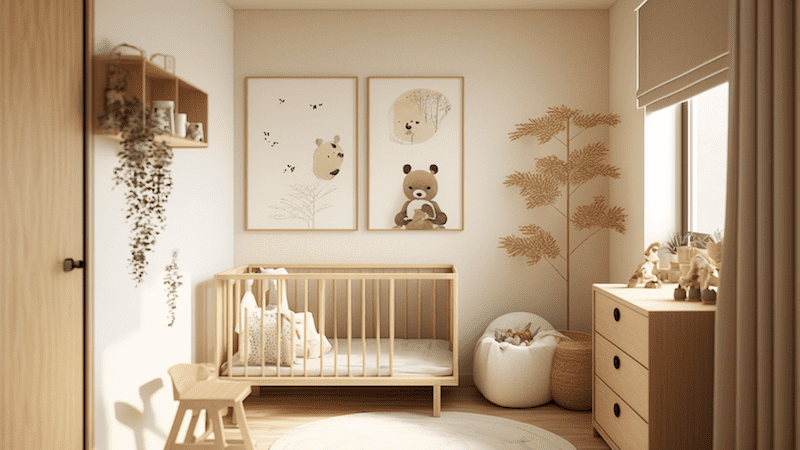
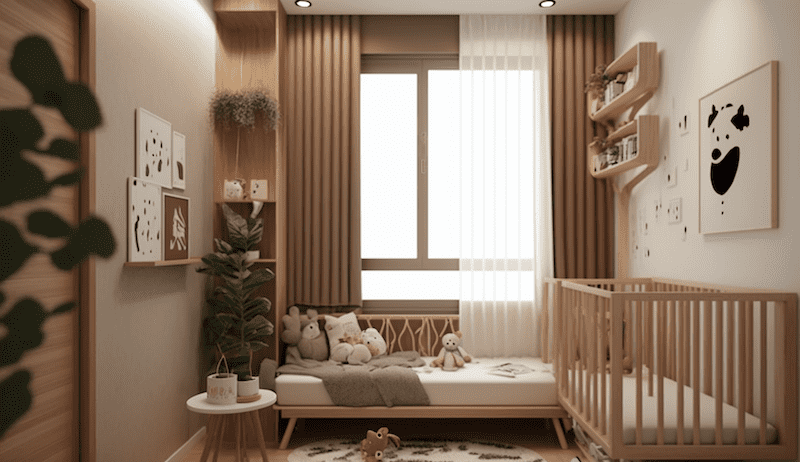
Build it in three layers.
Two things to watch. Beige turns muddy if every item is the same beige, so let the tones separate a little, sand against cream against pale oak. And keep one point of contrast somewhere in the room, usually the lamp, a print or the curtain rail, or the whole thing goes soft-focus.
The look also happens to be the practical one. A neutral room takes a change of bedding, a new print and a different basket and becomes a toddler’s room without repainting, which is not something a jungle mural will do for you.
The honest differences between the popular looks are how much wall work each one needs, how small a room it survives, and how gracefully it ages. This is what we would weigh before committing.
| Look | Room size it suits | What it needs on the walls | How it ages past toddlerhood |
|---|---|---|---|
| Beige and neutral | Any, and the best choice for the smallest bedroom because it does not visually shrink the room | Paint or nothing. Frames and shelves are optional extras, so it can be done with no fixings at all | Best of the five. Change the bedding and a print and it is a child’s room, not a nursery |
| Jungle or botanical | Medium and up. On a small wall the pattern closes the room in | Wallpaper or a large decal on one wall, which means a clean flat surface and patience | Reasonable. Keep the palette muted and it reads as a child’s room rather than a nursery once the cot goes |
| Pastel | Any. Pale colours behave like neutrals in a small room | Paint, plus small hung pieces. Low commitment | Fine, but pastel keeps reading as a nursery for longer than a neutral does, so budget for repainting rather than assume it carries |
| Monochrome and high contrast | Medium and up. Strong contrast in a very small room reads as busy | Framed prints, so several wall fixings, or a picture ledge to avoid drilling repeatedly | Good. Swap the prints and the scheme survives entirely |
| Rainbow or bright playful | Medium and up, and best where there is good natural light | The most work: multi-colour paint, decals or a mural, and usually several fixings | Weakest of the five, and the one we would expect to repaint first |
The table weighs wall work, room size and how each look ages. It does not price them.
Split the question in two, because the answer is different for the cot and for the rest of the room.
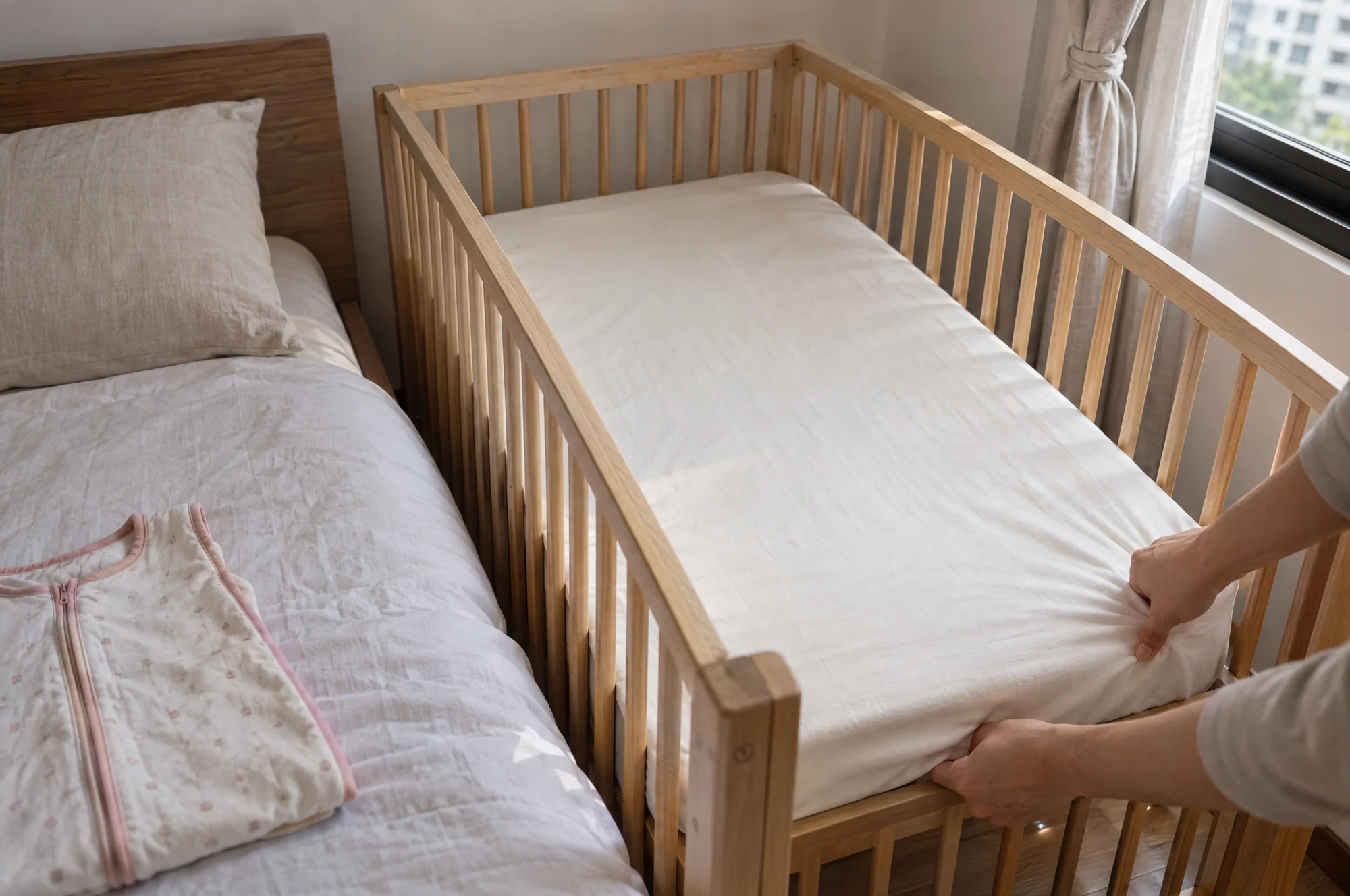
Inside the cot, almost nothing. HealthHub, relaying safe-sleep guidance from the American Academy of Paediatrics (AAP), says to keep loose objects away, “including blankets, bumper pads, loose bedding, pillows and stuffed toys” from a baby’s sleeping area, because “these objects increase the risk of entrapment, suffocation, and strangulation”.
The sleep surface itself should be “a firm mattress covered by a well-fitted sheet”. That rules out cot bumpers, the draped throw, the canopy that hangs into the cot and the toys along the rail, however good they look.
The same guidance asks you to keep your baby in their own cot for at least six months and preferably a year, and to keep that cot in your room, close to your bed. Worth knowing before you design a nursery your baby will not sleep in yet.
Outside the cot, most things, with two checks. We would fix anything mounted above or beside the cot so that it cannot come down into it, which in practice means a proper wall fixing rather than adhesive strips for anything with weight.
Cords are the second check, and Singapore’s childcare licensing code names curtain cords directly. The Early Childhood Development Agency (ECDA) sets a Code of Practice for licensed early childhood centres, and its clause on the care of infants (5.4.4) sets out what a centre must ensure at naptime: “Sleeping area is safe and conducive for infants’ sleep. Cots and mattresses should not be placed near curtain cords.”
The same clause adds: “Cots are free of objects that can increase the risk of entrapment, suffocation or strangulation. This includes pillows, pillow-like toys, blankets and bumper pads.”
Those rules bind centres, not homes. The reasoning still transfers: put the cot where no cord can reach it, and you have removed the hazard rather than supervised it.
One correction to something this page used to say. The version of this article we are replacing suggested that room colour or lighting could damage a baby’s eyesight. We could not verify that against any health authority and have removed it.
HealthHub’s baby-sleep guidance treats nursery lighting as a sleep question, not an eye one: keep the room dim for naps, and let natural light in when it is time to be awake, because the contrast helps set the sleep and wake cycle.
If baby-proofing the rest of the flat is next on your list, we have a separate guide to baby proofing an HDB home.
Start with the plan, not the mood board.
HDB’s sales brochures print their floor plans to a metre scale, so you can measure your own bedroom off the page with a ruler before you have keys. The Kim Keat Crest sales brochure from the February 2026 Build-To-Order (BTO) exercise, for example, prints a scale bar running from 0 to 10 metres on its plan pages and no room dimensions in figures, so the bar is what you measure against. If your flat came with one, dig it out and measure the wall you want to decorate off the plan.
The whole-flat figures are published too, and they vary more between projects than you might expect. In that same February 2026 exercise, four-room flats ranged from 89 to 94 square metres depending on the project, three-room flats from 67 to 69, and five-room flats came in at 113.
HDB gives two figures for each: an estimated floor area, which is “the estimated area of the whole apartment, comprising the internal floor area and the air-conditioner ledge”, and an internal floor area “computed based on the centre line of the apartment wall”, which for those four-room flats was 86 to 90 square metres. The second number is closer to what you can furnish. (Figures as of the February 2026 BTO exercise.)
The plan marks which windows are the three-quarter-height type, and that type’s parapet figure is printed in the legend. In the Kim Keat Crest brochure, windows are standard height unless marked otherwise, and the marked type, W1, is a three-quarter-height window with a parapet wall of about 550mm. That figure is worth knowing when you decide where the cot goes.
Do not assume grilles come with the flat. In the Kim Keat Crest brochure, window grilles, a built-in wardrobe and lighting are Optional Component Scheme items, and only for 2-room Flexi flats. The scheme is HDB’s list of optional fittings you choose and pay for with the flat.
The package carrying the grilles is the one that “offers seniors the convenience of having a flat in move-in condition”. For 3-room and bigger flats the scheme covers floor finishes, internal doors and sanitary fittings, and grilles are not on that list. So in a family-sized flat they are a separate job, and worth planning before your baby is mobile.
If your nursery contains or adjoins the household shelter, the room HDB fits with a steel door and strengthened floor, walls and ceiling, that wall follows its own rules. They come from the SCDF’s Technical Requirements for Household Shelters 2023, and clause 7.2 sets out what you may and may not do to it. It is worth reading before you write that wall off.
Permitted: “Drilling into internal face of HS walls and ceiling slabs to a depth of not more than 50mm to affix inserts and removable screws is allowed”, and the fixtures the clause names are the ones you would hang, “pictures, posters, cabinets or shelves”. The insert is the part the rule constrains: “There is no restriction to the diameter of the non-metallic insert as long as it does not exceed 50mm in length.” In plain words, the wall plug you screw into has to be non-metal, a plastic plug rather than a metal anchor, and no longer than 50mm.
The condition attached to those fixtures is that they “have to be removed by the owners within 48 hours upon notification”. The clause does not say what triggers that notification, so treat it as a standing obligation rather than something you will be asked about routinely. Painting the walls, ceiling and door is also allowed, as long as you do not paint over the notice on the shelter door.
Not permitted, and these are the ones to hand your contractor in writing: power-driven nails into the internal shelter walls, wall tiles or gypsum plastering on the internal faces, and any hacking or drilling beyond what clause 7.2 itself permits. On SCDF’s rules, then, a framed print on the shelter wall is fine on a removable screw in a non-metallic insert no longer than 50mm, and a nail gun is not.
One thing to check before you drill, because two documents can point different ways: clause 7.2.1(g) permits that 50mm hole. The Kim Keat Crest sales brochure does not: its Important Notes, printed under both the 2-room specification page and the one covering 3-room and 4-room flats, say “The walls, ceiling, floor and door of the Household Shelter shall not be hacked, drilled, altered or removed.” A sales brochure covers one project, so the one to read is your own.
The Meteorological Service Singapore puts the mean annual relative humidity at around 82%, rising above 90% in the morning before sunrise and falling to around 60% in the afternoon on days without rain. Outdoors that swing runs from above 90% before dawn to around 60% on a dry afternoon, and aircon dries the room further at night.
What that means in practice: adhesive decals and washi tape lift at the corners first, so check them monthly rather than assuming they have held. Leave an air gap behind large timber or rattan pieces rather than pushing them flat against an outside wall.
For the rug your baby will actually roll around on, buy one you can put in a machine, because in this climate you will be washing it more often than the picture suggests. If you are running aircon in the nursery, we have looked at whether air conditioning affects babies and how to set it.
Once the room’s constraints are settled, the shopping is the easy part. Our guide to where to buy nursery decor in Singapore lists the places worth a trip, and our infant guides cover the rest of the first year, the sleep, the feeding and most of the gear.
Decorate the room. The cot stays bare.

Infant
Safe sleep for babies, the rules health bodies give for where and how a baby sleeps, comes down to a few habits…
Infant
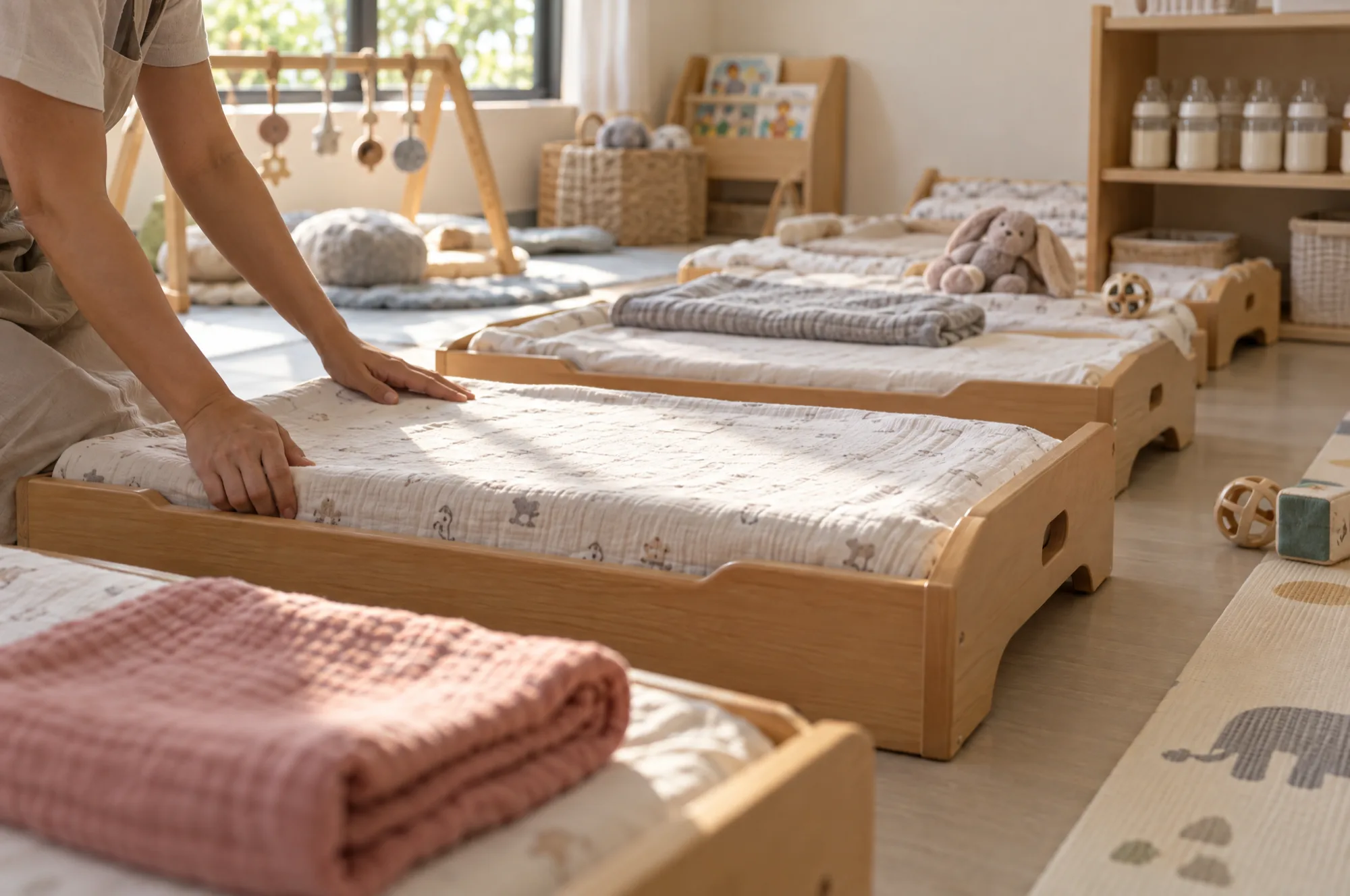
Infant care in Singapore is licensed care for babies from 2 months up to 18 months, full-day or half-day. At a centre…
Infant
A travel system is an infant car seat paired with a stroller, so the seat lifts out of the car and clicks…