
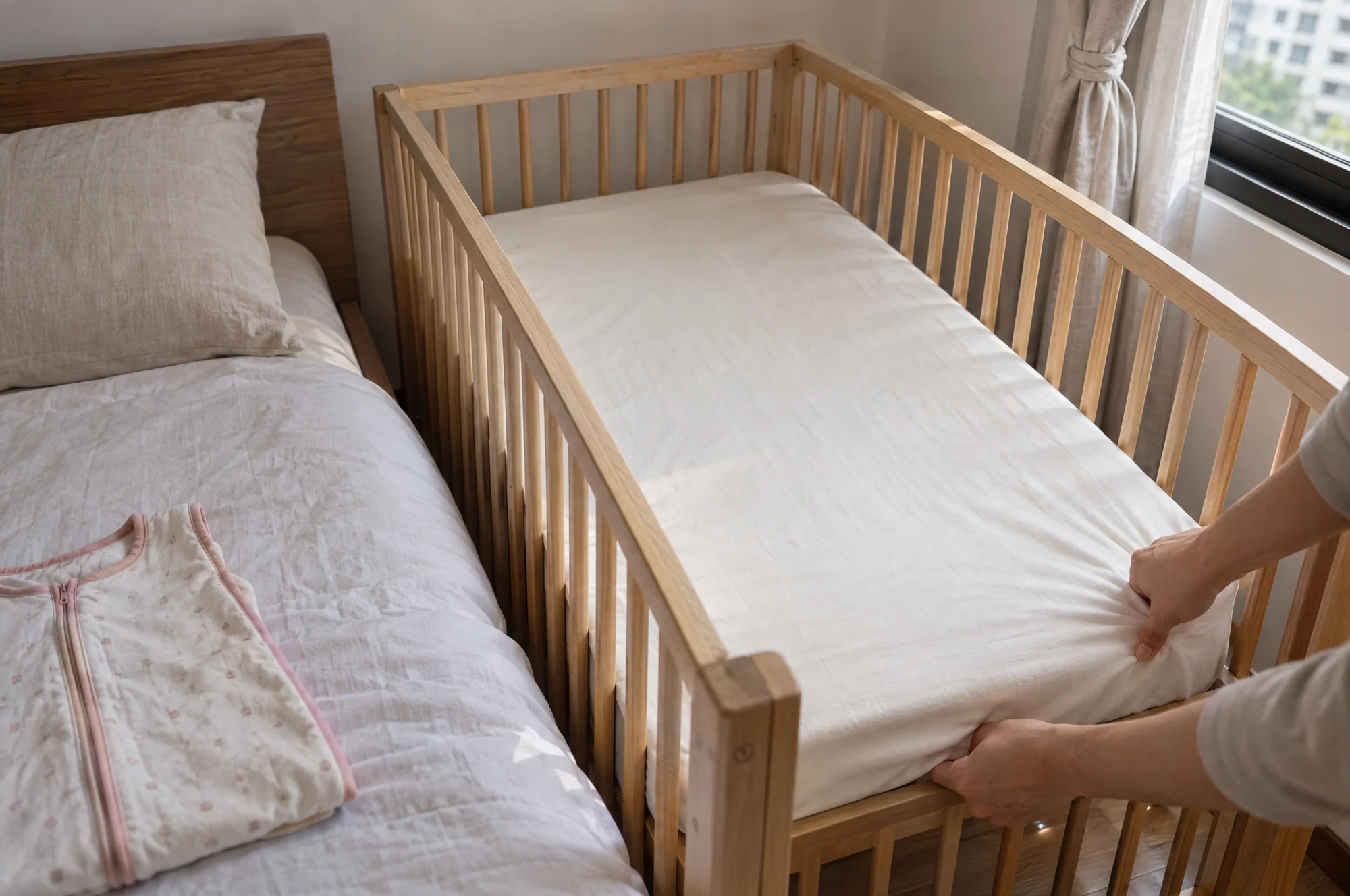
Infant
Safe sleep for babies: where and how your baby should sleep
Safe sleep for babies, the rules health bodies give for where and how a baby sleeps, comes down to a few habits…
Infant
Infant care in Singapore is licensed care for babies from 2 months up to 18 months, full-day or half-day. At a centre on one of the Government's two fee schemes, a full day costs at most S$1,235 or S$1,290 a month, before GST (the Goods and Services Tax) and before subsidy (as of September 2026).…
Infant care in Singapore is licensed care for babies from 2 months up to 18 months, full-day or half-day. At a centre on one of the Government’s two fee schemes, a full day costs at most S$1,235 or S$1,290 a month, before GST (the Goods and Services Tax) and before subsidy (as of September 2026). Where the main applicant, usually the mother, works, a Singapore Citizen baby draws a S$600 Basic Subsidy off that, and up to S$710 more if the household earns S$12,000 a month or less.
The Ministry of Social and Family Development (MSF) says the wait for a place typically runs from a few weeks to a few months after you register interest, and longer if you hold out for one centre that is full. And every infant class must keep at least one qualified staff member for every five babies.
The S$300 infant care fee announced at the 2026 National Day Rally is a target for 2030, with cuts starting from 2028. It is not in force yet, so it changes nothing on this year’s bill.
Infant care is a programme of its own, not the first year of childcare. The Early Childhood Development Centres Regulations 2018 define an infant class as one “for children who are 2 months of age or older but are below 18 months of age”. So 2 months is the youngest a baby can start.
Whether your own baby is ready then is a call for you and your doctor. The rule only sets the floor.
The Early Childhood Development Agency (ECDA) is the Government agency that licenses preschools and runs the subsidies. Our guide to what ECDA does covers its wider role. ECDA licenses infant care as its own class, Class A, apart from childcare’s Class B, and one preschool may hold both.
At 18 months your child moves up to childcare, which ECDA’s subsidy page counts from 18 months to 6 years. Its fee cap and its subsidy are both lower, and one teacher may look after more children. Our guide to choosing a childcare centre picks up from there.
We’d start a few months before your return-to-work date and register with more than one centre. The official figures below are why.
You register with each centre yourself. ECDA says to find centres on the Preschool Search in LifeSG, the Government’s app and website for public services, then contact each centre on the details shown to ask about vacancies or register your interest directly. MSF says a centre can then either confirm a place or put your baby on its waitlist.
MSF told Parliament in February 2024 that the wait “typically ranges from a few weeks to a few months” from the point you register interest. It named one thing that stretches it: some parents prefer one specific centre, and if it is full, they may have to wait longer.
Supply has grown since then. MSF counted around 14,600 infant care places in 2023, with 72 per cent taken up. At the end of 2024 it counted around 16,000, with about 70 per cent taken up, and said infant care use was below 90 per cent in every Planning Area, the planning districts Singapore is divided into.
So places exist, just not always at the centre nearest your flat. Registering with two or three centres gives you a fallback if your first choice has no room on the date you need.
A fee cap is the most a centre may charge. ECDA sets it as a condition of funding under two schemes, the Anchor Operator Scheme (AOP) and the Partner Operator Scheme (POP). The caps below bind centres on those schemes, so ask each centre which scheme it is on, if any, before you compare its price with this table.
| Programme | Anchor Operator (AOP) | Partner Operator (POP) | Status |
|---|---|---|---|
| Full-day infant care | S$1,235 | S$1,290 | In force since 1 January 2023 |
| Half-day infant care | Not published on ECDA’s Anchor Operator page | S$950 | Partner Operator cap in force since 1 January 2026 |
| Full-day infant care at Government-supported preschools, before means-testing | Not stated by scheme | Not stated by scheme | S$300 before means-testing at Government-supported preschools. Announced, not in force. Cuts from 2028, target by 2030. The announcement does not list which centres count |
Announced, not in force: the S$300 fee. Until the cuts begin, today’s fee caps stand. Your own bill can still fall sooner: from the start of 2027, more households qualify for the income-based subsidy, as the next section explains.
The full-day caps have not moved since 1 January 2023, when ECDA lowered both by S$40. ECDA says a Partner Operator centre may not raise fees past its cap, and needs ECDA’s approval for any rise inside it.
Two subsidies come off the fee, both from ECDA’s Infant and Child Care Subsidy Scheme, and both are paid straight to the centre. So the bill you get is already net of them.
The Basic Subsidy for infant care is S$600 a month where the main applicant works at least 56 hours a month, and S$150 where they do not. The main applicant is the mother, or the single father in cases of divorce, separation or widowhood.
The Additional Subsidy adds up to S$710 more. It is means-tested, which means it is worked out from what the household earns: it shrinks as income rises, and stops above S$12,000 a month, or above S$3,000 a head in households of five or more.
Here is one worked example, at one income. MSF uses a household earning S$12,500 a month, with two children, as its median-income example. We take it as a household of four: two parents and two children.
That is above the S$12,000 ceiling. The S$3,000-a-head route is only for households of five or more, so it does not apply here. The household draws the Basic Subsidy and nothing else.
| Line | Per month |
|---|---|
| Full-day fee at the Anchor Operator cap | S$1,235 |
| Less the Basic Subsidy | S$600 |
| Left for the family to pay, before GST | S$635 |
At a Partner Operator centre at its cap, the same sum leaves S$690. ECDA’s caps exclude GST, so the bill will be higher than either figure. Ask each centre for its monthly fee with GST.
At S$12,000 a month or less (or S$3,000 a head in a household of five or more), the Additional Subsidy comes off too, though never past a minimum co-payment, the least every family pays itself. Our childcare fees guide sets out the infant care subsidy and that minimum at every income band.
For your own figure, log in to LifeSG with Singpass, the Government’s digital ID login. ECDA says its preschool search shows estimated fees after subsidies.
That S$12,500 household’s sum will change. At Budget 2026 the Government said it will raise the income threshold for means-tested preschool subsidies to S$15,000 from the start of 2027, and that eligible parents can receive more in infant care subsidies. The Budget statement does not publish the new rates.
At the 2026 National Day Rally, the Government said full-day infant care fees at Government-supported preschools will come down to S$300 a month before means-testing. That is less than half of today’s fees.
“Before means-testing” means before the income-based subsidy, and the Government says lower-income families will continue to pay even less. The cuts roll out progressively from 2028, with the target reached by 2030. Implementation timelines are due in early 2027.
What it does not change yet is the fee. The cuts start from 2028, so a baby starting infant care in 2026 or 2027 starts on today’s caps. How fast fees fall after that is due in early 2027.
The one change already dated before then is on the subsidy side, in January 2027, as above.
It is also not a promise for every centre. The announcement names Government-supported preschools and does not list which centres those are.
The announcement also says the Government will expand that network of operators. The details due in early 2027 are the next place to look.
A second change was announced at the same Rally. Full infant care subsidies will be extended to families with Singapore Citizen children whatever the main applicant’s working status. The Rally page gives it no start date yet; details are due in early 2027.
Until then, a non-working main applicant draws the S$150 Basic Subsidy. ECDA’s Special Approval route can give higher subsidies for a limited time to a main applicant who is not working for a reason ECDA accepts, such as looking for a job or being pregnant. The ECDA subsidy page lists every reason it accepts.
Five. ECDA’s minimum ratio for an infant class is one qualified programme staff member to five babies, written 1:5, for children 18 months and below. It is the tightest ratio at any class level, and the only one with no alternative.
| Class level | Staff to children | With an added assistant educator |
|---|---|---|
| Infant (18 months and below) | 1:5 | Not applicable |
| Playgroup (18 months to below 3 years) | 1:8 | 1 + 1 : 12 |
From playgroup up, ECDA allows a larger group when an assistant educator joins the qualified teacher. For infants it lists that option as not applicable, so the only way to take more babies is more qualified staff.
The law has a rule on this too: the Regulations carry a regulation on the programme staff-child ratio and supervision for infant classes. They also define an infant educator as someone approved under the Act to do infant educator duties.
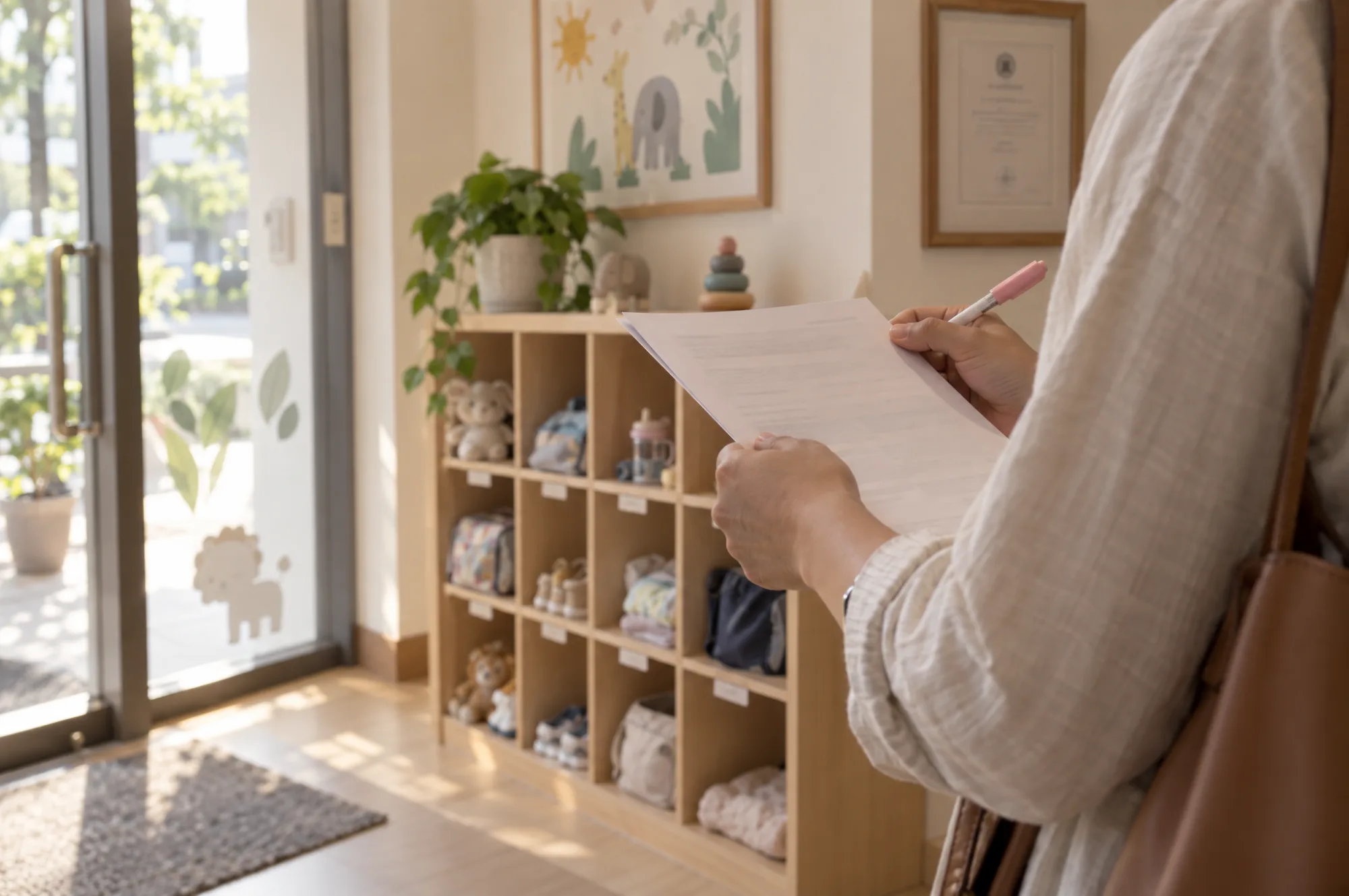
A visit is where the rules above become things you can see. Take this list.
You can also check a centre’s licence length before you go, on the LifeSG Preschool Search. Besides its inspections at renewal, ECDA makes unannounced visits to check standards of care and supervision.
Much of this choice comes down to whose rules apply. A centre works to ECDA’s: a licence you can check, a staff ratio set in law, and inspections. At home, the rules are yours.
ECDA licenses paid services that regularly care for five or more children under 7, so a helper or grandparent minding one baby at home needs no licence from it.
The Basic Subsidy is for Singapore Citizen children enrolled in an ECDA-licensed infant or childcare centre, so it does not pay for care at home.
The two can also come in turn: care at home for the first months, and a centre place after. If you plan it that way, register with centres early enough for the date you need.
If a helper will look after your baby, our guide to managing a helper who cares for your baby covers the day-to-day. More on this stage is in our infant guides.

Infant
Safe sleep for babies, the rules health bodies give for where and how a baby sleeps, comes down to a few habits…
Infant
A travel system is an infant car seat paired with a stroller, so the seat lifts out of the car and clicks…
Infant
A stroller travels one of three ways: checked in at the counter with your bags, gate-tagged, meaning it is labelled at the…