
Infant
Safe sleep for babies: where and how your baby should sleep
Safe sleep for babies, the rules health bodies give for where and how a baby sleeps, comes down to a few habits…
Infant
Looking for breastfeeding massage in Singapore? Check the lactation massage services in our list that helps mothers overcome common nursing challenges, and boost milk production. Get expert support for your breastfeeding journey.
Breastfeeding massage and lactation massage are two names for one treatment, and lactation massage is the name the businesses in this piece use for it. It is hands-on work on a breast that has gone hard, swollen or blocked, a drainage and comfort treatment rather than a milk supply cure. Singapore’s own health guidance is specific about how it should feel: HealthXchange, the patient education site run by SingHealth, says to massage the breast gently before and during a feed, and to “avoid deep tissue massage as this may cause trauma to the breast tissue”.
Published rates run from about S$100 to S$180 for a session, and a home visit adds a travel fee on top (as of September 2026).
Before you pay anyone, two things are worth knowing. KK Women’s and Children’s Hospital (KKH), National University Hospital (NUH) and Mount Alvernia Hospital each run a lactation service you can still reach after you go home. And the therapist’s credential is something you can check yourself, on a public register, in about a minute.
In brief: Lactation massage helps drainage and comfort for engorgement and a blocked duct. Gentle is the instruction; deep tissue is the thing to avoid. Published rates are roughly S$100 to S$180 a session, plus a home visit fee.
Two public registers let you check a credential before booking: the IBCLC registry for a lactation consultant, the TCM Practitioners Board register for a TCM physician. A fever with worsening pain past 24 hours needs a doctor, not a massage table.
The target is different, and so is the goal. An ordinary massage works on muscle. This one works on breast tissue and the lymphatic system around it, to move milk that is not moving and to bring down swelling that is stopping it.
Four words appear on every page selling this service, and they are not interchangeable.
A massage therapist and an IBCLC are not the same person, though one person can be both. That distinction is the whole reason the section further down on checking a credential exists.
Thomson Medical, which runs its own ParentCraft Centre, sets out a session on its own site, and it runs 30 to 45 minutes. The practitioner asks when you gave birth, how feeding is going and where it hurts, then looks for firmness, warmth and blocked areas.
The pressure changes: lighter for lymphatic drainage around the edges of the breast tissue, firmer over a congested spot. Work often extends past the breast to the chest muscles, under the arms and towards the collarbone.
The part worth paying for is the last ten minutes. Thomson’s account says the practitioner teaches you self-massage to use at home: which direction to move, how much pressure, when to do it, and what to watch for.
You can already do a version of this yourself. HealthHub, the Health Promotion Board’s consumer site, tells mothers to “gently massage your breast to clear any blocked milk ducts” while feeding.
For drainage and comfort, yes, and Singapore’s own health sites say so without selling anything. HealthXchange’s management list for mastitis and blocked ducts opens with massaging the breast gently before and during a feed to stimulate milk flow, alongside hand expression before latching, varying feeding positions, and cold compresses between feeds to reduce swelling and pain.
For milk supply, the honest answer is smaller than the marketing, and two businesses selling the same treatment describe it in opposite terms. Madam Partum’s lactation page lists “Naturally boosts milk supply” among the benefits of its TCM lactation massage. Thomson Medical’s guide to the same treatment says this instead: “Massage alone cannot increase your milk supply, but it helps you empty your breasts fully at each feed.” A shopper reading only the first page would not know the second exists.
One more thing is worth setting straight, because it turns up on provider pages as a benefit. HealthXchange tells mothers to feed on demand and not to aim to empty the breasts, and warns that overfeeding or pumping to empty “may lead to hyperlactation (oversupply) and can worsen tissue swelling and inflammation”. More drainage is not automatically better.
When there is a fever. A blocked duct and mastitis feel similar in the first hours and are treated very differently, so the line between them is the most useful thing on this page.
| Blocked duct | Mastitis | |
|---|---|---|
| What it is | Incomplete drainage of milk | An infection of the breast tissue |
| How it looks | A painful hard lumpy area, usually not inflamed or reddened | A painful, red, inflamed wedge-shaped area, or red streaks |
| Fever | Not usually | Above 38.5 degrees Celsius |
| Other symptoms | Reduced milk flow from that breast; sometimes a small milk blister on the nipple | Chills, body aches and flu-like symptoms; sore or cracked nipples |
| What it needs | Draining the breast well: feeding, expressing, gentle massage, cold compresses | Medical help if it worsens past 24 hours. Antibiotics may be prescribed |
HealthXchange sets two thresholds a reader can act on. Ask a lactation consultant for help if you cannot clear the blockage yourself after several feeds, expressing and cold compresses. Seek medical help if bacterial mastitis is suspected, with worsening inflammation, pain and fever for more than 24 hours.
The instinct to stop feeding is the one to resist, and the advice on that comes from someone who does this for a living at KKH.
Sudden cessation of breastfeeding is not advisable in the presence of blocked ducts and mastitis.
Her reason, in the same article, is that stopping suddenly raises the risk of a breast abscess. Weaning off is fine once the blockage and the mastitis have cleared, done gradually. If you are trying to work out what a lump in your breast is, our guide to lumps while breastfeeding goes through the causes one at a time.
Three published price lists are below. They are what three named businesses charge, not a market rate, and prices of this kind move.
| Where it is published | What it covers | Price |
|---|---|---|
| Thomson Medical’s own guide | Its stated range for a 60-minute lactation massage session in Singapore | S$100 to S$180 |
| Thomson Medical’s own guide | Follow-up sessions, which it says cost less than the first | S$100 to S$150 |
| Madam Partum’s lactation page | TCM lactation massage, 60 minutes, at its Katong outlet or a Chien Chi Tow outlet | S$120 |
| Madam Partum’s lactation page | The same, 90 minutes | S$180 |
| Madam Partum’s lactation page | Home service, added on top, minimum booking 90 minutes | plus S$50, or S$70 for Sentosa |
| Mount Alvernia Hospital’s maternity page, Ladies Card partner benefits, archived 3 July 2026 | A partner package from Beauty Mums & Babies: a 15 Days Flexi Bundle of up to 15 wrap sessions, choosing from prenatal, postnatal or lactation massage | S$1,698 |
Two things fall out of that table. A home visit is not priced as a different treatment, it is the same session plus a travel fee and a longer minimum booking, which is why the bill jumps more than the fee alone suggests. And a bundle is not a per-session rate: the Mount Alvernia figure covers up to 15 sessions across three different massage types, so no single lactation massage price can be pulled out of it.
Neither Thomson Medical’s guide nor Madam Partum’s page publishes a fee for a hospital lactation clinic or a charity line.
| Route | Published price, S$ |
|---|---|
| Gleneagles Parentcraft, lactation consultation, per hour | S$88 |
| Mount Elizabeth, lactation consultation, per 1.5 hours | S$107 |
| NUH lactation consultant assessment, per session | S$120 |
| Madam Partum TCM lactation massage, 60 minutes | S$120 |
| Madam Partum TCM lactation massage, 90 minutes | S$180 |
Thomson Medical’s guide gets closest, advising readers to “look for practitioners with recognised certification, such as IBCLCs (International Board Certified Lactation Consultants), or therapists trained in lactation massage”, and then it stops. It does not say where to look.
Two public registers exist, and you can use both without asking anyone’s permission.
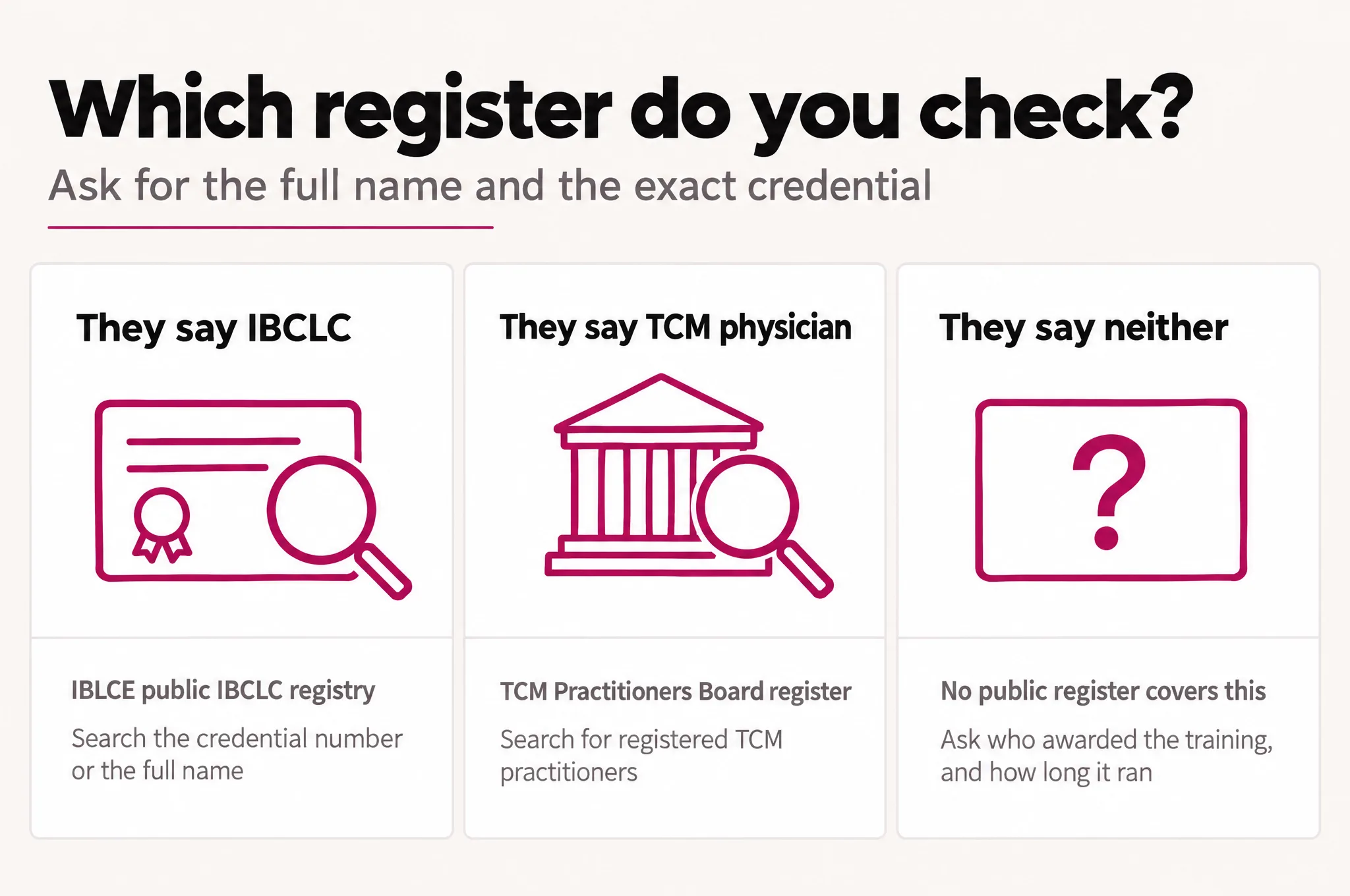
Which register do you check? Ask for the full name and the exact credential. If they say IBCLC, use the IBLCE public IBCLC registry and search the credential number or the full name. If they say TCM physician, use the TCM Practitioners Board register and its search for registered TCM practitioners. If they say neither, no public register covers this, so ask who awarded the training and how long it ran.
Search the Public IBCLC Certification Registry, run by the IBCLC Commission. Its own instructions are exact: search by credential number, written as a capital L, a dash, then the digits, which is case sensitive and must be an exact match, or search by name, and it recommends the full first and last name. The registry updates within 24 hours of a change, so an expiry date on it is current.
Several of the businesses selling this service are TCM based. The Traditional Chinese Medicine Practitioners Board (TCMPB) is a statutory board under the Ministry of Health, set up on 7 February 2001, and its job includes approving or rejecting applications for registration and regulating the conduct and ethics of registered practitioners. Its own registered practitioners page links a public search, “Search for registered TCM practitioners”, which opens the Ministry’s professional registration system.
Then there is no register to check, and it is worth knowing that plainly rather than assuming one exists. The Ministry of Health’s Health Professionals Portal lists the searches Singapore publishes for registered healthcare professionals, and there are seven: doctors, dentists, pharmacists, nurses, allied health professionals, optometrists and opticians, and TCM practitioners. Massage therapist is not among them.
That does not make an unregistered therapist bad at the work. It means the claim on their page is the only evidence you have, so ask what the training was, who awarded it, and whether they hold anything that appears on either register above.
Yes, and if you delivered at one of them you may already have paid for part of it.
| Who | What they offer | How to reach them |
|---|---|---|
| Breastfeeding Mothers’ Support Group (Singapore), or BMSG | Mother-to-mother counselling by trained volunteer counsellors, plus an IBCLC directory and a hospital hotline list | Phone and WhatsApp 6339 3558, 9am to 9pm daily |
| KK Women’s and Children’s Hospital (KKH) | Its Lactation Service, and a lactation tele-consultation service. You leave your details and a lactation consultant returns the call | 6-CALL KKH, that is 6225 5554 |
| National University Hospital (NUH) | A lactation hotline for personalised breastfeeding advice, and Breastfeeding Triple Support at National University Polyclinics after you go home | Lactation hotline 9722 0376 |
| Mount Alvernia Hospital | The Alvernia Parentcraft Centre: outpatient consultations after discharge. Its listed breastfeeding assessments and engorgement support are written on the page as Alvernia Ladies Card member benefits, so ask what applies to you. A lactation consultant also visits daily during a ward stay | Parentcraft Centre 6347 6641 |
BMSG describes itself as Singapore’s only breastfeeding charity, supporting mothers by mothers for over 30 years. Its counsellors are experienced breastfeeding mothers trained under the Australian Breastfeeding Association’s syllabus and accredited by BMSG, and the organisation refers on to IBCLCs and doctors when a case needs one. KKH’s own patient page prints BMSG’s number, 6339 3558, in its list of places to call, which is a hospital pointing at a charity rather than at itself.
BMSG also keeps the list nobody else keeps: a page of lactation hotlines and hospital-based services, with the fees it has recorded against each. As of September 2026 that page lists a lactation consultant assessment at NUH at S$120 a session with priority for NUH patients, a consultation at Gleneagles Hospital’s Parentcraft Centre at S$88 an hour, and Mount Elizabeth at S$107 for an hour and a half. Those are BMSG’s figures, not the hospitals’ own published rates, so confirm the current fee with the hospital when you call.
The order that makes sense for most people: call BMSG’s counselling line first, because a counsellor may sort a latch problem on the phone, then pay for the hands-on session if the problem is still there.
The massage works on the breast, not the abdomen, so the guidance above does not change: gentle before and during a feed, no deep tissue work. What HealthHub adds for mothers who have had a caesarean is about position rather than massage. It names the football hold and the lying down hold as the two that suit a caesarean recovery, and it says to approach your hospital’s lactation consultants if you have problems.
Our c-section recovery guide covers the rest of the first weeks.
Gentle massage stays on HealthXchange’s own list of things to do for mastitis and blocked ducts, alongside hand expression, varied feeding positions and cold compresses. Deep tissue massage is not on that list and is specifically ruled out. The threshold that matters more: worsening inflammation, pain and fever for over 24 hours means suspected bacterial mastitis, and that is a doctor’s job.
In part, yes. HealthHub tells mothers to gently massage the breast to clear blocked ducts while feeding, and Thomson Medical’s account of a session says the practitioner teaches self-massage to take home: the direction, the pressure, the timing and the signs to watch for. That is a reasonable thing to pay one session for.
On Madam Partum’s published fee chart, yes, and twice over. It adds S$50 per trip and S$70 for Sentosa, though the same page’s terms also put CBD at S$70, so confirm the fee for your address when you book. The chart sets a minimum booking of 90 minutes for home service, which is the S$180 slot rather than the S$120 one.
Thomson Medical’s guide says within the first few days after birth, and that the techniques used then are usually very gentle. That is the provider’s own answer rather than an official guideline, so treat it as such, and ask the hospital’s lactation service if you are unsure about your own situation.
Look the person up yourself. If they say IBCLC, search the public IBCLC registry by credential number or full name. If they say TCM, search the TCM Practitioners Board’s register.
It takes a minute, and it is the check the page selling you a session does not do for you.
Then read our guide to lactation consultants in Singapore, which covers what an IBCLC actually does and how to choose one. The rest of our infant stage guides are here if you are still finding your feet.

Infant
Safe sleep for babies, the rules health bodies give for where and how a baby sleeps, comes down to a few habits…

Infant
Infant care in Singapore is licensed care for babies from 2 months up to 18 months, full-day or half-day. At a centre…
Infant
A travel system is an infant car seat paired with a stroller, so the seat lifts out of the car and clicks…