

Pregnancy
Abdominal separation after pregnancy: how to check it, and when to get help
Abdominal separation, which doctors call diastasis recti, is a gap down the middle of your belly. Your long front tummy muscle has…
Pregnancy
To be a subsidised patient at KK Women's and Children's Hospital (KKH), and pay its lower rate for each specialist visit, you need a referral. It can come from a polyclinic, one of the government's clinics for primary care (the everyday care you get before any specialist), or from a public hospital where you are…

To be a subsidised patient at KK Women’s and Children’s Hospital (KKH), and pay its lower rate for each specialist visit, you need a referral. It can come from a polyclinic, one of the government’s clinics for primary care (the everyday care you get before any specialist), or from a public hospital where you are already a subsidised patient.
It can also come from a GP (general practitioner, a family doctor) under the Community Health Assist Scheme (CHAS), if you hold a CHAS card. CHAS is a scheme whose card brings down the bill for common illnesses and dental care at CHAS clinics. Walk in without a referral, or bring a letter from a private GP outside CHAS, and KKH charges private rates.
The gap is large: KKH lists a subsidised specialist visit at its women’s clinics at S$37.20 to S$101.49 for a Singapore citizen, depending on how much subsidy you get. A first private visit costs S$170.48 to S$222.14, depending on how senior the doctor is. These are the prices KKH has charged since 8 August 2025.
What the letter costs you is the choice of doctor, and some time. A subsidised patient’s care is led by a specialist KKH assigns. Across public hospitals in 2024, the Ministry of Health (MOH) says, subsidised patients waited a median of 35 days for a first specialist appointment after a referral, against 12 days for unsubsidised (private-rate) ones.
A median is the middle figure: half of patients waited less, half waited longer. So the typical subsidised wait was about three times as long as the private one.
The first change is the bill: with a referral that qualifies, KKH charges its subsidised rate for each specialist visit. Without one, you pay the private rate for the grade of doctor you see. KKH’s fee pages list three grades of specialist: Associate Consultant (the lowest fee), Consultant, and Senior Consultant (the highest).
| Clinic | Subsidised, first or repeat visit | Private, first visit | Private, repeat visit |
|---|---|---|---|
| Women’s specialist clinics | S$37.20 to S$101.49 | S$170.48 to S$222.14 | S$118.59 to S$159.47 |
| Children’s specialist clinics | S$43.50 to S$101.49 | S$192.82 to S$239.26 | S$139.41 to S$181.81 |
Each private range runs from an Associate Consultant to a Senior Consultant. The subsidised range runs from the most subsidy to the least, and KKH says where you fall depends on your eligibility. MOH ties that to your citizenship and a means test, a check of your household income.
These are consultation fees only, the charge for seeing the doctor. Medicine, lab tests and X-rays are charged on top, and KKH’s women’s clinics add that Saturday and evening clinics can cost more.
Permanent residents (PRs) can be subsidised on a referral too. KKH’s fees above are for citizens, though, and it says a PR’s prices may differ.
The second change is who leads your care: KKH says every patient gets team-based care, meaning a care team led by one specialist. For a subsidised patient that is “an assigned specialist”; a private patient chooses theirs. KKH also says patients get the same quality of care whatever their subsidy status.
The third is the wait, which the section on appointments below sets out.
If a polyclinic doctor confirmed your pregnancy, that visit is where the referral starts. Our guide on when to see a doctor to confirm a pregnancy covers that visit. These are the steps from there to KKH.
SPaRK does not replace the referral. It decides which KKH clinic you see first, not which rate you pay.
Yes, if you hold a CHAS, Merdeka Generation or Pioneer Generation card. The Merdeka Generation and Pioneer Generation cards are held by seniors, as MOH describes both groups.
MOH told Parliament in April 2024 that these cardholders, referred from a CHAS GP clinic, can get subsidised care at public specialist clinics based on their citizenship and the means test, “similar to patients referred from polyclinics”. KKH lists a referral by a GP under CHAS among its subsidised routes.
A GP clinic outside CHAS is a different case. KKH charges non-subsidised rates for a referral “by a General Practitioner or private hospital”, whether or not the letter names a doctor. So before you ask your family GP for the letter, check that the clinic is under CHAS and that you hold a card; chas.sg sets out who qualifies.
Polyclinics still make most referrals. In the ten years to 2023, MOH counted 3.9 million referrals to public specialist clinics from polyclinics and 0.74 million from GP clinics. That is about five referrals in six from a polyclinic. GP referrals did climb, from 65,000 in 2014 to 88,000 in 2023.
MOH’s answers to Parliament give waiting times for public hospitals as a whole, not for KKH alone, so treat them as a guide. In 2024, the median wait from a primary care referral (one from a polyclinic or GP) to a first appointment at a public hospital’s Specialist Outpatient Clinic (SOC), its specialist clinic, was 35 days for subsidised patients and 12 days for unsubsidised ones.
| Patient type | Median wait, days |
|---|---|
| Subsidised patients | 35 days |
| Unsubsidised patients | 12 days |
A later MOH answer put the median wait for any new subsidised SOC appointment at 23 days from January to June 2026. It measured something wider than referrals from primary care, so the two figures are not a trend. Its five busiest specialties (fields of medicine) were bone and joint surgery, eyes, ear, nose and throat, general surgery and skin, so neither pregnancy care nor children’s medicine is among them.
Urgency moves you up. MOH’s February 2025 answer on waiting times says every referral is ranked by how urgent the condition is, and urgent cases get earlier appointments whatever their subsidy status.
For a pregnancy, the timing of the first visit matters too. KKH says SPaRK also works out when you should be seen, so you do not come too early in the pregnancy or lose out by coming too late. If the date you are given worries you, ask the polyclinic doctor, and tell them about any bleeding or pain.
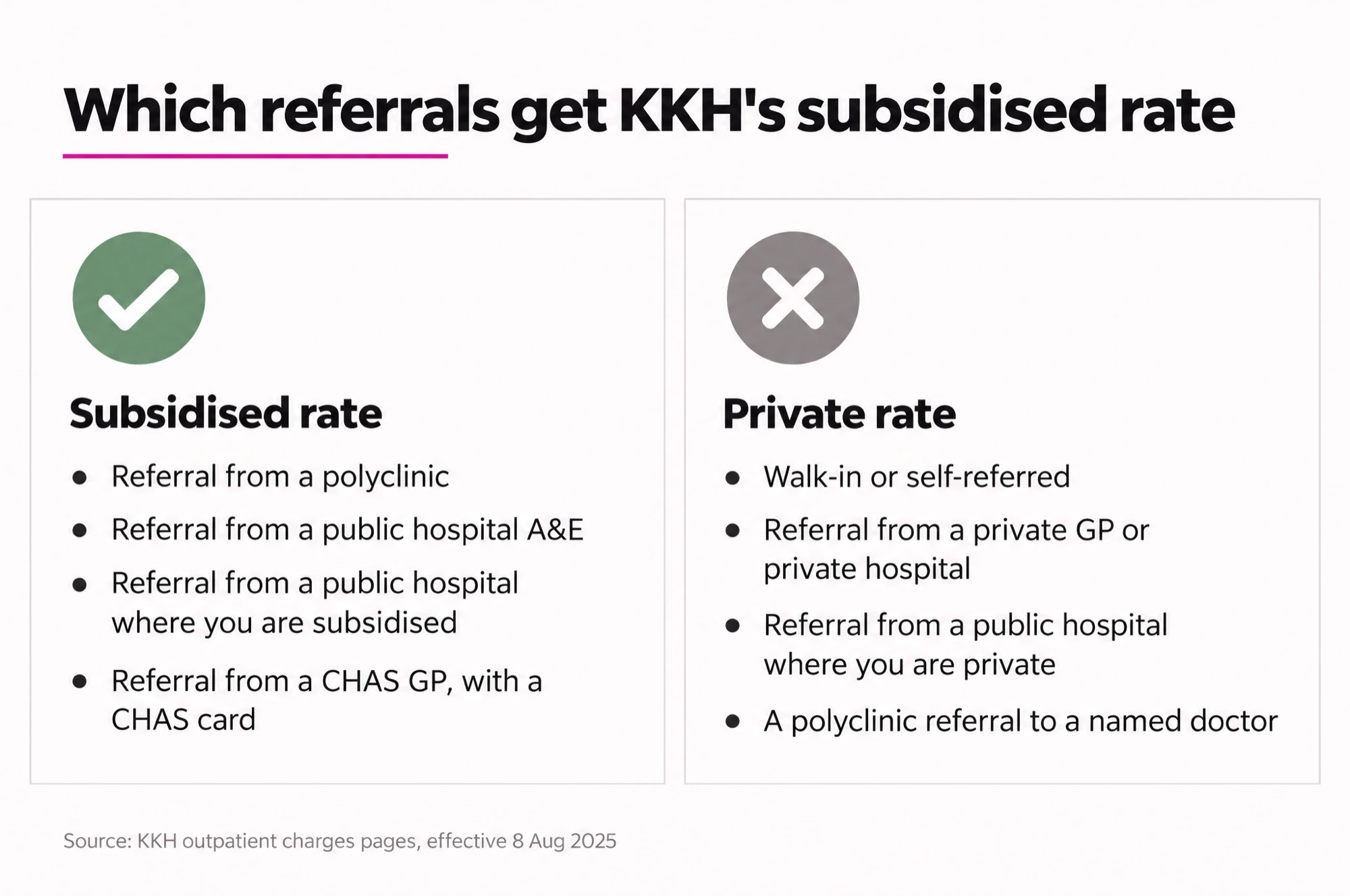
KKH’s women’s and children’s charges pages carry the same list of routes that do and do not get subsidised rates. The rule behind it: the subsidy follows a referral from the public system or a CHAS clinic, made to KKH and not to a doctor you pick.
Which referrals get KKH’s subsidised rate
Subsidised rate
Private rate
Source: KKH outpatient charges pages, effective 8 Aug 2025
Two cases catch people out. A polyclinic referral to a named doctor pays private rates, even though it came from a polyclinic.
The other is being a private patient already. KKH counts a polyclinic referral only if you are not already being treated at KKH, at non-subsidised rates, for the same condition. So if you began this pregnancy with a private KKH doctor, a polyclinic letter for it does not make you subsidised; switching has its own rules, below.
Private to subsidised. KKH’s switch page says a citizen or PR who is not yet a KKH patient needs a referral from a polyclinic or a CHAS GP clinic, or from a hospital where they are already subsidised.
An existing KKH patient who still needs financial help after MediShield Life and MediSave is sent to KKH’s Medical Social Workers instead. MediShield Life is the national basic health insurance plan, and MediSave is the national medical savings scheme. The Medical Social Workers are the KKH staff who look at that financial help: ask your doctor at a visit, or call 6394 1029 or 6394 1028.
Subsidised to private. The switch page covers only the move to subsidised care. KKH’s charges pages tie private rates to choosing your specialist, though. So if you want a named obstetrician (a pregnancy and birth doctor) partway through, expect to pay private rates from then on, and ask KKH’s billing team how the change works before your next visit.
The same referral rules apply at KKH’s children’s clinics; its children’s charges page carries the same list. Routine jabs (vaccinations) and check-ups are a different matter, and our guide to choosing a paediatrician in Singapore covers where to get them. These steps are for when a doctor thinks your child needs a paediatric (children’s) specialist.
In an emergency, go to KKH’s Children’s Emergency, its emergency department for children. A referral from the emergency department of a public hospital also counts for subsidised rates at KKH’s clinics. KKH lists its Children’s Emergency fee at S$176, covering basic lab tests, basic procedures, X-rays and standard charges.
The referral settles what each clinic visit costs. That leaves the delivery, which is billed on its own. MOH’s hospital stay subsidy is set for three classes of ward, C, B2 and B2+, at a level that depends on household income.
Our guide to public versus private maternity care in Singapore sets the subsidised route this letter opens against a private one, hospital by hospital, on MOH’s own figures, with what MediSave covers either way. Read it before you say yes to the letter or book a private gynae (gynaecologist).

Pregnancy
Abdominal separation, which doctors call diastasis recti, is a gap down the middle of your belly. Your long front tummy muscle has…
Pregnancy
The foods to avoid during pregnancy are a short list. Skip raw or undercooked meat and seafood, raw or soft-boiled eggs, soft…

Pregnancy
Yes, you can give birth in Singapore as a foreigner. But if neither parent is a Singapore citizen, your baby is not…