
Pregnancy
Foods to avoid during pregnancy in Singapore: the hawker, home and tonic checklist
The foods to avoid during pregnancy are a short list. Skip raw or undercooked meat and seafood, raw or soft-boiled eggs, soft…
Pregnancy
Abdominal separation, which doctors call diastasis recti, is a gap down the middle of your belly. Your long front tummy muscle has two halves joined by a strip of tissue, and that tissue stretches thin as your baby grows. Ireland's public health service, the Health Service Executive (HSE), says the gap is normal in pregnancy…
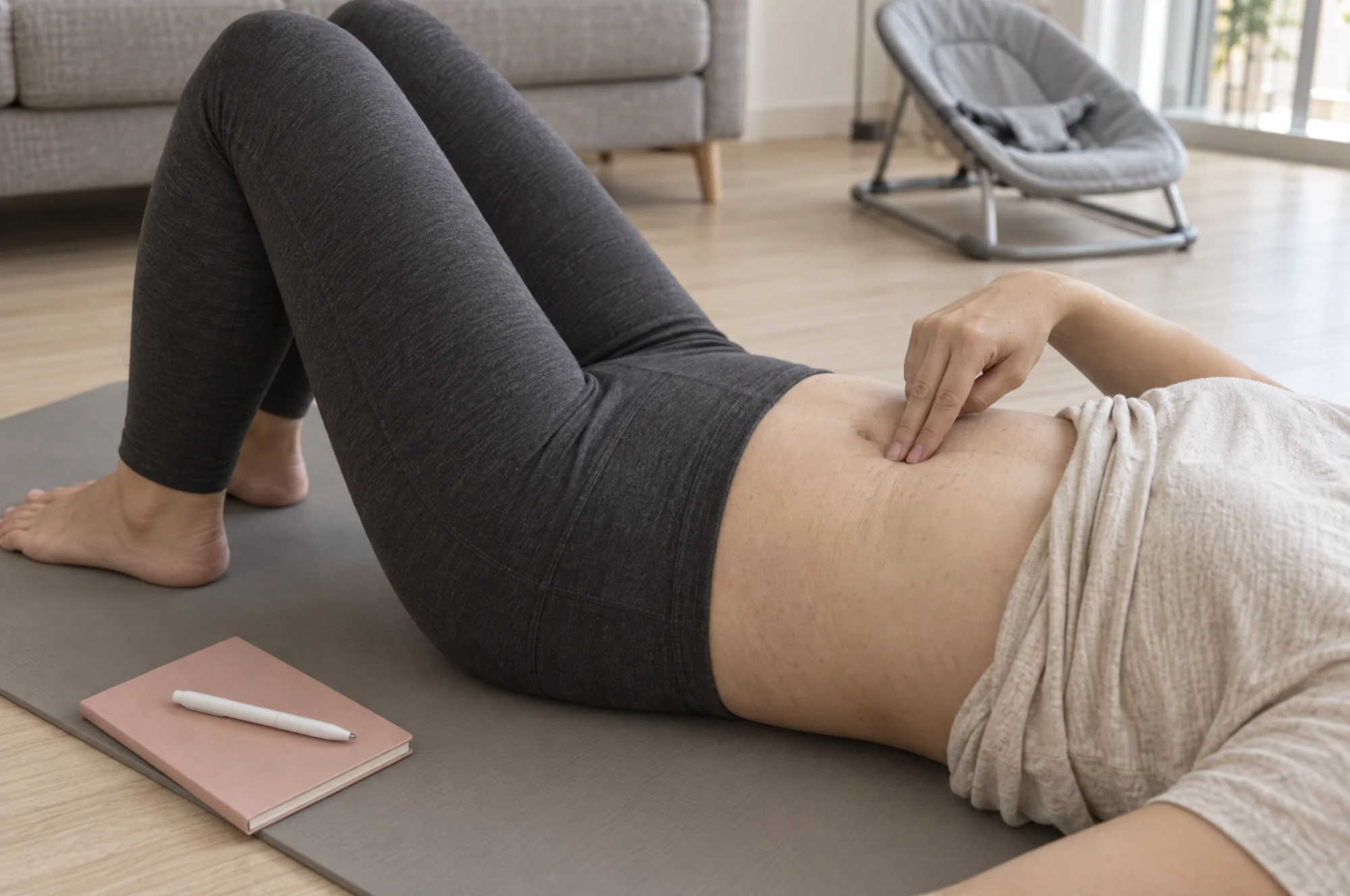
Abdominal separation, which doctors call diastasis recti, is a gap down the middle of your belly. Your long front tummy muscle has two halves joined by a strip of tissue, and that tissue stretches thin as your baby grows. Ireland’s public health service, the Health Service Executive (HSE), says the gap is normal in pregnancy and can take up to 6 weeks after the birth to reduce, sometimes longer.
It is common, and it usually narrows. In a Norwegian study of 300 first-time mothers, 60% had abdominal separation 6 weeks after the birth and 32.6% still had it at 12 months.
So a gap in the first weeks is not a sign you did anything wrong. The useful next step is a simple self check you can do at home on the floor, and a note of what you feel to take to your postnatal review, the follow-up visit the hospital books for you before you go home.
The muscle in question is the rectus abdominis, the long muscle down the front of your belly that people call the six-pack. Its two halves meet down the middle along a band of tissue called the linea alba. In pregnancy that band stretches and thins, and the two halves drift apart.
You may notice one of two things. A soft dip down the middle of your belly when you lift your head, or a ridge or dome along the same line when you strain. A review of treatments for abdominal separation, by a team of Dutch surgeons, describes that dome: the thinned middle bulges when the pressure inside your belly rises.
It is not a hernia, where something pushes out through a break in the wall of the belly. The same review says that with abdominal separation the wall stays in one piece, and that the gap carries no risk of strangulation, the emergency where part of the bowel gets trapped. A lump that pokes out at or near your belly button is a different matter, and we come back to it below.
You will also see it written as diastasis recti abdominis, rectus diastasis or DRAM, short for diastasis of the rectus abdominis muscles. All of these mean abdominal separation.
You need the floor, a few minutes and one hand. These are the HSE’s steps, in its order.
Count the fingers that fit across the gap. The HSE’s line is 2: if more than 2 fingers fit between the muscles, it says there are things you can do to help reduce the gap, and the next sections cover them.
The Norwegian study used the same kind of finger count, taken by physiotherapists at three spots: 4.5 cm above the belly button, at it, and 4.5 cm below. It counted 2 to 3 fingers as mild, 3 to 4 as moderate and 4 or more as severe. It also counted a visible bulge along the middle as abdominal separation even when fewer than 2 fingers fit, so note a bulge if you see one.
Write down three things while they are fresh: how many fingers fit, where the gap is widest, and whether you saw a bulge. That note is what you take to your doctor.
Usually, yes. The Dutch surgeons’ review says abdominal separation goes away by itself after childbirth in most women. The HSE puts the first stretch at up to 6 weeks, and says it can take longer.
The clearest picture of “longer” comes from the Norwegian study, published in the British Journal of Sports Medicine in 2016. It followed 300 first-time mothers from the middle of pregnancy to a year after the birth, with a physiotherapist’s check at four points. Fewer mothers came to the later checks: 178 at 12 months.
| When the mothers were checked | Share with a separation |
|---|---|
| Week 21 of pregnancy | 33.1% |
| 6 weeks after birth | 60% |
| 6 months after birth | 45.4% |
| 12 months after birth | 32.6% |
Read the chart left to right. The share rose from 33.1% at week 21 of pregnancy to 60.0% at 6 weeks after the birth, then fell to 45.4% at 6 months and 32.6% at 12 months. In that study, most cases of abdominal separation were mild.
Two things follow. A gap at 6 weeks puts you with the majority, not on the edge. And about a third of the mothers in that study still had one at a year, so a gap that is slow to close is common too, and worth a proper look rather than worry.
One finding from the same study is reassuring if your back aches. At 12 months, mothers with abdominal separation reported the same amount of low back and pelvic pain as mothers without one.
The table sorts everyday moves into three rows, and each row names who gives the advice. The Singapore advice in it is about recovery in general. The advice on abdominal separation itself comes from the HSE and from the American College of Obstetricians and Gynecologists (ACOG), a US group of doctors who specialise in pregnancy, birth and women’s health.
| When | What | Who says so |
|---|---|---|
| Fine now | Pelvic floor exercises, from the first days after the birth. The pelvic floor is the sling of muscle that holds up your bladder, womb and bowel. Simple exercises for the big muscle groups, tummy and back included, aiming for 20 to 30 minutes of activity a day. Good posture | ACOG; the HSE for posture |
| Change how you do it | Do not hold your breath when you bend, lift or exercise. Add moderate exercise gradually, and stop if you feel pain | The HSE for breathing; ACOG for the rest |
| Leave until checked | Anything moderate or vigorous, until your gynaecologist clears you. After a caesarean: no heavy lifting for at least two months, and no crunches or Russian twists (a seated twist from side to side) until 12 weeks after the birth | The Health Promotion Board, on the HealthHub website; KK Women’s and Children’s Hospital (KKH) for lifting; the HSE for crunches |
The breath line deserves a moment. The HSE calls holding your breath while you bend, lift and exercise a bad habit some people fall into when their tummy muscles are weak. Lifting a baby, a car seat or a laundry basket counts.
Not according to the HSE and ACOG, though most of the advice online says to avoid both.
ACOG’s committee opinion, its written guidance for doctors on exercise in pregnancy and after it, says abdominal strengthening exercises, crunches included, have been shown to reduce both how often abdominal separation happens and how wide the gap is, after vaginal and caesarean births. The HSE goes a step further and lists a repeat crunch among the things that help reduce the gap, with a caesarean wait of 12 weeks. Its crunch is a slow curl up from lying on your back until your shoulders lift slightly off the floor, done several times until you feel tired.
Neither the HSE nor ACOG mentions planks, either way. Two of the small physiotherapy trials in the Dutch review used planks in their programmes. So neither guide bans a plank, and neither tells you to do one. Whether it suits your gap is a good question for a physiotherapist.
It may help in the first 8 weeks, alongside other things. It is not a fix on its own.
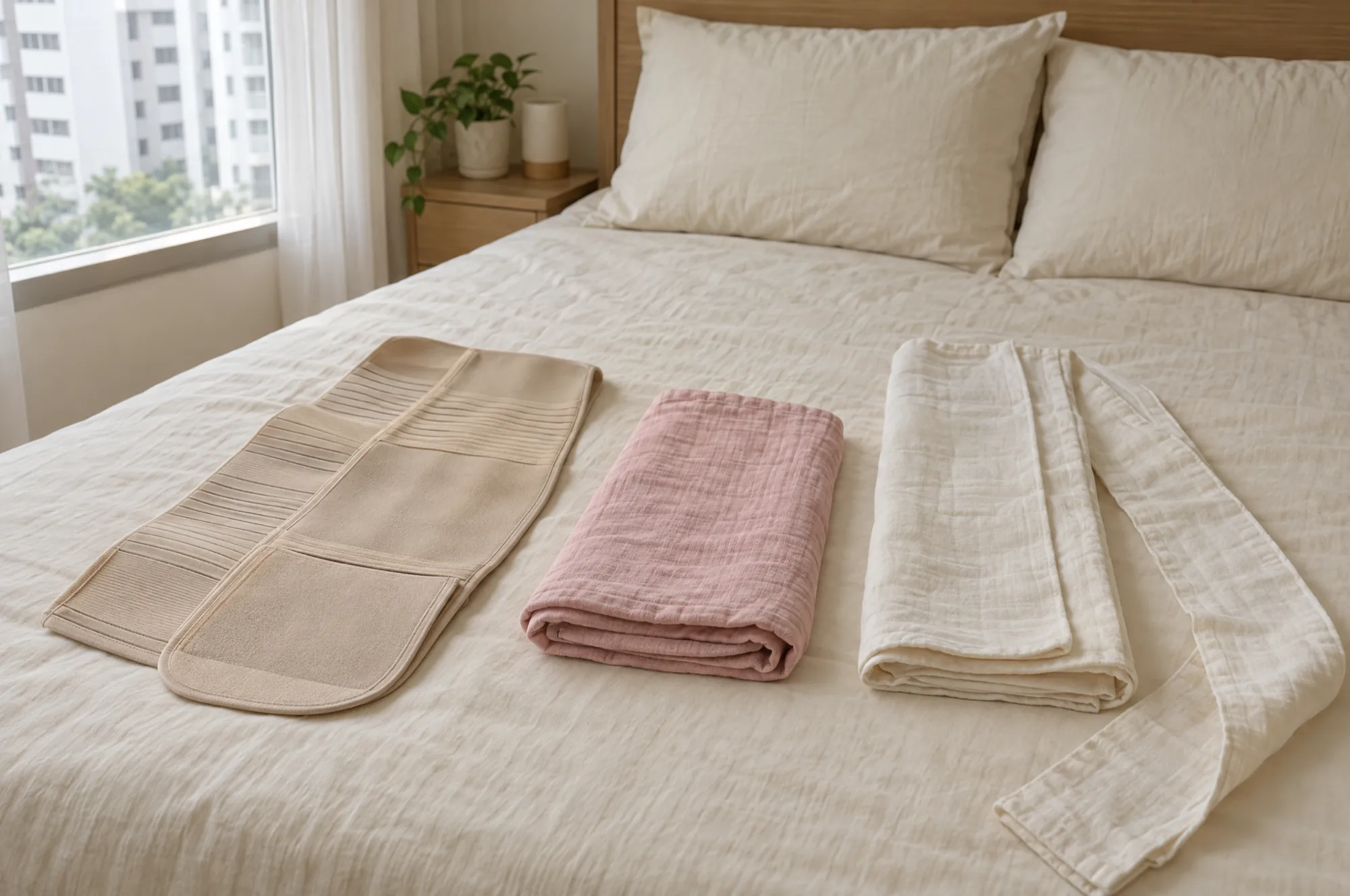
If you wrap your belly during confinement, with a modern binder or a traditional cloth wrap like the bengkung, the HSE gives a clear line. It says a binder or compression top can help narrow the gap for up to 8 weeks after the birth. It lists that beside good posture and a repeat crunch, as one of three things that help, not the only one.
After a caesarean, a binder has a second job. SGH’s recovery advice says an abdominal binder is useful to reduce pain from movement, as you get out of bed and walk in the days after the operation.
SGH’s page talks about pain only. It does not say whether a binder changes the gap. So wear one if it feels supportive, and still do the self check. The wrap is support; the finger count is the measure. If you are still planning the wrap, our guide to how long postpartum confinement lasts sets out the weeks it covers.
When the gap still worries you about two months after the birth, or when it comes with other signs. A physiotherapist is who the HSE and the Dutch review send you to for abdominal separation. In Singapore the specialty is called women’s health or pelvic health physiotherapy, SGH’s name for it. It also covers the pelvic floor.
In Singapore, the route runs through the appointment you already have. KKH’s discharge advice says you are given a postnatal follow-up before you leave hospital, at its Women’s Specialist Clinic, a GP clinic or a polyclinic, on a date your doctor sets. That is the place to show your note and ask whether you need a referral.
Then there is cost. MediSave is your personal healthcare savings account. The Ministry of Health (MOH) answered a question in Parliament on 13 January 2026. It says the MediSave Maternity Package pays for pre-delivery and delivery expenses. It names outpatient care after the birth, such as lactation support. Outpatient means visits where you go home the same day. The answer says MOH does not track what that care costs, and it does not mention physiotherapy. So ask the clinic what you will pay, and how, before your first session.
The same answer says that Singaporeans who struggle to afford their postnatal medical care can ask the medical social workers at the public hospitals whether they qualify for financial help, such as MediFund. For one private clinic’s published fee for a women’s health physiotherapy session, see the dated price table in our postnatal Pilates guide.
For most mothers, no. The Dutch surgeons’ review, published in Surgical Endoscopy in 2017, says abdominal separation is mostly treated without surgery, with or without a physiotherapist’s help. It says a surgeon comes in when it causes severe problems with how the belly works or looks.
The review is frank about the evidence on both sides. It found the published research on surgery for abdominal separation to be of low quality, and noted there are no agreed guidelines on when to operate. On physiotherapy, the programmes it looked at narrowed the gap while the muscles were tightened, but did not close it at rest, and what that means for comfort or looks is unclear.
This guide gives no recovery time for surgery. The recovery times published online come mostly from clinics that sell the operation. If surgery comes up, ask the surgeon what recovery would look like for you.
Do the self check in this guide, waiting until at least 5 weeks after the birth if you had a caesarean. Write down how many fingers fit, where the gap is widest, and whether you saw a bulge. Take that note to your postnatal review and ask your doctor one question: do I need a referral to a women’s health physiotherapist?
Then, before you book any class, read our guide to postnatal Pilates and when it is safe to start. It covers when a class is the wrong thing to buy first.

Pregnancy
The foods to avoid during pregnancy are a short list. Skip raw or undercooked meat and seafood, raw or soft-boiled eggs, soft…
Pregnancy
Yes, you can give birth in Singapore as a foreigner. But if neither parent is a Singapore citizen, your baby is not…
Pregnancy
Pregnancy is counted as 40 weeks from the first day of your last period, not from the day you conceived. So in…