
Pregnancy
Midwifery in Singapore: what a midwife does, and when you will meet one
Midwifery in Singapore is the care a registered midwife (RMW) gives you through pregnancy, labour and the weeks after birth. The Singapore…
Pregnancy
The argument you have been handed is about safety. The published figures are about something else: who delivers you, what you pay, and the room you recover in. On the Ministry of Health's own bill data, a normal delivery on the subsidised public route typically costs between S$946 at National University Hospital in a Ward…
The argument you have been handed is about safety. The published figures are about something else: who delivers you, what you pay, and the room you recover in.
On the Ministry of Health’s own bill data, a normal delivery on the subsidised public route typically costs between S$946 at National University Hospital in a Ward C bed and S$1,609 at Singapore General Hospital in a Ward B2 bed. Ward class is the bed you are in, and on the Ministry’s table C and B2 are the subsidised beds. The same delivery in a one-bedded private hospital room typically costs between S$8,417 at Raffles Hospital and S$13,367 at Gleneagles Hospital (as of September 2026).
There is a third route that is easy to miss. You can be a private patient inside a public hospital, choosing your own obstetrician, and that typically costs between S$4,345 and S$6,640.
The warning you have probably heard, that a private hospital may have nowhere to send a sick newborn, does not hold as a blanket rule. Mount Elizabeth Hospitals, Gleneagles Hospital and Thomson Medical all state on their own sites that they run a neonatal intensive care unit. If a baby needs a level of care the hospital it was born in does not have, there is a named team that moves them: KKH’s Children’s Hospital Emergency Transport Service.
Public versus private is the wrong first question about giving birth in Singapore, because the label hides the choice that actually decides your bill. In a public hospital you pick between subsidised care and private care, and that single choice moves the price more than the choice of hospital does.
| Route | Who delivers you | Where you recover | Typical bill, normal delivery |
|---|---|---|---|
| Subsidised, public hospital (Ward B2 or C) | A team. KKH states that subsidised patients “will receive team-based care led by an assigned specialist and will not be able to specify a doctor for delivery” | KKH describes its subsidised maternity wards as “naturally ventilated five to six bedded ward with shared bathroom facilities” | S$946 to S$1,609 |
| Private patient, public hospital (Ward B1 or A) | Your own obstetrician, booked through the hospital’s private clinic sessions | KKH admits private patients to wards holding 33 single-bedded rooms and 8 four-bedded rooms | S$4,345 to S$6,640 |
| Private hospital | Your own obstetrician, in private practice | A single room, with a lodger bed or sofa for your partner at the hospitals that publish their room details | S$8,417 to S$13,367 (one-bedded room) |
Subsidies are why the first row is so much cheaper, and they are not for everyone. The Ministry of Health states that “Singapore Citizens and Permanent Residents are eligible for up to 80% and 50% subsidies, respectively” for acute inpatient care at public hospitals, with the exact level set by household income per person. No application is needed; the subsidy follows from your means-test status.
The Ministry of Health publishes the real bills. Its fee benchmark pages carry the typical bill for each procedure at each hospital, by ward type, with the middle range and the average length of stay beside it.
Ward class is the bed you are in, and it moves these figures more than the choice of hospital does. In the Ministry’s own table, Ward C and Ward B2 are the subsidised beds and Ward B1 and Ward A the unsubsidised ones, which is why the table below sorts by route as well as by hospital.
| Hospital and ward | Typical bill |
|---|---|
| NUH subsidised, Ward C | S$946 |
| KKH subsidised, Ward B2 | S$1,486 |
| KKH private, Ward B1 | S$4,345 |
| NUH private, Ward A | S$6,640 |
| Thomson Medical, 1 bedded | S$10,802 |
| Gleneagles, 1 bedded | S$13,367 |
Two numbers in that picture do most of the work. A subsidised Ward C bed at NUH and a one-bedded room at Gleneagles are the same procedure, in the same city, on the same page.
| Hospital | Route | Ward | Typical bill | Middle range | Average stay |
|---|---|---|---|---|---|
| National University Hospital | Public, subsidised | Ward C | S$946 | S$770 to S$1,385 | 2.1 days |
| National University Hospital | Public, subsidised | Ward B2 | S$1,025 | S$796 to S$1,478 | 2.1 days |
| Singapore General Hospital | Public, subsidised | Ward C | S$1,319 | S$937 to S$1,893 | 2.5 days |
| KK Women’s and Children’s Hospital | Public, subsidised | Ward C | S$1,385 | S$1,138 to S$1,799 | 2.2 days |
| KK Women’s and Children’s Hospital | Public, subsidised | Ward B2 | S$1,486 | S$1,243 to S$1,898 | 2.0 days |
| Singapore General Hospital | Public, subsidised | Ward B2 | S$1,609 | S$1,187 to S$2,091 | 2.5 days |
| KK Women’s and Children’s Hospital | Public, unsubsidised (private patient) | Ward B1 | S$4,345 | S$3,808 to S$5,063 | 1.9 days |
| Singapore General Hospital | Public, unsubsidised (private patient) | Ward B1 | S$4,757 | S$4,150 to S$4,900 | 2.0 days |
| National University Hospital | Public, unsubsidised (private patient) | Ward B1 | S$5,118 | S$4,580 to S$5,651 | 1.9 days |
| Singapore General Hospital | Public, unsubsidised (private patient) | Ward A | S$5,276 | S$5,132 to S$5,872 | 2.2 days |
| KK Women’s and Children’s Hospital | Public, unsubsidised (private patient) | Ward A | S$5,780 | S$5,297 to S$6,628 | 2.0 days |
| National University Hospital | Public, unsubsidised (private patient) | Ward A | S$6,640 | S$5,870 to S$7,474 | 2.1 days |
| Parkway East Hospital | Private hospital | 4 bedded | S$6,994 | S$6,654 to S$7,612 | 1.9 days |
| Parkway East Hospital | Private hospital | 2 bedded | S$7,519 | S$6,902 to S$8,269 | 2.0 days |
| Thomson Medical Centre | Private hospital | 4 bedded | S$7,580 | S$5,385 to S$9,945 | 2.1 days |
| Raffles Hospital | Private hospital | 1 bedded | S$8,417 | S$7,161 to S$9,354 | 2.0 days |
| Mount Alvernia Hospital | Private hospital | 2 bedded | S$8,878 | S$6,743 to S$10,122 | 2.0 days |
| Parkway East Hospital | Private hospital | 1 bedded | S$9,258 | S$7,854 to S$10,456 | 2.1 days |
| Thomson Medical Centre | Private hospital | 2 bedded | S$9,263 | S$7,876 to S$10,904 | 2.2 days |
| Mount Alvernia Hospital | Private hospital | 1 bedded | S$10,287 | S$9,067 to S$11,588 | 2.1 days |
| Mount Elizabeth Hospital | Private hospital | 2 bedded | S$10,705 | S$8,836 to S$13,142 | 2.5 days |
| Thomson Medical Centre | Private hospital | 1 bedded | S$10,802 | S$9,425 to S$12,494 | 2.3 days |
| Mount Elizabeth Hospital | Private hospital | 1 bedded | S$12,597 | S$11,272 to S$14,022 | 2.2 days |
| Mount Elizabeth Novena Hospital | Private hospital | 1 bedded | S$12,724 | S$11,358 to S$14,126 | 2.2 days |
| Gleneagles Hospital | Private hospital | 1 bedded | S$13,367 | S$11,954 to S$14,636 | 2.3 days |
The typical bill is the median, the point where half of patients were charged less. The middle range covers the middle half of bills, so a quarter of patients paid less than the bottom figure and a quarter paid more than the top one. The full tables are on the Ministry of Health’s page for vaginal delivery.
A caesarean costs more in every row the two tables share. The Ministry publishes a separate table for caesareans (as of September 2026). On it, an uncomplicated caesarean typically bills S$2,317 at NUH in a subsidised Ward B2 bed and S$21,556 at Gleneagles in a one-bedded room, and the average stay is about a day longer.
MediSave is your own CPF healthcare savings account, and the amount it releases for a birth is fixed by the type of delivery, not by the hospital. That single fact explains the two bills better than anything else on this page.
The CPF Board sets these limits (as of September 2026, page last updated 6 April 2026): up to S$1,120 for a natural delivery, S$2,380 for a caesarean, and S$2,440 for a complicated caesarean. Daily hospital charges draw up to S$1,130 a day for the first two days and S$400 a day after that. A further S$900 covers pre-delivery bills such as consultations, scans, tests and medication.
Those figures do not change if you book a private hospital. The S$1,486 delivery at KKH in a subsidised Ward B2 bed and the S$13,367 delivery at Gleneagles in a one-bedded room both release the same S$1,120, and the difference has to come from insurance or from cash. You also cannot claim more than the bill itself: the amount released is the actual bill or the limit, whichever is lower.
Insurance closes less of that gap than most people expect. NUH’s own billing page explains that because MediShield Life payouts “are pegged at Class B2/C wards”, a patient in a Ward A or private hospital bed will find “the MediShield Life payout will make up a small proportion of the bill”.
If you are relying on an Integrated Shield Plan rider, check which one you hold. The Ministry of Health announced on 26 November 2025 that from 1 April 2026, new riders may no longer cover the plan’s minimum deductible, which runs from S$1,500 to S$3,500 a policy year depending on ward class. The yearly cap on what you co-pay was also raised to at least S$6,000, and both the deductible and the co-payment can be paid from MediSave.
Riders bought before 1 April 2026 are a separate question, and the Ministry said each insurer would decide its own approach for existing policyholders. Your insurer is the one to ask, and the answer changes what a private birth costs you by thousands.
This is the part the argument usually turns on, and there is a plain answer. KKH’s own bill estimator states that for a delivery procedure, “Subsidised patients will receive team-based care led by an assigned specialist and will not be able to specify a doctor for delivery.”
The team is not thin. The delivery suite at KKH has 28 rooms and handles 30 to 35 births a day, run by teams that include midwives, obstetricians, anaesthetists and neonatologists. What you give up is knowing in advance which of them will be there.
If keeping one doctor matters to you, the subsidised route is not where you get it, and a private hospital is not the only place that offers it. KKH runs private clinic sessions on weekday evenings and Saturday mornings, with a surcharge, and publishes a private antenatal package from S$818 before GST (as of September 2026). GST is Singapore’s goods and services tax.
That package covers six consultations with bedside scans, the 20-week detailed scan, and the blood tests for anaemia and gestational diabetes. Before any of that comes the visit that confirms the pregnancy, and our guide to when to see a doctor to confirm a pregnancy sets out what happens at it.
The rooms differ as plainly as the bills do. Private patients at KKH go to wards holding 33 single-bedded rooms and 8 four-bedded rooms, and subsidised patients go to what the hospital describes as “naturally ventilated five to six bedded ward with shared bathroom facilities”. On the private side, Mount Elizabeth Hospitals list maternity packages from S$4,500 with GST for a single maternity room at Orchard, including a lodger bed and a postnatal menu, rising to S$17,365 for the Orchard suite (prices effective from 3 August 2026, hospital charges only).
Those two package prices are not a like-for-like comparison. The KKH figure is before GST and the Mount Elizabeth one already includes it.
Ward photographs on a hospital website are taken by the hospital. A maternity tour is the honest version, and NUH has published one.
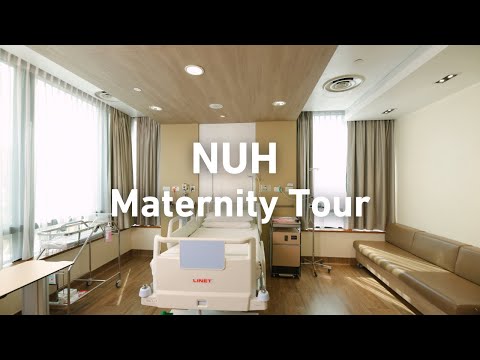
Watch on YouTube: NUH Maternity Tour, by National University Hospital (NUH) Singapore.
We picked this one because it is a hospital walking you through its own delivery suite and wards, rather than a parent describing one birth. Ask each hospital you are shortlisting whether it runs a tour or a webinar you can book, and do that before you pay a deposit.
A neonatal intensive care unit (NICU) is the ward that cares for newborns who are premature, ill, or born with a condition needing treatment straight away. The claim that private hospitals do not have one is repeated widely, and it does not hold for Mount Elizabeth Hospitals, Gleneagles Hospital or Thomson Medical, all of which describe one on their own sites.
| Hospital | What its own site states |
|---|---|
| KK Women’s and Children’s Hospital | A 40-bed neonatal intensive care unit, which it calls the largest in Singapore, able to perform major surgery inside the unit and holding a dedicated operating room. Its neonatology page describes the unit as the largest in Southeast Asia and says it treats infants “including those referred from other hospitals”. A 45-bed Special Care Nursery takes infants on after they are stabilised in the unit. |
| National University Hospital | Neonatal care at “Levels I, II and III”, with Level II and III care managed in its neonatal intensive care unit and high dependency unit, and pre-delivery counselling for high-risk pregnancies. |
| Mount Elizabeth Hospitals | A neonatal intensive care unit that “specialises in the monitoring and care of ill or premature newborn infants” and “also admits babies with congenital problems or trauma during delivery”, with a standby team for high-risk deliveries. |
| Gleneagles Hospital | A neonatal intensive care unit providing “specialised medical care for premature infants”, and “Standby for high-risk deliveries” among the services it lists. |
| Thomson Medical Centre | Neonatology is listed among the specialist services at its paediatric centre. Under the heading “Paediatrics & Neonatal Intensive Care”, its paediatric centre page and its neonatology page both state: “Our Neonatal Intensive Care Unit (NICU) is equipped to care for premature infants and newborns requiring specialised respiratory or surgical support.” |
Having a unit and having every level of care are different things, and this is where the fear in the argument is doing real work. A newborn can need something a given hospital does not provide, and that is why a transfer service exists.
KKH runs the Children’s Hospital Emergency Transport Service (CHETS), a mobile intensive care team of neonatologists and paediatricians trained in critical care retrieval, with nurses from its neonatal and children’s intensive care units. KKH describes the team as travelling “by road and air to the bedside of any child requiring their services”, stabilising the child there, and then making “a safe, controlled transfer back to KK Women’s and Children’s Hospital”.
It is not something you call. The team is activated by the doctors already treating your baby, and KKH says it “co-ordinates closely with the child’s primary team of doctors to obtain vital information before activation”. Its instructions to referring hospitals include telling parents to expect the team, explaining why the transfer is needed, and not leaving the child until they have met the team and signed a consent-for-transfer form.
KKH’s own page for the service does not say who pays for the move, or how the receiving hospital’s bill is worked out afterwards. That is a fair question to put to a financial counsellor before you deliver, along with what your insurance would do in that situation. KKH advises having financial counselling after 30 weeks.
The subsidy is the thing you do not get, and it is most of the gap in the first table. The Ministry of Health states that Singapore Citizens and Permanent Residents are the ones eligible for acute inpatient subsidies at public hospitals, at up to 80 per cent and 50 per cent respectively.
The bill figures further up need reading with that in mind. They are, in the Ministry’s own words, “based on actual transacted fees for Singapore Citizens”, so the subsidised rows describe what a citizen paid and are not a quote for anyone else. Ask each hospital’s business office for an estimate against your own pass type before you compare.
MediSave has a separate catch, and a way round it. It belongs to CPF members, so a foreign spouse with no CPF account has no MediSave of her own to draw on for a delivery. The MediSave Maternity Package is paid from “Self and spouse’s MediSave”, though, so a citizen or permanent resident partner’s account still applies.
Notice which line does not appear in any of those three. Nothing in the sourced figures supports the claim that one route delivers a safer birth than another, and anyone telling you otherwise from one birth is telling you about their birth.
Run the estimated bill calculator on the hospital you are shortlisting. KKH publishes one on its own site, and the estimate you get back with your own pass type and ward class is worth more than any range on this page. Then book the financial counselling appointment, which KKH says belongs after 30 weeks.
Our list of questions to ask at your first checkup is the one to take with you.
For the wider picture of antenatal care here, start with hospitals and clinics for pregnant women in Singapore. If you are weighing something other than a hospital birth, we have looked at giving birth at home in Singapore. Antenatal classes are covered in our guide to birthing classes in Singapore, and the rest of the Pregnancy hub picks up from there.
Bill benchmarks and MediSave limits are revised without notice, so open the official page before you budget.

Pregnancy
Midwifery in Singapore is the care a registered midwife (RMW) gives you through pregnancy, labour and the weeks after birth. The Singapore…

Pregnancy
There is no single number, which is why the figures your friends quote never agree. On the Ministry of Health's own bill…

Pregnancy
A standalone breastfeeding class in Singapore costs up to about S$97 (as of September 2026), and the floor depends on which product…