
Infant
Safe sleep for babies: where and how your baby should sleep
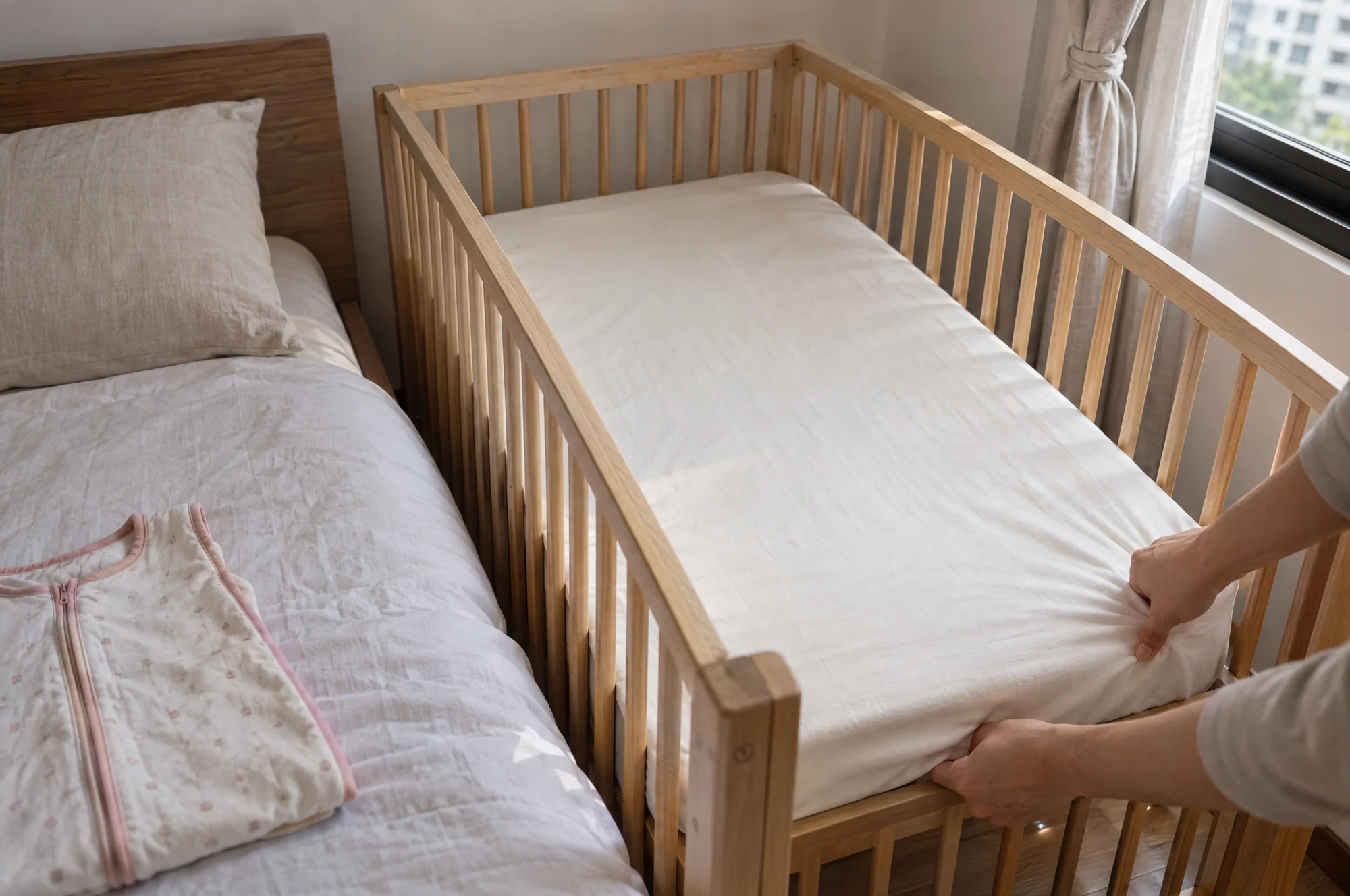
Safe sleep for babies, the rules health bodies give for where and how a baby sleeps, comes down to a few habits…
Infant
A stroller travels one of three ways: checked in at the counter with your bags, gate-tagged, meaning it is labelled at the gate and returned to you at the aerobridge on arrival, or taken into the cabin with you. Singapore Airlines, Scoot and Cathay Pacific will each check a fully collapsible stroller in free of…
A stroller travels one of three ways: checked in at the counter with your bags, gate-tagged, meaning it is labelled at the gate and returned to you at the aerobridge on arrival, or taken into the cabin with you. Singapore Airlines, Scoot and Cathay Pacific will each check a fully collapsible stroller in free of charge when an infant is in the booking, on top of the ordinary baggage allowance. Scoot extends that to an older child too.
The cabin is the route with conditions attached, and those conditions are a different shape at each airline. Only Singapore Airlines states its limit as a single sum: “Less than 7kg, and sum of length, width and height should not exceed 115cm”.
The others measure differently. Cathay Pacific caps three separate sides at the same 7 kg, Scoot caps both the sides and the same 115 cm sum through its ordinary cabin bag size, and Emirates publishes no stroller measurement on its Singapore cabin baggage page.
Those four airlines are the ones covered here, each rule taken from the airline’s own page or contract, as of September 2026.
| Airline | Into the cabin | Checked in, at the counter or at the gate |
|---|---|---|
| Singapore Airlines | Under 7 kg, with length plus width plus height not over 115 cm. Must fit the overhead compartment, be packed in a bag before boarding, and stay closed. Counts as one piece of your cabin baggage | A fully collapsible stroller checks in on top of the infant’s free checked allowance |
| Scoot | Must meet Scoot’s standard cabin bag dimensions and fit the overhead locker or under the seat in front. Folded and packed in a carrier bag before boarding. Does “not count toward your cabin baggage limits” | Free, and “not be counted as part of your checked baggage allowance”, if an infant or a child is in the booking |
| Cathay Pacific | “one collapsible pram or stroller weighing not more than 7 kg (15 lb) and no larger than 56 x 36 x 25 cm (22 x 14 x 9 in) if cabin stowage is available”, free per child or infant | “one free check-in collapsible pram or stroller and one infant’s car safety seat per infant”, in every class |
| Emirates | “one carry-cot or one fully collapsible stroller into the cabin if there is room”. No stroller measurement published | “If there is no space for these items in the cabin, they will have to be checked” |
Sources, in order: Singapore Airlines’ travelling with young children FAQ, its travelling with children page and its checked baggage page, Scoot’s travel information page and its Conditions of Carriage, Cathay Pacific’s Conditions of Contract, and Emirates’ cabin baggage rules for Singapore.
All the figures in this section were read in September 2026.
Singapore Airlines adds three measurements together. Under 7 kg, and length plus width plus height no more than 115 cm. One number to beat.
Cathay Pacific does not add anything up for the cabin stroller. Its Conditions of Contract sets a box instead: not more than 7 kg, and “no larger than 56 x 36 x 25 cm”. A stroller measuring 60 by 30 by 20 cm sums to 110 cm and clears Singapore Airlines comfortably, and it is still 4 cm too long for Cathay’s box.
One oddity in that Cathay figure is worth knowing. The same document prints 56 x 36 x 23 cm for cabin baggage generally, twice, with the identical “22 x 14 x 9 in” conversion beside both. Nine inches is 22.9 cm, which points to 23 rather than 25, so treat 23 cm as the safe depth.
That same document does add checked baggage up, which is a different question from the cabin. It sets a 158 cm sum for a piece of check-in baggage generally, and a 115 cm sum for an infant’s check-in baggage on flights where its Baggage Policy B applies. The same document defines Policy B as “All other flights”, the other one covering only journeys between Hong Kong and New Zealand, so from Singapore Policy B is the one that applies to you. Whether the free stroller sits under that infant cap is not stated, so measure the folded stroller before you check it in with Cathay.
Scoot prints no stroller figure. Its travel information page says the stroller “must meet Scoot’s standard cabin bag dimensions”, and Scoot publishes those as 54 cm by 38 cm by 23 cm, with total linear dimensions not over 115 cm, on both its baggage page and in clause 6.3(a) of its Conditions of Carriage, the contract you agree to when you buy a ticket. So Scoot caps the sides and the sum.
Emirates publishes no stroller measurement on that page, and no page in this guide’s sources carries one. Its cabin baggage rules allow “one carry-cot or one fully collapsible stroller into the cabin if there is room”, and say nothing about the size of it. The same page does set a general carry-on limit of “55 by 38 by 22 cm” at 7 kg in economy, but it never ties the stroller to that box the way Scoot’s page does, so ask at check-in rather than assuming either figure applies.
Measure your stroller folded, in centimetres, at its widest point in each direction, and keep the three numbers on your phone. That answers three of the four above, and gives you something concrete to show the Emirates agent at check-in.
This is the part worth reading twice, because the two Singapore carriers land on opposite answers.
On Singapore Airlines, a cabin stroller costs you allowance. The FAQ is direct about it: “If you are bringing a stroller on board the cabin, it will count towards your cabin baggage allowance.” Checking it in is the generous route instead, because a fully collapsible stroller and a car seat go in “in addition to the free checked baggage allowance”.
Its cabin baggage page is less direct. Beside the rule about paying extra when your baggage exceeds the free allowance, that page adds “Exception applies for baby strollers.” and never says what the exception is. The FAQ is the more specific of the two and is the one followed here, so ask at check-in if you are close to the limit.
On Scoot, a cabin stroller costs you nothing: “Foldable light-weight strollers do not count toward your cabin baggage limits.” Check it in instead and it still costs nothing, under both Scoot’s travel information page and clause 6.3(e) of its Conditions of Carriage, which puts a stroller among the special items that “do not constitute part of the Checked Baggage allowance”.
Scoot’s general baggage page words it the other way, saying infant equipment “may be checked in as part of your checked baggage allowance”. That page points the reader to the Conditions of Carriage, so the contract is the one to quote at the counter if you are questioned. Clause 6.3(e) is the number to have ready for the checked-baggage question, and only for that.
Do not quote it at the gate. The same clause opens by saying special items “may not be carried on board as part of Cabin Baggage”, and it lists a stroller among them, with the hand-carry asterisk on crutches rather than on the stroller. Scoot’s travel information page carries the same denial and then reverses it for strollers. Its special items list puts an asterisk on Stroller, Walker and Car Seat, and footnotes all three: “Foldable light-weight stollers or walkers, and FAA approved child safety seats are permitted as hand carry, though subject to security screening and acceptance by local authorities.” The misspelling of strollers is Scoot’s own, left as printed. That footnote, not clause 6.3(e), is the sentence to have at the gate.
On the allowance question, then, the budget airline is the more generous one. Worth knowing before you decide which route to take at Changi.
Scoot attaches one condition, and prints it as a footnote under the same special items list rather than in the main text: “The waiver of the check-in baggage allowance is only applicable if an infant/child is present in the booking”. A grandparent sending the stroller ahead on a separate booking does not get that waiver, so the stroller counts against the ordinary checked allowance.
A gate-tagged stroller is normally handed back at the aerobridge, the covered walkway from the aircraft door into the terminal. Singapore Airlines names ten places where that does not happen, on its travelling with children page: “Please note that retrieval at the aerobridge is not available for the following destination: Adelaide, Ahmedabad, Bandung, Chongqing, Copenhagen, Darwin, Dhaka, Kochi, Malé, Perth.”
Flying to one of those ten means planning the arrival without wheels. Pack a carrier or a sling for the walk through the terminal, because the airline tells you to check with ground staff on stroller retrieval, and at those ten it does not name the spot.
Singapore Airlines also flags what happens on a Scoot leg inside a Singapore Airlines itinerary: “all Scoot flights will require the stroller to be checked in at the aerobridge if there is no space in the cabin compartment.”
Scoot and Cathay Pacific both publish an answer, and in both cases it sits in the contract documents rather than on the help pages.
Scoot’s Conditions of Carriage, effective 01 July 2026, puts baby gear in the same category as surfboards and skis. Clause 13.6, on items on limited release, reads: “Infant Equipment including but not limited to prams, buggies and car seats may be carried in the hold of the aircraft subject to space being available. Scoot may carry such items on a ‘limited release’ (i.e. entirely at your own risk for damage or delay) basis.” The clause then suggests insurance.
Cathay Pacific’s Conditions of Contract carries a liability notice instead, and one limb of it is baggage. Under the Montreal Convention, the treaty that sets those limits, “Liability is limited to 1,519 SDRs per passenger in total for both cabin baggage and check-in baggage”.
The cap is set in SDRs, or Special Drawing Rights, rather than in dollars, so it has to be converted on the day: the notice says those values “will be subject to fluctuation in currency conversion rates” and points to the International Monetary Fund for the current ones. Cathay adds that the notice “cannot be used as a basis for a claim for compensation” and “does not form part of the contract between the Cathay and you”, so read it as the shape of the limit rather than as a number to claim against.
Two contracts is not four. Singapore Airlines’ and Emirates’ own conditions of carriage are not quoted here, so read nothing into their absence. Whichever airline you are on, open its conditions of carriage before you fly and search it for “pram”, “stroller” and “limited release”.
The practical protection you can take is the same whichever carrier you are on. A padded travel bag, and photographs of the stroller from four sides at the gate before you hand it over, with the timestamp on. That is what turns a claim from a description into evidence.
Before deciding to keep the stroller with you through the terminal, know that you do not have to. Changi Airport’s own page says: “Changi Airport offers complimentary use of baby strollers, on a first-come-first-served basis. You may approach the information counters to obtain one. Strollers are also available at the concierge counters in Jewel.”
First come, first served is doing real work in that sentence, so this is a plan that can fail on a busy morning. It also only covers the Singapore end of the trip.
It still changes the sums. If your own stroller is heavy, checking it at the counter and borrowing one at Changi is often the easier morning, and it takes the cabin size question off the table.
Jetstar Asia has stopped flying, and a stroller policy for it is no use to you. The Qantas Group announced the closure of “the Group’s Singapore-based low-cost subsidiary”, and the airline’s “final day of operation on 31 July 2025”.
Only the intra-Asia routes went with it. The same release says there are “no changes to Jetstar Airways and Jetstar Japan services into Asia”, so a Jetstar Airways flight from Australia is a different airline and still runs.
Counter, gate and cabin are not three equal choices. Each one fails in its own way, and knowing which failure you can live with is the whole decision.
If you are still choosing a stroller and travel is part of the reason, the weight and the folded size are the two numbers that decide all of this. Our guide to choosing a stroller is where the trade-offs live, and the strollers we would pick for Singapore parents is where to start if you want a light one.
Four airlines are covered above. For any other carrier, start with the two pages that settled it for these four.
Two more things worth doing on any carrier. Ask at check-in whether the stroller is tagged through to your final destination, not just to the connection. And ask whether gate-side return is available at the arrival airport, since Singapore Airlines publishes a list of ten where it is not, so the answer can change with the destination.
Screenshot the paragraph you are relying on, with the date on it. It is faster to show a ground agent the rule than to describe it.
Measure the stroller folded and note the three numbers. Check your airline’s baggage page for the word “stroller”, and its conditions of carriage for “limited release”. Which of the three routes you want is the last call, and it is worth packing a carrier for the walk in case the cabin is full.
Airline pages can change without notice, so the rules above carry the month they were checked. Open the airline’s own page before you travel and confirm the figure still reads the same.
For the rest of the gear decisions around this age, the Infant hub collects them, and where to buy a stroller in Singapore is the place to start if you are still shopping for one.

Infant
Safe sleep for babies, the rules health bodies give for where and how a baby sleeps, comes down to a few habits…

Infant
Infant care in Singapore is licensed care for babies from 2 months up to 18 months, full-day or half-day. At a centre…
Infant
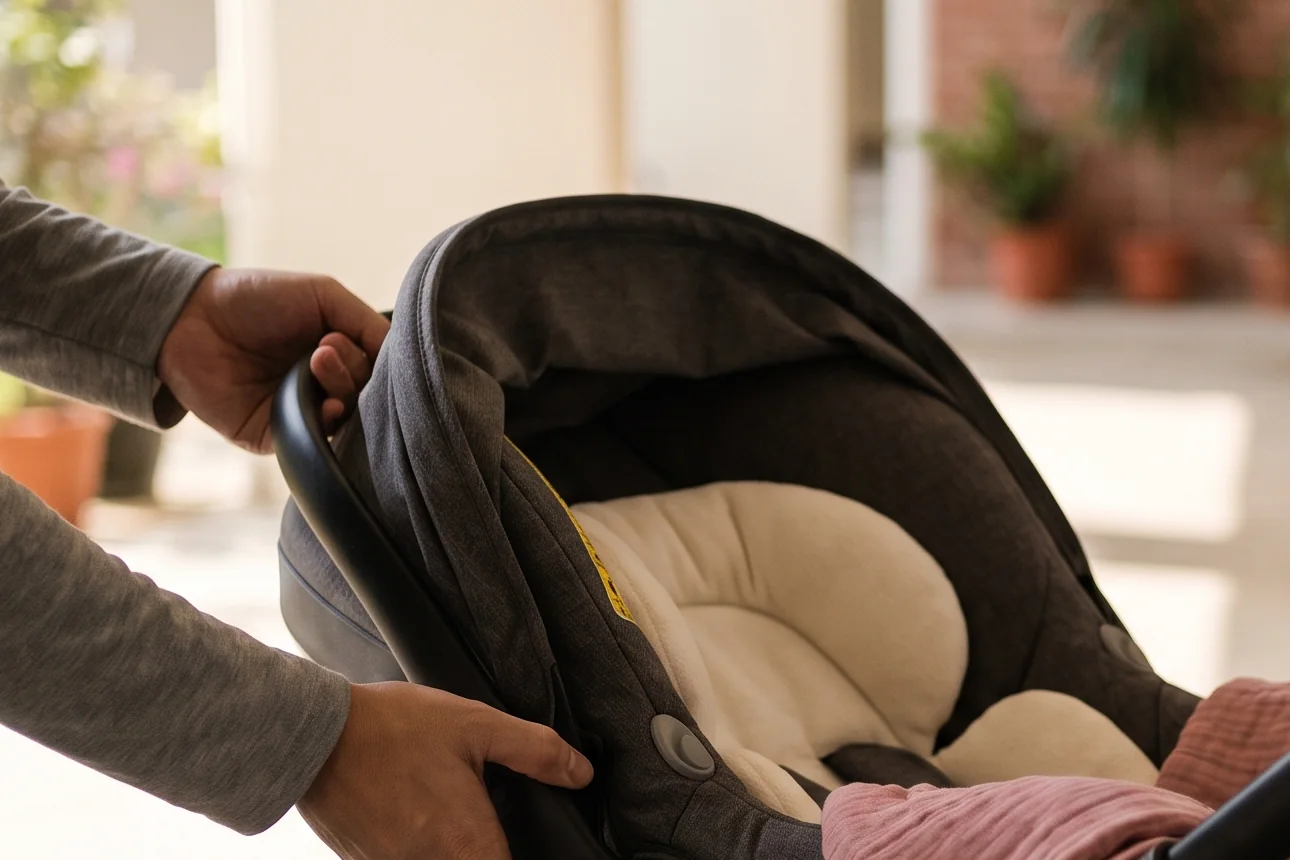
A travel system is an infant car seat paired with a stroller, so the seat lifts out of the car and clicks…