

Pregnancy
Cost of Giving Birth in Singapore, Hospital by Hospital
There is no single number, which is why the figures your friends quote never agree. On the Ministry of Health's own bill…
Pregnancy
Midwifery in Singapore is the care a registered midwife (RMW) gives you through pregnancy, labour and the weeks after birth. The Singapore Nursing Board (SNB) registers every midwife here. A midwife can deliver a straightforward birth without a doctor in charge. When a midwife finds something that is not normal, the midwife must tell the…
Midwifery in Singapore is the care a registered midwife (RMW) gives you through pregnancy, labour and the weeks after birth. The Singapore Nursing Board (SNB) registers every midwife here. A midwife can deliver a straightforward birth without a doctor in charge.
When a midwife finds something that is not normal, the midwife must tell the obstetrician. An obstetrician is the doctor who specialises in pregnancy and birth.
At a public hospital such as KK Women’s and Children’s Hospital (KKH), you can meet a midwife at four points. They are the antenatal clinic (antenatal means before birth), the classes, the delivery suite where you give birth and, for some first-time mums, your home after the birth.
One recent change is at KKH. From 3 August 2026, women with a low-risk pregnancy can start midwife-led antenatal care there at 16 weeks, not 24. Low-risk means no known problem for you or the baby so far.
A doula is a different person. A doula gives comfort and support in labour. Under the standards of DONA International, a doula professional body, its doulas do no medical checks. The table below sets the three roles side by side, and the next section walks one pregnancy in order.
The SNB sets out the job in its core competencies for the registered midwife, a standards paper revised in 2023. A midwife gives “support, care and advice during pregnancy, labour and the post-partum period”. Post-partum means the weeks after birth.
Midwives “conduct births on their own responsibility”, the paper says. In plain words, a midwife can lead a normal birth without a doctor in charge. A midwife also cares for your newborn and baby up to 12 months old.
Every new midwife must be able to do these things:
A midwife is also trained to act in an emergency, such as heavy bleeding after birth or a baby’s shoulder getting stuck. The midwife also has a duty to call in help: the midwife must inform the obstetrician or doctor whenever there is an abnormality or complication that affects you or the baby.
SingHealth, the public healthcare group KKH belongs to, often calls its midwives nurse-midwives. The title points to the usual route. SingHealth builds its midwifery workforce with Nanyang Polytechnic (NYP), whose Advanced Diploma in Nursing (Midwifery) is a course for registered nurses.
In this guide, a nurse-midwife and a registered midwife are both simply the midwife.
All three can help you around your baby’s birth. What differs is what each one is trained and allowed to do.
| Midwife | Obstetrician | Doula | |
|---|---|---|---|
| Who they are | A registered midwife, licensed by the SNB | A doctor who specialises in pregnancy and birth | A trained birth companion who gives physical, emotional and informational support |
| Medical checks in pregnancy | Yes, for a normal pregnancy, including spotting common complications | Yes. The midwife must bring the doctor in for any abnormality or complication | No. The standards of DONA International, a doula body, bar every clinical or medical task |
| At the birth | Delivers a normal vaginal birth on their own responsibility and runs the CTG monitor | Part of the team in KKH’s Delivery Suite, with anaesthetists (the doctors who give the epidural) and neonatologists (the doctors for newborns) | Continuous comfort and support; no examinations |
| How you get one | Part of the Delivery Suite team at KKH, and runs KKH’s midwife-led antenatal clinic | A subsidised patient at KKH (one who pays the lower, government-subsidised rate) gets team-based care led by an assigned specialist; you cannot pick the doctor for the delivery | Not on KKH’s list of Delivery Suite staff; a doula works for you, the client |
The doula column needs the most explaining. DONA International defines a doula as “a trained professional who provides continuous physical, emotional and informational support” before, during and shortly after childbirth. Its standards of practice say a DONA doula “does not perform clinical or medical tasks”, naming blood pressure checks, the baby’s heartbeat and vaginal examinations, and “will not diagnose or treat in any modality”.
So a doula adds to your midwife’s care. A DONA doula does not take the midwife’s place.
Here is one public hospital pregnancy in order, with the points where a midwife is part of your care. The examples are from KKH. Other hospitals may set up their clinics differently. For everything else in your pregnancy, start with our pregnancy hub.
| When | What happens |
|---|---|
| Week 8 to 12 | First visit with your doctor and the dating scan, on KKH's pregnancy timeline |
| From week 16 | KKH's midwife-led antenatal clinic for low-risk pregnancies, from 3 August 2026 |
| Labour and birth | Midwives, obstetricians, anaesthetists and neonatologists in KKH's Delivery Suite |
| First hour | The midwife starts skin-to-skin and feeding, unless a medical reason stops it |
| First 6 weeks | EMPOWER2 pilot: KKH midwives visit first-time mums at home in three areas |
Your first check is not with a midwife. KKH tells you that if you think you are pregnant, you contact your doctor to arrange the first appointment. That doctor can be at a polyclinic (a subsidised public clinic in your neighbourhood), a family clinic or KKH.
KKH’s pregnancy timeline puts that first visit at weeks 8 to 12. It comes with the dating scan, the ultrasound that estimates your due date.
If you start at a polyclinic, the antenatal guide from National Healthcare Group (NHG) Polyclinics sets out which routine checks and screening tests happen there and which happen at the hospital.
KKH has run a midwife-led clinic for low-risk mothers since 2010. From 3 August 2026, SingHealth says women with low-risk pregnancies can start there from 16 weeks, earlier than the 24 weeks it used to be.
SingHealth’s reason is about time. Its Group Chief Nurse says midwives “spend the most time with expectant women”. An earlier start gives the team more chances to notice when something is wrong, including your mood.
That matters because at least one in 10 women in Singapore have depression or anxiety around pregnancy and birth, SingHealth says, citing local data.
The classes are another place to meet a midwife. KKH says its antenatal programme classes are taught by its lactation consultants (breastfeeding specialists), midwives, physiotherapists and parentcraft nurses (nurses who teach baby care). Our guide to birthing classes in Singapore compares what each hospital offers and what it costs.
KKH’s Delivery Suite has 28 delivery rooms and handles 30 to 35 births a day (KKH figures, as of August 2026). Teams of midwives, obstetricians, anaesthetists and neonatologists run it.
In labour, the midwife does the hands-on work. That means watching your contractions and the baby’s heartbeat on the CTG, checking how far labour has moved, and talking you through pain relief.
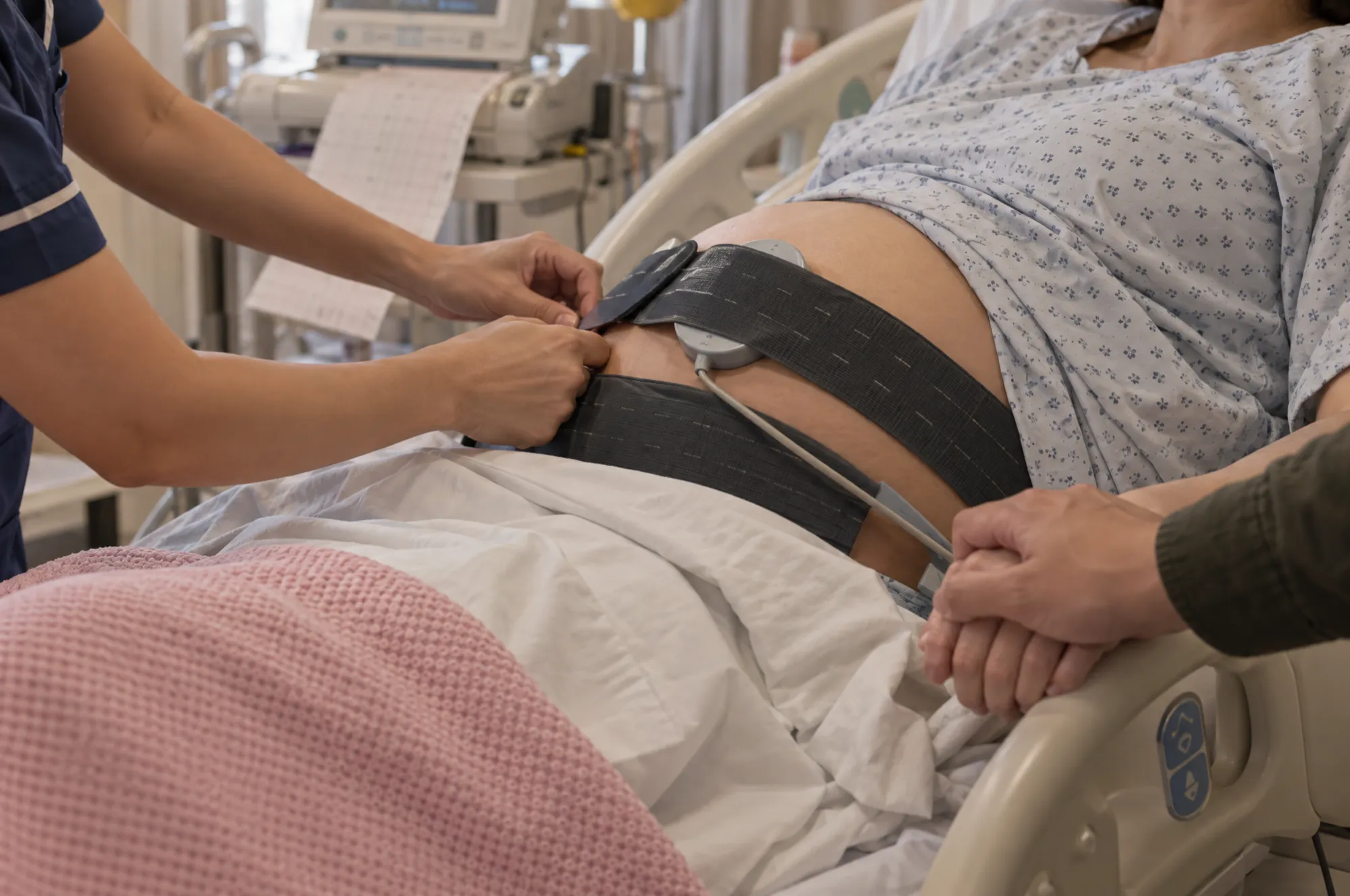
Straight after a normal birth, the midwife’s job is to put the baby on your chest for skin-to-skin contact and start breastfeeding within the hour, unless there is a medical reason not to. The midwife also checks the baby and keeps an eye on your recovery, and helps with feeding problems alongside the hospital’s lactation consultants.
For now, KKH’s midwife home visits after the birth are a pilot. EMPOWER2 is KKH’s community midwifery pilot, which brings midwifery care to your home. Since May 2025 it has sent KKH midwives to first-time mothers in Kallang, Sengkang and Punggol in the first six weeks after birth, to help with breastfeeding, recovery and confidence as a new parent.
If you live in one of those three areas and are having your first baby at KKH, ask about it at your antenatal visits.
The clinic is for low-risk pregnancies, so being offered a place tells you how the team reads your pregnancy at that point. Saying yes does not take you out of the hospital. The midwife works inside the same KKH team, and must bring in the obstetrician whenever something is not normal.
What you gain is more time with a midwife, and earlier.
Questions we would ask at the clinic before deciding:
The clinic team is the place to get these answers. If you are a subsidised patient, you cannot pick the doctor for your delivery, whichever clinic you attend.
Yes, for a normal birth. The SNB says midwives “conduct births on their own responsibility”, and a safe normal vaginal delivery is one of the skills every new midwife must have. In KKH’s Delivery Suite the obstetricians are on the same team, and the midwife’s duty is to call them in for any abnormality or complication.
The SNB sets one firm limit. Its 2023 paper says: “RMWs practising independently are not permitted to conduct home births.” So a midwife who works for themself, outside a hospital, cannot deliver your baby at home.
You may be thinking about hiring your own midwife or a doula. Two things decide what is possible here.
First, the law on who may be paid to attend a birth. Section 27(2) of the Nurses and Midwives Act 1999 says: “No person other than a qualified midwife may attend a woman at childbirth for a fee or reward.” Doctors are exempt.
Our guide to giving birth at home in Singapore walks through what that means, who it covers and why the position of a paid doula is not settled by the Act.
Second, the SNB rule above: an independent midwife may not conduct a home birth. Put together, a midwife you hire privately cannot deliver your baby at home, and a DONA doula does no medical work. Either one can be extra support, but neither replaces the hospital team that conducts the birth.
Midwifery in Singapore was not always hospital work. In 1965, a baby was born in Singapore every 11 minutes or so, according to the National Archives of Singapore. Kandang Kerbau Hospital, now KKH, handled an average of 100 deliveries a day, and its births reached a high of 39,835 in 1966.
Hospital care was not easy for every mother to reach. Many, especially in rural areas, relied heavily on midwives, who delivered babies, issued birth reports and gave antenatal and postnatal care. In the 1960s Singapore had over 1,000 registered midwives.
One of them, a midwife from 1964 to 1988, recorded an oral history for the National Archives in 1997. In it she described how home deliveries were managed.
Today the SNB bars independent midwives from home births, and the midwives in this guide work in hospital teams. Yet the job has kept the same shape: pregnancy, birth and the weeks after.
The hospital you choose decides which midwife-led options you can use, because the midwife-led clinic and the home visits above are KKH services. If you have not settled that yet, read our guide to public vs private maternity care in Singapore next.
That guide sets out the three routes: a subsidised or a private patient at a public hospital, or a private hospital. For each one it covers who delivers your baby and what you pay.

Pregnancy
There is no single number, which is why the figures your friends quote never agree. On the Ministry of Health's own bill…

Pregnancy
A standalone breastfeeding class in Singapore costs up to about S$97 (as of September 2026), and the floor depends on which product…

Pregnancy
If you have no MediSave savings and no insurance of your own, your husband's MediSave can pay for the birth. The MediSave…