
Discover the Best Child Car Seat and Stroller Combos
Six travel systems, sorted by the job each one does best. A travel system is a car seat and a stroller sold…
Review
What Singapore Parents Should Know About Washing, Sterilising & Drying Bottles
What Singapore Parents Should Know About Washing, Sterilising & Drying Bottles
Sponsored. This is a sponsored article that contains a promotional product. Lollababy, the maker of that product, checked the facts about it before publication, and nothing else. Which option we would pick, and everything this page says about the alternatives, is ours. How we work with brands.
The short answer: sometimes. Sterilising is worth doing for about the first year. A machine that does it is optional, and which one is worth buying depends on which of three jobs you want to stop doing yourself: washing, sterilising or drying.
HealthHub, the Ministry of Health’s own health portal, lists “sterilise bottles before each use” among the ways to keep a child from catching gastroenteritis. The UK’s National Health Service (NHS) says to sterilise all feeding equipment, bottles and teats included, until a baby is at least 12 months old. A pot of boiling water does that for nothing.
So the real question is how much of the work you want taken off you. Washing, sterilising and drying are three separate jobs, and the machines below do one, two or all three.
A steam steriliser sterilises: S$169 for one that holds six bottles. A steriliser that also dries is S$249. An all-in-one that washes the bottles first, then sterilises and dries them, is S$639. All three prices are from the makers’ own Singapore pages.
None of them is compulsory. The pot does what the guidance asks for. What the machines buy is time and sleep, and each rung up the ladder buys a little more of it. Here is what each one does, and what it still leaves to you.
| Method | Jobs it does | Price in Singapore | What you still do yourself |
|---|---|---|---|
| A pot of boiling water | Sterilises | Nothing, if you own a pot | Wash, time it, lift everything out, dry it. Teats wear out faster this way |
| Steam steriliser (Philips Avent Baby Bottle Sterilizer SCF291/01) |
Sterilises, stores | S$169 | Wash, and dry |
| Steriliser and dryer (Philips Avent Sterilizer SCF293/01) |
Sterilises, dries, stores | S$249 | Wash |
| All-in-one bottle care station | Washes, sterilises, dries, stores | S$639 | Load it, and buy its detergent tablets |
Prices as of August 2026, from the makers’ own Singapore pages. The two Philips models are named because Philips publishes a Singapore price for them, which is what makes the ladder comparable. They are price markers, not a verdict. The all-in-one sold in Singapore has its own section below. Storing appears on three rows because all three machines claim it; the gap between the rungs is the washing and the drying.
For the first year, yes. HealthHub puts “sterilise bottles before each use” on the same short list as handwashing and the rotavirus vaccine, under how to keep a child from catching gastroenteritis. The NHS says to sterilise all feeding equipment until a baby is at least 12 months old, because “this will protect your baby against infections, in particular diarrhoea and vomiting”.
None of that requires an appliance. SingHealth’s HealthXchange lists three ways: boiling water for five to ten minutes, steam sterilisation, or sterilisation tablets dissolved in clean water. The NHS lists the same three and gives the timings: at least ten minutes in a pot, or at least 30 minutes in cold-water solution that you change every 24 hours.
The pot is free and it works. It also costs ten minutes at a stove at 3am, and the NHS notes that teats wear out faster when boiled. For a parent doing most of the care alone, a machine that runs itself is not a luxury.
Our guide to choosing a bottle steriliser in Singapore lists the models we would shortlist.
This is the sentence that decides which machine you need. The NHS puts it this way: “Putting feeding equipment through the dishwasher will clean it but it does not sterilise it.” Cleaning and sterilising are two jobs. A steriliser does the second one, and it is not built to do the first.
The order matters too. The NHS instruction is to wash bottles and teats in hot soapy water with a bottle brush soon after a feed, rinse them in cold running water, and only then sterilise. Its sterilising guide and its Best Start in Life guide both put cleaning first.
So a steriliser does not replace the brush; it takes over the step after it. The brushes, drying racks and cleaning sets we rate are the other half of the kit. Each step up the ladder hands one more job to the machine, and which jobs you hand over is the whole decision.
The basic tier is an electric steam steriliser. Philips Singapore lists the Avent Baby Bottle Sterilizer SCF291/01 at S$169, and describes it as sterilising up to six bottles with accessories in ten minutes, then switching itself off. Against a pot, what you are buying is a timer and your attention back.
It does not wash, and it does not dry. Philips says contents stay sterile for up to 24 hours if you keep the lid on, so damp bottles can wait inside. If sterilising is the only job you want handled, this and a good brush is a complete answer to what the health guidance asks for.
The next tier adds drying. Philips Singapore lists the Avent Sterilizer SCF293/01 at S$249, and says it has bottles ready in 40 minutes using jets of filtered air. The extra S$80 buys one thing: the bottles come out dry, so nothing sits on a rack. Storage is the same 24 hours on both models.
The cost is time. Ten minutes becomes about 40, so you stop running a cycle between feeds and run one a day, for the next day. That changes how many bottles you need to own. If you are still choosing bottles, the five baby bottles we rate is where we would start.
A UV cabinet uses ultraviolet light rather than steam. We have not tested one, so we will not tell you whether it works. None of the health guidance above lists it: the NHS and HealthXchange name cold-water solution, steam and boiling. A cabinet does not wash a bottle either, so it sits in the same tier as a steriliser and dryer: the washing is still yours.
The top tier takes over the washing as well. An all-in-one bottle care station washes the bottles, sterilises them, dries them and holds them until you want them. It is the only row in the table above that washes.
Lollababy’s Pristine™ Bottle Care Station is the one sold here, at S$639 for the unit on its own as of August 2026, or from S$687.90 bundled with detergent tablets.
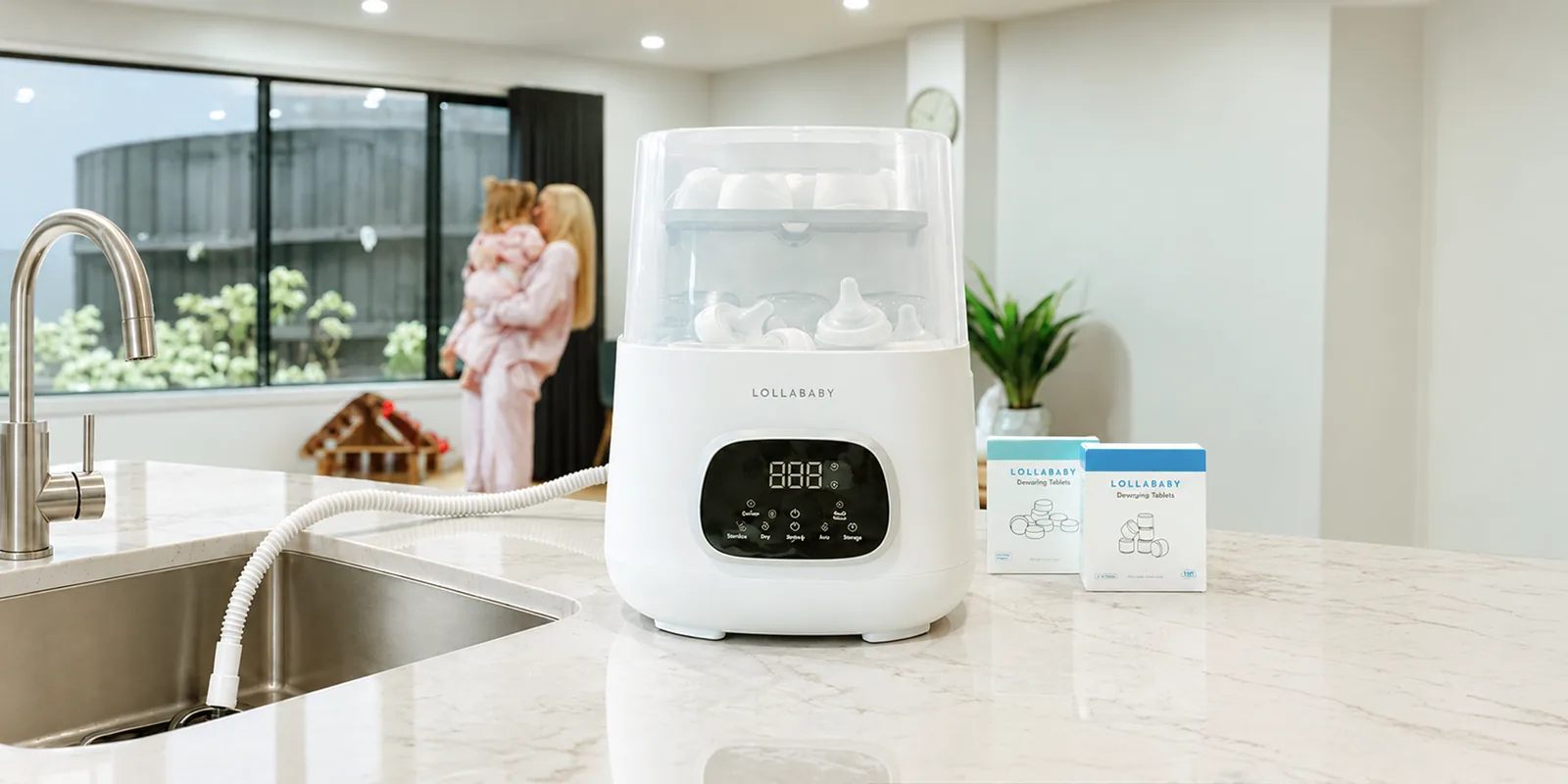
It takes up to six bottles with their accessories. Add breast pump parts and fewer bottles fit: Lollababy told us four bottles plus pump parts is a typical load. It washes with jets of water and detergent tablets, sterilises with high-temperature steam, then dries with HEPA-13 filtered air. After that it holds the load in a storage mode for 72 hours, running a disinfection cycle every hour.
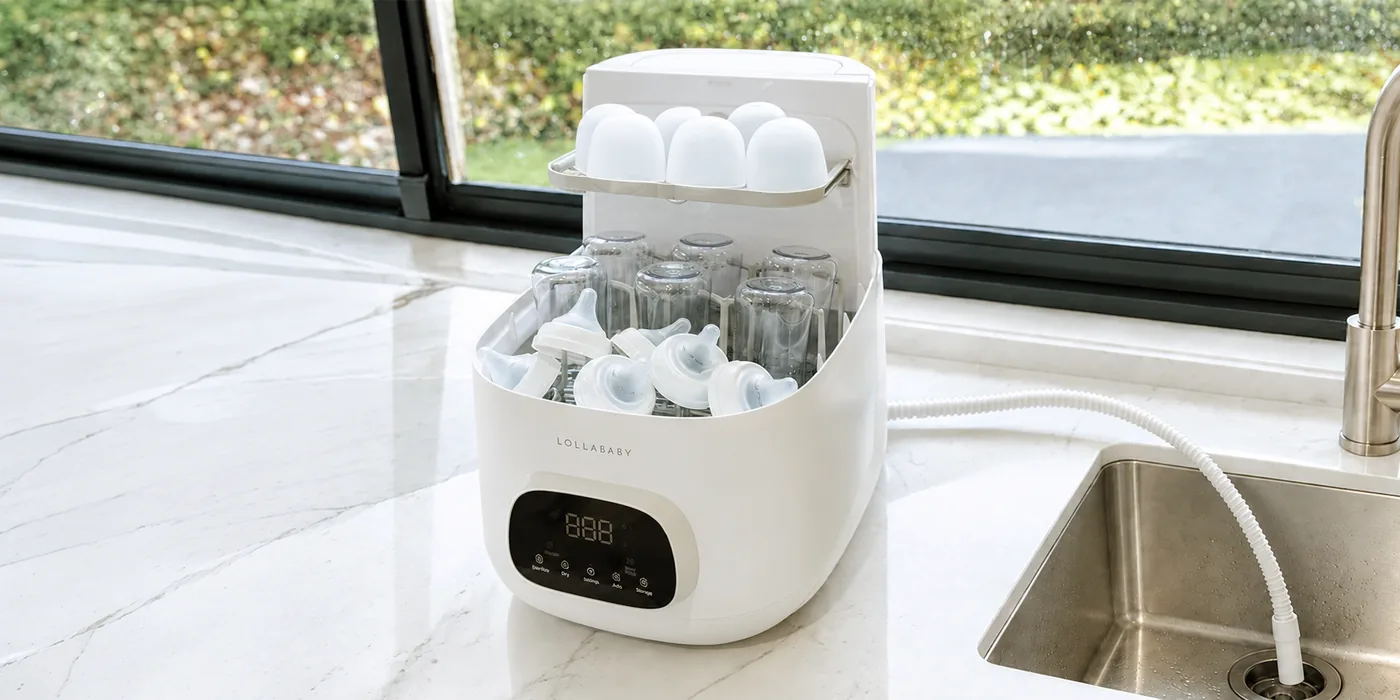
Used water drains straight down a hose into the sink, so there is no dirty-water tank to empty. Lollababy states the unit is certified by ASTA and carries Singapore’s SAFETY Mark, registration 191118-12. The warranty is one year, supported locally.
Now the parts that decide whether S$639 is worth it to you, which are the parts a spec sheet does not lead with.
It needs a permanent spot beside the sink. The unit is 27 cm wide, 39 cm deep and 39.5 cm high, and it weighs 16.5 kg. There is no plumbing to install, but the drain hose has to reach a sink, so it cannot live in a cupboard and come out when needed. In an HDB kitchen, that strip of counter beside the sink is often the first thing to check. If the space is there, it is worth considering even in a small HDB kitchen: for a mother caring for her baby alone most of the day, the rest and the calm it buys can matter more than the counter it takes.
The Standard cycle takes 95 minutes. Lollababy told us the Fast cycle takes 50. Even so, the Standard cycle on its own is closer to an hour and a half than to ten minutes, which means you need enough bottles to cover the run.
So count the bottles you own before you buy, especially if yours come apart into several pieces.
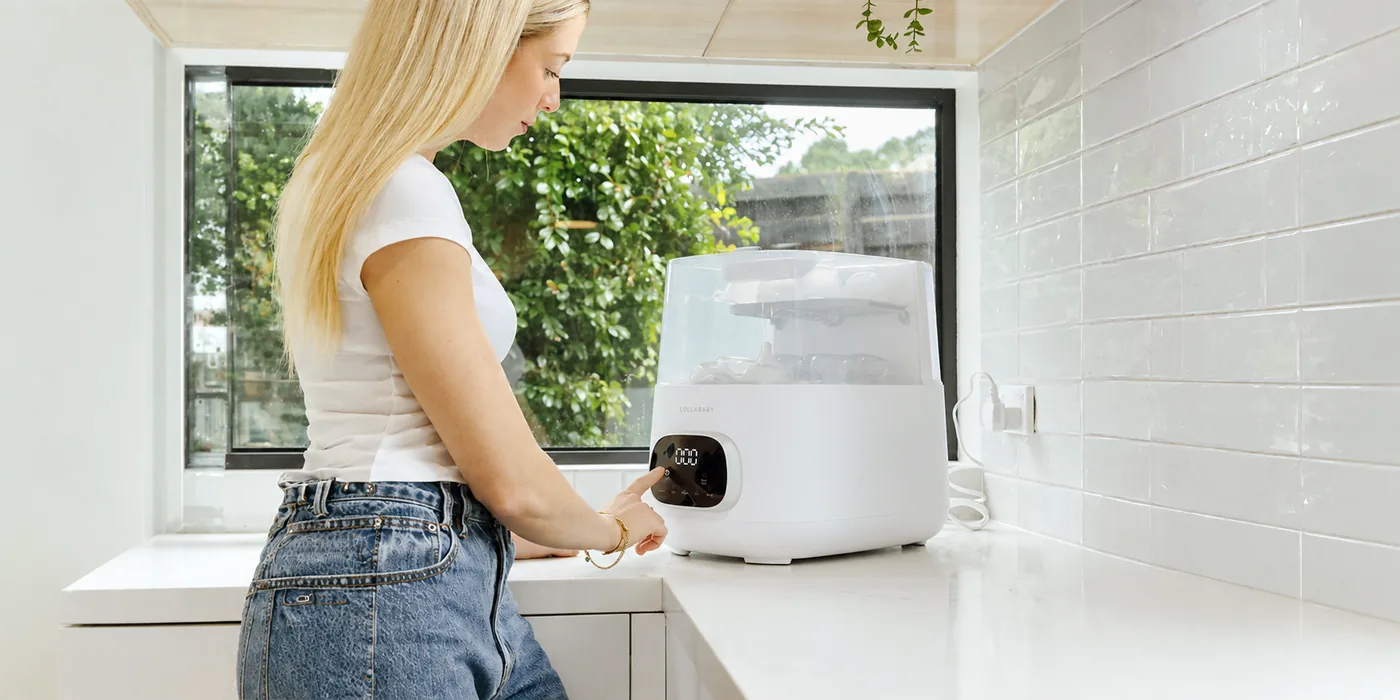
It has running costs, and they are worth knowing up front. At Lollababy’s August 2026 pack prices, every wash uses two of its own detergent tablets, which works out at roughly 35 to 45 cents a cycle. At two cycles a day that is about S$21 to S$26 a month, and at three it is about S$31 to S$39.
The HEPA-13 filter is S$14.95 each in a box of two and needs changing every three to six months, so call it S$30 to S$60 a year. Descaling tablets are S$25.90 a pack, one tablet per descaling cycle, and Lollababy told us to descale every one to two weeks.
Each cycle also uses about 3.6 litres of water. Lollababy publishes no power rating for the unit, so we cannot put a number on the electricity.
The tablets are not optional. Lollababy’s product page says third-party detergents “may affect cleaning performance or leave chemical residues on feeding items”, and that using them “will void your warranty”. In practice, that means the running cost above is the running cost: there is no supermarket refill to switch to later.
Set against that, what you are buying is the washing, done for you. We have not tested these machines against each other and will not tell you one steam cycle sterilises better than another. What the all-in-one changes is who does the washing: nobody in your home wants to stand at the sink with a bottle brush, then sterilise everything for another ten to fifteen minutes, at 2am.
Work out which of the three jobs you want to hand over, then buy the machine that does those and no more. None of them is compulsory. All of them buy back time, and if you are doing most of the care on your own, that time is the point.
If washing up is not the problem, and you just want the sterilising handled reliably while you do something else, the basic steam steriliser at around S$169 does the job. A pot does it too, if you are at home and can stand over it; the steriliser is for the nights you cannot. Nothing in the guidance above asks for more than that, and we would say so on a page nobody paid for.
If damp bottles are the problem, the extra S$80 for a model that dries buys you exactly that and nothing else. Whether one thing is worth S$80 depends on how much a drying rack bothers you, and for a lot of small kitchens it does.
If the washing itself is the problem, which is what exclusive pumping, a dozen pump parts, or nobody free at the sink at midnight all come down to, then the all-in-one is doing something the other three cannot. S$639, plus roughly S$290 to S$370 a year in tablets and filters at two cycles a day, before descaling, is the price of not scrubbing. That is real money, and what it buys is real too: the one job none of the others touch, done while you rest. Only you can weigh the two.
One thing holds at every tier. Sterilising is the last step, never the first, and a machine that does not wash leaves you the step before it. Whichever you choose, the guidance is the same for the first year: clean, then sterilise, before each use.
If the washing is the job you want gone, the Pristine is the one option on this page that takes it off your hands, and it does so with a one-year warranty supported here in Singapore. Measure 27 cm by 39 cm of counter beside your sink, then see the Pristine Bottle Care Station on Lollababy’s site for the full specifications, the current bundles and what comes with each.

Six travel systems, sorted by the job each one does best. A travel system is a car seat and a stroller sold…

Six baby sunscreens sold in Singapore, sorted by the job: a compact mineral lotion for trips, a stick for quick top-ups, one…

This roundup covers seven products for a baby with a blocked nose, and they are not all the same kind of thing….