Primary 1 Registration in Singapore: Phases and 2027 Changes
Primary 1 registration in Singapore runs over five phases for Singapore Citizen and Permanent Resident children: Phase 1, 2A, 2B, 2C and 2C Supplementary. The Ministry of Education (MOE) runs it online, from June to August, and which phase your child can enter depends on the family's existing tie to the school. Two rules change…
By Wei Chun
Updated 2 Oct 2026
15 min read
Primary 1 registration in Singapore runs over five phases for Singapore Citizen and Permanent Resident children: Phase 1, 2A, 2B, 2C and 2C Supplementary. The Ministry of Education (MOE) runs it online, from June to August, and which phase your child can enter depends on the family’s existing tie to the school.
Two rules change from the 2027 Primary One Registration Exercise, the one that places children starting Primary 1 in 2028. MOE will raise the reserved Phase 2C places from 40 to 60 in every school except small-intake schools with fewer than 180 Primary 1 places. It will also split Phase 2C into two tracks at 12 named schools, one for families living within 2km and one for families living beyond it, with no home-school distance priority inside either track.
MOE has not published the 2027 exercise’s dates or its birth-date window yet (as of September 2026). Every date below is from the 2026 exercise, which MOE publishes on its own phase page as a reference.
Which phase your child can register in
You may register in a phase as long as you meet at least one of its requirements. The phases run in order, and each one is a narrower door than the one after it: Phase 1 is for siblings, Phase 2C is for everyone left.
The five Primary 1 registration phases for Singapore Citizen and Permanent Resident children. The dates are the 2026 exercise’s own, which MOE publishes on its phase page as a reference (page last updated 11 September 2026).
Phase
Who can register
2026 registration window
2026 result
Phase 1
A child who has a sibling studying in the school. Every eligible applicant is offered a place
30 June to 2 July 2026
8 July 2026
Phase 2A
A child whose parent or sibling is a former student of the school, whose parent sits on the School Advisory or Management Committee, whose parent is a staff member, or who is studying in the MOE Kindergarten inside that primary school
9 to 10 July 2026
17 July 2026
Phase 2B
A child whose parent joined the school as a parent volunteer no later than 1 July of the year before registration and has given at least 40 hours of service by 30 June of the registration year, whose parent is endorsed by the church or clan directly connected with the school, or whose parent is endorsed as an active grassroots leader. 20 places are reserved
20 to 21 July 2026
27 July 2026
Phase 2C
A child who is not yet registered in a primary school, whatever the family’s connection to it. 40 places were reserved in the 2026 exercise, rising to 60 from the 2027 one
28 to 30 July 2026
11 August 2026
Phase 2C Supplementary
A child who is still not registered after Phase 2C
17 to 18 August 2026
27 August 2026
Three rules sit across all five phases. You register your child for one school only in any phase, and if you submit more than once MOE takes the latest submission. An unsuccessful application in one phase does not use up the next: you register again in the next phase your child is eligible for.
The third rule is balloting. It happens whenever applicants outnumber vacancies, which MOE says can happen in any phase from 2A to 2C Supplementary.
There is a sixth phase, Phase 3, for international students. It runs on a different timeline, and MOE considers those children only after every Singapore Citizen and Permanent Resident child has been admitted.
Age is the other gate, and it is fixed by birth date rather than by school year. For the 2026 exercise, a child had to be born between 2 January 2020 and 1 January 2021, both dates included, to start Primary 1 in 2027. MOE has not published the 2027 exercise’s window yet (as of September 2026).
What changes from the 2027 exercise
MOE announced the revised framework on 10 September 2026 and said it takes effect from the 2027 Primary One Registration Exercise, for children starting Primary 1 in 2028. Two things change, and both land on Phase 2C.
The first is a number. Reserved Phase 2C places go from 40 to 60 in all schools, except small-intake schools, which MOE’s own annex defines as schools with fewer than 180 Primary 1 places. Those stay at 40.
Phase 2B keeps its 20 reserved places.
Those 20 extra places are not new places. MOE says the increase comes from the earlier registration phases, so families with an alumni or volunteer tie are giving them up. MOE’s annex also sets the flow: places left over after Phase 2A are split between Phases 2B and 2C in a ratio of one to two.
The second change is a different shape of ballot, and it applies at 12 schools only. MOE calls it the Two-Track Scheme.
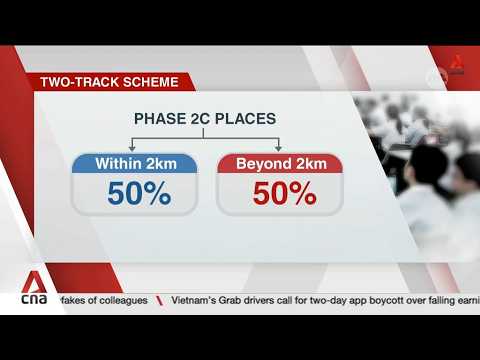
At those schools, Phase 2C places are divided equally between a track for children living within 2km of the school and a track for children living beyond 2km. MOE’s own labels are Phase 2C (2km or less) and Phase 2C (more than 2km).
Inside each track there is no home-school distance priority at all. If Singapore Citizen applicants outnumber the places in a track, MOE ballots.
If one track fills with places to spare, those places flow to Singapore Citizen applicants in the other track, and Permanent Resident children are considered only after every citizen applicant in both tracks has been admitted. Where the number of places will not divide evenly, the odd place goes to the 2km or less track.
MOE’s worked example uses the minimum: a school with 60 reserved Phase 2C places and nothing flowing down from the earlier phases splits them into 30 and 30.
MOE picked the 12 schools by housing profile: at each of them, public housing accounts for less than 40% of the dwelling units within 2km. The reasoning is in the announcement.
Priority today runs on citizenship and then distance, and in neighbourhoods with little public housing that keeps a school’s intake looking like its immediate neighbourhood rather than like the country. MOE’s own footnote puts about 8 in 10 of Singapore’s resident population in public housing.
These are the 12 schools, as MOE lists them in Annex A of the announcement (as of September 2026):
Anglo-Chinese School (Junior)
Anglo-Chinese School (Primary)
CHIJ (Katong) Primary
Methodist Girls’ School (Primary)
Nanyang Primary School
Ngee Ann Primary School
Pei Hwa Presbyterian Primary School
Raffles Girls’ Primary School
Singapore Chinese Girls’ Primary School
St. Margaret’s School (Primary)
Tanjong Katong Primary School
Tao Nan School
MOE says it will review the list from time to time as housing around the schools changes, and that it does not expect the list to move often. Check it against the announcement in the year you register, not in the year you read this.
CNA reported the announcement on the day MOE made it, 10 September 2026, and its broadcast graphic shows the same equal split this section describes.
Watch on YouTube: Primary 1 registration: More Phase 2C places from 2027, new two-track scheme at 12 schools, by CNA.
We picked this one because it is CNA, a Singapore news organisation, reporting on the day, rather than a commentary months later. Every rule it covers is written out above, so nothing on this page depends on watching it.
Does living within 1km still help you?
Almost everywhere, yes. Distance only ever comes into it when a school has more applicants than vacancies. When it does, MOE admits in this order, by citizenship first and then by Home-School Distance, which is MOE’s own name for the distance band your address falls into:
Singapore Citizens living within 1km of the school
Singapore Citizens living between 1km and 2km
Singapore Citizens living beyond 2km
Permanent Residents living within 1km
Permanent Residents living between 1km and 2km
Permanent Residents living beyond 2km
Read that list twice, because the citizenship tier outranks the distance tier. A Singapore Citizen living beyond 2km is admitted ahead of a Permanent Resident living across the road.
The Two-Track Scheme is the exception, and it is narrower than it first looks. It changes Phase 2C at 12 schools. It does not touch Phase 1, Phase 2A, Phase 2B or Phase 2C Supplementary anywhere, including at those 12, where MOE’s annex marks every other phase “No change”.
You are planning a move to get closer to a school
Check the list of 12 above first, because the answer splits there.
If the school is not one of the 12
Distance works the way it always has. Getting inside 1km moves you up two bands, inside 2km moves you up one, and both matter only if that school ballots. Before you commit, read the 30-month rule in the next section: the priority comes with a condition attached.
If the school is one of the 12
From the 2027 exercise, moving from 3km to 1.5km buys you nothing in Phase 2C, because both addresses sit in the same 2km or less track and there is no distance priority inside it. Crossing the 2km line still matters, but only as a choice of which queue you join. In the earlier phases at those schools, distance still works normally.
One more thing the move does not buy. Distance priority is a tiebreaker, not a place. It decides who is admitted when a school is oversubscribed; it does not create a vacancy, and in an undersubscribed school it changes nothing at all.
How long your family must live at the address
Thirty months, and the clock does not start where most people assume. The address MOE uses is the parents’ official residential address as it reads on their NRICs (the National Registration Identity Card), and if your child gets in on distance priority, the family must stay at that address for at least 30 months from the start of the registration exercise. For the 2026 exercise that start date was 30 June 2026.
Where the property is new or resale, MOE sets a different start:
A new property: the 30 months run from the time your family moves in.
A resale property: they run from the start of your child’s Primary 1 school term.
The same 30 months apply to two other routes. If you used a caregiver’s address to win priority, you have to keep the same childcare arrangement at that address. If your child was admitted through the active grassroots leader route to a school within 2km, you have to stay at the address you registered with.
Measuring the distance is not a job for a map app. MOE measures Home-School Distance as the shortest distance from any point on the school’s boundary to your registered address, based on the building outline in the development’s building plan.
The official tool is the OneMap School Query service at onemap.gov.sg/school. OneMap is the national map of Singapore, run by the Singapore Land Authority (SLA).
Check it again in the year you actually register. MOE warns that a distance band can change between years, because building plans get resubmitted and school boundaries move. A 1.02km reading in 2026 is not a promise about 2027.
The parent volunteer route, and what a school dropping it means
MOE’s Phase 2B criterion is exact. The parent must have joined the primary school as a parent volunteer no later than 1 July of the year before P1 registration, and must have given at least 40 hours of voluntary service to that school by 30 June of the registration year.
Run that rule against the 2027 exercise, the one for children starting Primary 1 in 2028. The join-by date was 1 July 2026 and the hours are due by 30 June 2027, which means the joining half has already passed. The same arithmetic puts the next join-by date at 1 July 2027, for a child registering in 2028.
That criterion says what a volunteer must do. It does not say that every school runs a volunteer route, and some schools state on their own pages that they do not.
Tao Nan School’s own P1 page puts it plainly: the school does not recruit parent volunteers under Phase 2B, because of the support it already gets from its Parent Support Group, its alumni association and the Singapore Hokkien Huay Kuan, a clan association. Tao Nan is also on the list of 12 Two-Track Scheme schools, so a family aiming there has neither the volunteer route nor, from the 2027 exercise, the distance tiebreaker in Phase 2C.
Hong Wen School’s parent volunteer page is a withdrawal rather than a standing policy. It says the school will not accept any parent volunteer applications for Phase 2B from that point on, starting with the registration held in 2025 for entry in 2026.
Where the route does run, the door shuts early. Woodlands Primary School’s own page set 30 April 2026 as the application deadline, with 40 hours of service to be completed by 30 June 2027, for a Phase 2B place for a child entering Primary 1 in 2028. That deadline has already passed.
Now the part parents ask about and nobody answers. If you are a year into 40 hours and your school stops taking volunteers, MOE’s own P1 registration pages carry no fallback, no transitional arrangement and no credit for hours already served. We could not find one, and we would rather say so than invent reassurance.
What you actually have left is the rest of Phase 2B and the phase after it. Phase 2B also opens to a parent endorsed by a church or clan directly connected with the school, and to a parent endorsed as an active grassroots leader, though the grassroots route only reaches schools within 2km of your address. After that comes Phase 2C, which is where the 20 places taken from the earlier phases are going.
So before you commit two years to a school, ask that school directly whether it will be running the scheme for your child’s registration year, and get the answer in writing. A school page that described the scheme last year is not a commitment for next year, and both examples above are on the schools’ own websites rather than in any MOE list.
If your child gets no place in Phase 2C
There is one more phase, and then a posting. Phase 2C Supplementary is for a child who is still not registered after Phase 2C; in the 2026 exercise it ran on 17 and 18 August with results on 27 August. If your child is unsuccessful there too, MOE posts them to a school that has a vacancy.
Nobody is left without a place. Primary school education is compulsory for Singapore Citizens, and the posting is how MOE closes the gap. What you lose at that point is the choice, not the place.
Two things are worth doing before you get there. MOE publishes each school’s vacancies and balloting status during the exercise, and the previous year’s data before it starts, so you can see which schools admitted every applicant in a phase last time. And in Phase 2C and Phase 2C Supplementary a few schools carry a cap on how many Permanent Resident children they take, which matters if your child is a PR.
How to register, and where Parents Gateway fits
Registration happens on the P1 Registration Portal, and you get in with Singpass, the national digital login, using two-factor authentication. Only one parent needs to register, and that parent declares in the portal that the other parent has consented.
Set up Singpass two-factor authentication well before the exercise opens, and check the account still works.
Log in to the P1 Registration Portal when it goes live. In the 2026 exercise that was 9am on 30 June 2026, the first morning of Phase 1.
Read the phases and schools the portal says your child is eligible for. Do not work it out yourself: the portal is what MOE registers against.
Register for one school, during the registration period of a phase your child is eligible for.
Check the result from 8am on the announcement day for that phase. MOE also sends the result by SMS.
If the portal does not show your child, or shows no phase or school, have the other parent log in first. If it is still not there for either of you, the portal has an online form for registering that way. During the registration period you can also call or email the school you are applying to, between 9am and 4.30pm.
Parents Gateway (PG) is a different thing, and it is worth being clear about, because it sits next to this process in most parents’ heads. You register on the P1 Registration Portal with Singpass. PG is a separate MOE app, built with the Government Technology Agency, that lets schools send updates on programmes and activities and lets parents give consent for their children to take part in them.
MOE’s own 2026 exercise release says parents of prospective P1 students can download and register for the app with their Singpass account. Through it they receive updates on the P1 Registration Exercise process and requirements, information on administrative tasks before school starts such as P1 orientation dates and buying uniforms and book supplies, and tips on supporting a child’s move to Primary 1. Our guide to Parents Gateway covers what arrives there and when.
What to do now
Do one thing first: check whether the school you have in mind is on the list of 12. That single fact decides whether a home move, a rental or a two-year volunteer stint is worth starting, and it is the only part of this you can settle today. Then open the OneMap School Query service and read your actual distance band, rather than the one you assume.
After that it is a waiting game with a known shape. MOE announced the 2027 exercise’s framework on 10 September 2026 and has not yet published that exercise’s dates or the birth-date window it uses, so both are worth checking on moe.gov.sg before you plan around any date in this guide.
No. Preschools licensed by the Early Childhood Development Agency (ECDA) , the government body that licenses and regulates preschools in Singapore, stay…