
Preschool
IB Preschools in Singapore: Fees, Licence and IB Status
Ten preschool campuses in Singapore say on their own websites that they run the International Baccalaureate Primary Years Programme (IB PYP), and…
Preschool
No. Preschools licensed by the Early Childhood Development Agency (ECDA) , the government body that licenses and regulates preschools in Singapore, stay physically open in the haze, and so do MOE Kindergartens. That holds even at the worst level, when the 24-hour Pollutant Standards Index (PSI), Singapore's main air quality number, is forecast at 300…
No. Preschools licensed by the Early Childhood Development Agency (ECDA), the government body that licenses and regulates preschools in Singapore, stay physically open in the haze, and so do MOE Kindergartens. That holds even at the worst level, when the 24-hour Pollutant Standards Index (PSI), Singapore’s main air quality number, is forecast at 300 or more. At that level the Ministry of Education (MOE), the Ministry of Social and Family Development (MSF) and ECDA strongly encourage parents to keep infants and young children at home.
The centre stays open for children whose parents have no other care, with indoor activities and air purifiers running in enclosed rooms. Kindergarten programmes and early intervention programmes are suspended at that level, though the buildings stay open.
The call is made the evening before, from the 24-hour PSI forecast that the National Environment Agency (NEA) puts out. The 24-hour reading is the one the health advice is built on. The haze advisories from ECDA, NEA and MOE linked on this page say nothing about fees for a day at home, so that one is for your centre, and the questions to ask it are below.
Two numbers decide what happens at the centre. ECDA tells preschools to plan the next day from NEA’s 24-hour PSI forecast, for example whether a field trip goes ahead. On the day itself, they use the 1-hour PM2.5 reading, which measures fine particles in the air over the last hour, to adjust what happens now, such as whether the children go outside.
ECDA also points centres to the haze guidelines in its Code of Practice for Early Childhood Development Centres, the rules it sets for licensed centres. In a haze spell, ECDA has told preschools to follow the health advice that goes with each air quality level. The table puts that advice, from the Ministry of Health (MOH), beside what centres are told to do.
| 24-hour PSI forecast | MOH’s advice for children | What preschools are told to do |
|---|---|---|
| 0 to 100 (Good or Moderate) | Normal activities | Normal activities, in line with MOH’s advice |
| 101 to 200 (Unhealthy) | Minimise prolonged or strenuous outdoor physical exertion | Cut down long outdoor activities and strenuous indoor exercise. Children with long-term heart or lung conditions sit out outdoor activities and exercise |
| 201 to 300 (Very unhealthy) | Minimise outdoor activity | Follow MOH’s advice for children: as little time outdoors as possible |
| 300 or more (Hazardous) | Avoid outdoor activity | Stay open for children who come in, with indoor activities such as reading and air purifiers in enclosed rooms. Kindergarten and early intervention programmes are suspended. Parents are strongly encouraged to keep infants and young children at home |
The words in the middle column are MOH’s, and MOH defines them: minimise means do as little as possible, avoid means do not do, and prolonged means several hours at a stretch. MOH’s line for children is the same one it gives for older people and pregnant women.
Whatever the level, NEA’s joint agency release of 4 September 2026 sets out three things every centre has in place during a haze spell:
PM2.5 means fine particles in the air smaller than 2.5 micrometres. The hourly reading shows the air right now, and haze.gov.sg sorts it into four bands, measured in micrograms per cubic metre:
ECDA’s answer gives centres the reading as a guide, with no fixed step for each band. For a sense of what to expect, here is what MOE’s own schools do at each band, from the Minister for Education’s haze press conference remarks of 16 October 2026. At Elevated, no long or strenuous outdoor activity, though light indoor exercise can go on.
At High, students stay in enclosed rooms with air purifiers running, do nothing strenuous and eat indoors, and school hours stay the same. At Very High, lessons are scaled down and all physical and after-school activities stop. That list is for MOE’s schools, so ask your preschool how its own steps compare.
At a forecast of 300 or more, keeping infants and young children at home is what MOE, MSF and ECDA ask parents to do. The centres stay open because, as the Minister put it, some parents cannot work from home or find other care. Sending your child in on that day is allowed, and the centre will look after them indoors.
CNA’s video from the same press conference carries the Minister’s answer on preschools.
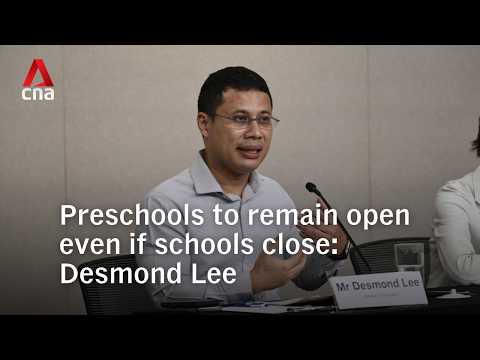
Watch on YouTube: Preschools to remain open even if haze hits hazardous levels: Desmond Lee, by CNA.
It runs about nine minutes, for a parent who wants the reasoning in the Minister’s own words.
Below 300, it is your call, and MOH’s column in the table is the fairest guide. For children, its advice moves from cutting long or strenuous outdoor play once the forecast passes 100 to keeping outdoor time as short as possible past 200.
A child with asthma, or a heart or lung condition, is a different case. SingHealth’s HealthXchange says haze can bring on asthma attacks that may need emergency care. MOE’s haze management page notes that children respond differently to haze. It asks parents to make sure a child always has their medicine with them, such as an inhaler for asthma, or to care for the child at home.
During a haze spell, NEA puts out a haze advisory each evening with the 24-hour PSI forecast for the next day. In 2026 the advisories started on the evening of 4 September, the day the PSI turned unhealthy for the first time since October 2023. Check the forecast on haze.gov.sg, NEA’s website or NEA’s myENV app before you plan the morning.
For MOE’s schools, MOE says a closure is announced at around the same time as the health advisory, and that the notice can be short. The Minister also warned that fake messages about school closures have gone round on social media. Go by MOE’s official channels, Parents Gateway (the app MOE schools use to message parents) and your own centre, not by a forwarded message in a chat group.
None of the six official haze advisories behind this guide mentions fees or attendance. They are ECDA’s three answers on haze, NEA’s release of 4 September 2026, MOE’s haze management page and the Minister’s remarks of 16 October 2026. So those pages set no rule that waives or refunds a fee for a day your child stays home, and the answer sits with your centre.
Ask before the next hazy week, not on the night. The questions in the next section start with this one.
If you are the one staying home, ECDA has answered the leave question directly. Asked whether parents can use their workplace’s unrecorded leave when a preschool closes for haze, it advises parents to raise it with their employer and agree on an arrangement. Unrecorded leave is time off an employer gives without taking it from your annual leave.
ECDA also points parents to the childcare leave page of MOM, the Ministry of Manpower. Eligible working parents of a Singapore citizen child under 7 get 6 days of paid childcare leave a year (as of August 2026). An increase was announced at the 2026 National Day Rally, so check MOM’s page for the number that applies to you.
ECDA tells every licensed centre to follow the haze guidelines in its Code of Practice, so how your centre does it is a fair question to ask. We would ask these on a clear day, when the staff have time to answer:
Write the answers down, or ask for them in a message. Whatever the fee answer is, you will know it before the forecast turns, not after.
The simplest protection is time indoors: staying inside when the PSI is high cuts a child’s exposure. That line, and most of the advice below, is from HealthXchange, SingHealth’s health site, in a page on children and haze that quotes doctors from KK Women’s and Children’s Hospital (KKH).
If there is a baby at home too, KKH’s emeritus neonatology consultant, Clinical Professor Victor Samuel Rajadurai, says an air-conditioned room all day is safe at 22 to 24°C, not 18 to 19°C. He also says a baby’s bed should have no protective curtains or covers around it, because they do not block tiny haze particles and can make the baby overheat.
The trip to preschool is short, and the advice treats it that way. NEA’s release says N95 masks, the tight-fitting kind made to seal around the face, are not needed for short exposure, such as the commute from home to school, or indoors.
For a child, a mask does less than parents expect. HealthXchange says most N95 masks do not fit children properly, so their protection is unreliable, and there is no international certification standard for children’s N95 masks. Surgical masks do not filter PM2.5. A mask must never be put on a baby, indoors or out.
If your child cannot avoid being outdoors, the mask has to be the right size and fit for their age. Our guide to kids’ N95 and KN95 masks covers the fit test that decides which one to buy.
Plan the route from one indoor place to the next. HealthXchange explains “minimise outdoor activity” this way: moving from one indoor place to another is fine, but parks, sports and playgrounds wait. If you must go out, go at the time of day when the air is usually cleaner, and check haze.gov.sg first.
Haze can make even a healthy child’s eyes itchy, watery or red, and bring a runny or blocked nose, sneezing, a dry or sore throat, a dry cough or difficulty breathing. KKH’s respiratory medicine senior consultant, Adjunct Assistant Professor Thomas Biju, says milder symptoms should settle on their own once the child’s exposure is cut down.
If symptoms carry on or get worse, take your child to a doctor. A child with asthma should follow their asthma action plan if the PSI passes 100 and they start coughing, wheezing or getting breathless. For the centre’s side of a child who falls ill, our guide to the preschool policy for a sick child covers when a centre sends a child home.
At a forecast of 300 or more, the Minister said MOE will consider closing schools and moving younger students, from preschool up to secondary school, to home-based learning. The Kindergarten programme itself is suspended at that level. The MOE Kindergarten and its Kindergarten Care (KCare) still stay physically open for children who need to be there.
The advice to stay home at 300 or more names infants as well as young children. HealthXchange calls newborns extremely vulnerable in the haze, and asks for extra care with babies born early, babies with a heart condition from birth, and babies who need oxygen or breathing support.
For those babies, KKH’s Professor Rajadurai advises seeing the paediatrician early if a cough worsens or breathing becomes hard, rather than putting it down to the haze.

Preschool
Ten preschool campuses in Singapore say on their own websites that they run the International Baccalaureate Primary Years Programme (IB PYP), and…
Preschool
If your child was hurt at a preschool in Singapore, the centre has to tell you. The Early Childhood Development Agency (ECDA)…
Preschool
An international kindergarten in Singapore costs roughly S$24,000 to S$46,000 a year for a five day week, and that is tuition alone….