
Toddler
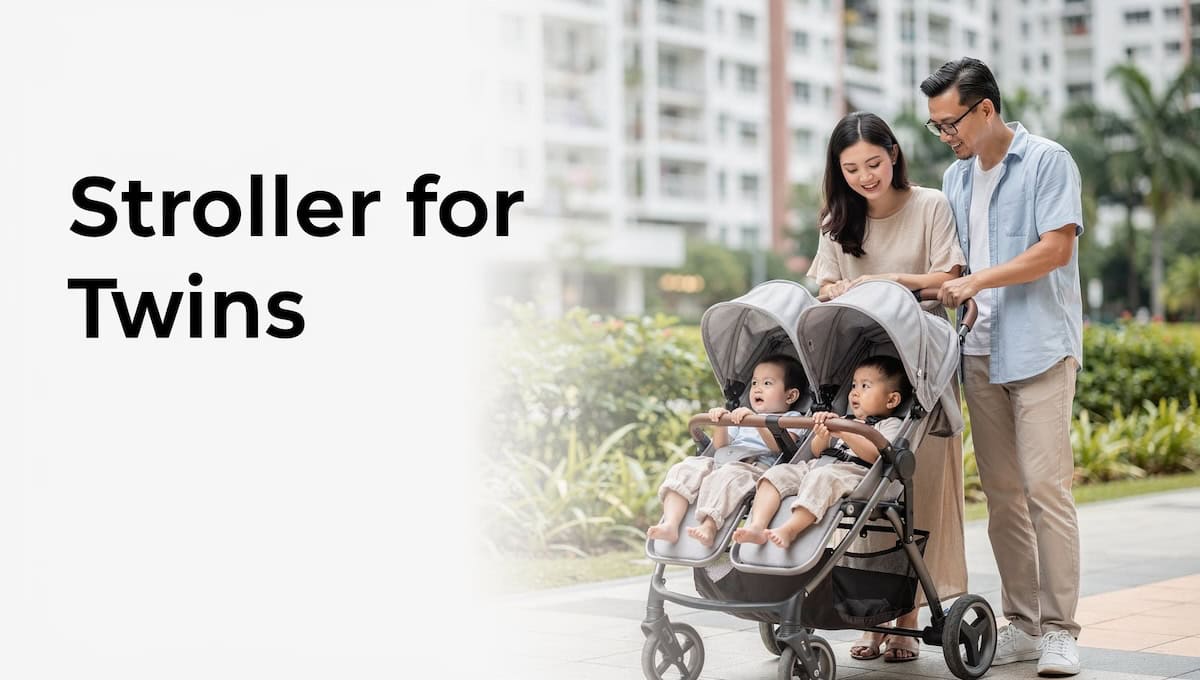
Double the Fun: Best Strollers for Twins
Explore the best stroller for twins options in Singapore for comfort, safety, and convenience on every family outing.
Toddler
Full-day childcare in Singapore is capped at S$610 a month at an Anchor Operator centre and S$650 at a Partner Operator centre, before GST, the Goods and Services Tax, and before any subsidy (as of September 2026). Full-day infant care is capped at S$1,235 and S$1,290. What you pay is that fee minus two subsidies…
Full-day childcare in Singapore is capped at S$610 a month at an Anchor Operator centre and S$650 at a Partner Operator centre, before GST, the Goods and Services Tax, and before any subsidy (as of September 2026). Full-day infant care is capped at S$1,235 and S$1,290.
What you pay is that fee minus two subsidies from the Infant and Child Care Subsidy Scheme. A Singapore Citizen child draws a flat Basic Subsidy of S$300 for childcare, or S$600 for infant care, where the main applicant works. On top of that sits a means-tested Additional Subsidy of up to S$467 or S$710, meaning an amount worked out from what your household earns.
A household on S$3,000 a month or less draws the maximum. The amount falls at every income step above that, and above S$12,000 the Additional Subsidy stops. The tables below give the figure at every band, for childcare and for infant care, and the minimum you pay whatever your subsidy comes to.
A fee cap is a ceiling ECDA sets on what a centre may charge. The Early Childhood Development Agency (ECDA) is the agency that licenses preschools and runs the subsidies, and our guide to what ECDA does covers its wider role. The cap arrives as a condition of funding: ECDA funds selected operators under two schemes, the Anchor Operator Scheme and the Partner Operator Scheme, and an operator that takes the money keeps to the ceiling.
| Programme | Anchor Operator (AOP) | Partner Operator (POP) |
|---|---|---|
| Full-day childcare | S$610 | S$650 |
| Full-day infant care | S$1,235 | S$1,290 |
| Half-day childcare | Not published on ECDA’s Anchor Operator page | S$490 |
| Half-day infant care | Not published on ECDA’s Anchor Operator page | S$950 |
The Partner Operator caps took effect on 1 January 2026, and ECDA says a Partner Operator centre may not raise fees past them, with any increase inside the cap needing ECDA’s approval. MSF puts the childcare reduction at 15 per cent since 2020.
Which scheme a centre sits on is one of the things to settle on a first visit. Our guide to choosing a childcare centre covers the rest of that visit.
Both subsidies come from one scheme, the Infant and Child Care Subsidy Scheme, which ECDA runs for infant care and childcare places. Five terms do all the work on this page, and ECDA uses them exactly. Everything in the band tables is one of these.
Subsidies go straight to the preschool, so the bill you receive is already net of them. One condition is easy to miss: the child must attend for at least one day in a month to draw subsidy for that month. ECDA’s subsidy overview page is where all of this is set out officially.
This is the table the headline figures come from. Read across your income row: the Basic Subsidy is the same for every working household, the Additional Subsidy shrinks as income rises, and the last column is the floor underneath both.
| Gross monthly household income | Or per capita income | Basic Subsidy | Additional Subsidy, maximum | Minimum co-payment |
|---|---|---|---|---|
| S$3,000 and below | S$750 and below | S$300 | S$467 | S$3 |
| S$3,001 to S$4,500 | S$751 to S$1,125 | S$300 | S$440 | S$25 |
| S$4,501 to S$6,000 | S$1,126 to S$1,500 | S$300 | S$340 | S$58 |
| S$6,001 to S$7,500 | S$1,501 to S$1,875 | S$300 | S$260 | S$104 |
| S$7,501 to S$9,000 | S$1,876 to S$2,250 | S$300 | S$190 | S$162 |
| S$9,001 to S$10,500 | S$2,251 to S$2,625 | S$300 | S$130 | S$232 |
| S$10,501 to S$12,000 | S$2,626 to S$3,000 | S$300 | S$80 | S$315 |
| Above S$12,000 | Above S$3,000 | S$300 | None | Not applicable |
| Non-working main applicant, any income | Any | S$150 | None | Not applicable |
Two things in that table are worth slowing down for.
The first is the shape of the ladder. The Additional Subsidy steps down by between S$27 and S$100 at each band, and the floor steps up at the same time. A pay rise that carries a household from S$7,500 to S$7,600 a month costs S$70 of subsidy and lifts the co-payment floor by S$58. That is the arithmetic behind a fee letter that changes without the centre changing its price.
The second is what actually changed on 1 January 2026. The maximum Additional Subsidy at each band is the same as it was in 2025. The minimum co-payment is not. ECDA’s own subsidy rate table publishes both years side by side, and the floor came down at five of the seven bands.
| Gross monthly household income | 2025 | From 1 January 2026 |
|---|---|---|
| S$3,000 and below | S$3 | S$3 |
| S$3,001 to S$4,500 | S$25 | S$25 |
| S$4,501 to S$6,000 | S$85 | S$58 |
| S$6,001 to S$7,500 | S$143 | S$104 |
| S$7,501 to S$9,000 | S$206 | S$162 |
| S$9,001 to S$10,500 | S$272 | S$232 |
| S$10,501 to S$12,000 | S$339 | S$315 |
So the 2026 improvement went to middle-income households, and it arrived through the floor rather than through the headline. A family at S$8,000 a month keeps S$44 more each month than it did in 2025, on the same subsidy entitlement.
Infant care covers a child from 2 to 18 months, and it carries the highest fee cap on ECDA’s Anchor Operator and Partner Operator pages. The subsidies are larger to match, but not in proportion. The Basic Subsidy is exactly double the childcare one, S$600 against S$300. The maximum Additional Subsidy is higher and not double: S$710 against S$467.
| Gross monthly household income | Or per capita income | Basic Subsidy | Additional Subsidy, maximum | Minimum co-payment |
|---|---|---|---|---|
| S$3,000 and below | S$750 and below | S$600 | S$710 | S$40 |
| S$3,001 to S$4,500 | S$751 to S$1,125 | S$600 | S$640 | S$110 |
| S$4,501 to S$6,000 | S$1,126 to S$1,500 | S$600 | S$500 | S$250 |
| S$6,001 to S$7,500 | S$1,501 to S$1,875 | S$600 | S$380 | S$360 |
| S$7,501 to S$9,000 | S$1,876 to S$2,250 | S$600 | S$240 | S$500 |
| S$9,001 to S$10,500 | S$2,251 to S$2,625 | S$600 | S$100 | S$640 |
| S$10,501 to S$12,000 | S$2,626 to S$3,000 | S$600 | S$40 | S$700 |
| Above S$12,000 | Above S$3,000 | S$600 | None | Not applicable |
| Non-working main applicant, any income | Any | S$150 | None | Not applicable |
Now put the two tables beside each other. At an Anchor Operator centre the infant care cap is S$625 a month higher than the childcare cap, and the Basic Subsidy is only S$300 higher. A working household above the Additional Subsidy ceiling therefore carries S$325 more a month for the same child, purely for being at the younger stage.
Lower down the ladder the co-payment floor widens the gap again. At S$6,001 to S$7,500 a month, the floor is S$104 for childcare and S$360 for infant care.
There is a reason the infant care side feels stuck. ECDA’s rate table carries a footnote on the infant care section: there have been no changes to infant care subsidies since 1 January 2023. The caps tell the same story. The S$1,235 and S$1,290 ECDA publishes today are the figures it set for 1 January 2023. So childcare co-payments came down for 2026 and the infant care numbers stayed where they were, which widened the distance between the two stages.
Relief for this stage has been announced, and it is years out. The Government said at the 2026 National Day Rally that full-day infant care fees at Government-supported centres will come down to S$300 a month before means-testing, rolled out progressively from 2028 with the target levels expected by 2030. Implementation timelines are due in early 2027. None of it is in force, so it changes nothing on a fee letter today.
ECDA and MSF each publish a worked example, at opposite ends of the income ladder. Between them they show how the floor behaves at the bottom and what a household above the ceiling is left paying.
A household on S$3,000 a month or less. ECDA’s example takes a working mother with a child in full-day childcare and a programme fee of S$740. She qualifies for S$300 of Basic Subsidy and S$467 of Additional Subsidy, which is S$767, more than the fee itself. The bill does not come to zero. The minimum co-payment for that band is S$3, so the subsidy actually paid is S$737 and the family transfers S$3.
A household on S$12,500 a month. MSF’s example takes a median-income household with two children in Anchor Operator childcare. Their total out-of-pocket fees for both children are S$730 a month in 2026. That works out at S$365 a child.
The second example is the one to sit with, because S$12,500 is above the S$12,000 ceiling. That household draws the Basic Subsidy and nothing else. Notice that S$365 a child is S$55 more than the S$310 you get from the Anchor Operator cap of S$610 minus a S$300 Basic Subsidy. Neither ECDA nor MSF breaks that S$730 down, so we cannot tell you what the S$55 is. ECDA’s caps exclude GST, so the ceiling is never the whole bill. Budget from a centre’s own quote, not from the cap.
The short answer is no. The Additional Subsidy needs the main applicant to be working at the point of application, so a household without that draws the S$150 Basic Subsidy and nothing more. On the infant care table that is the difference between S$150 and up to S$1,310 a month.
ECDA publishes two ways round it, and both are worth checking before you assume the subsidy is gone.
The first is automatic and narrow. Since 9 December 2024, a family with a Singapore Citizen child in a childcare programme and a gross monthly household income of S$6,000 or below, or per capita income of S$1,500 or below, qualifies for full childcare subsidies whatever the main applicant’s working status. ECDA sets that route out for childcare. A child in infant care goes through the second route instead.
The second is Special Approval, which grants higher subsidies for a limited period where the main applicant cannot work for a stated reason. ECDA’s list runs to looking for a job, studying or training for at least 56 hours a month, pregnancy, being medically unfit for work, caring for a child with special needs, caring for a sick family member who needs a full-time carer, caring full-time for a younger child aged 24 months or below who is not in preschool, and incarceration. Supporting documents are usually needed, and how long the higher rate lasts depends on the circumstances. Families renting under HDB’s Public Rental Scheme, or on ComCare Short-to-Medium-Term or Long-Term Assistance, get maximum subsidies under Special Approval until the next fixed point of assessment.
The working-status link is due to go. At the 2026 National Day Rally the Government said full childcare and infant care subsidies will be extended to families with Singapore Citizen children whatever the applicant’s working status. Details are promised for early 2027. Until they arrive, the two routes above are what a household has.
Both tables above have a known expiry. At Budget 2026 the Government said it would raise the monthly household income threshold for means-tested preschool subsidies to S$15,000, from the start of the following year, benefiting more than 60,000 families.
MSF put a date and a shape on it. From January 2027 the gross monthly household income ceiling for the Additional Subsidy rises to S$15,000, and the income thresholds for every subsidy tier are raised as well, to reflect how household incomes have moved. That second half matters more than the headline for anyone already inside the scheme: it is the whole ladder shifting, not just its top rung.
MSF carried its S$12,500 household through the change. Their total out-of-pocket fees for two children in Anchor Operator childcare fall from S$730 in 2026 to S$470 in 2027, a cut of 35 per cent. A household at that income draws no Additional Subsidy today and will draw one from January 2027.
The Budget statement also says eligible parents, including those who already qualified, can receive more in infant care and childcare subsidies. Neither document publishes the new band tables, so there is no honest way to tell you your own 2027 figure yet. The new rates will appear on ECDA’s rate table when they are set.
Partly, and the part it covers is the one that lands first. The Child Development Account (CDA) is the Baby Bonus savings account held in a child’s name, and MSF says you can pay a childcare centre’s or kindergarten’s deposit and registration fees from it by NETS or GIRO, provided the centre is a Baby Bonus Approved Institution.
Two practical notes from the same answer. Most centres collect those fees by GIRO rather than NETS, and a GIRO application can take up to six weeks to process, so a centre may ask you to pay cash to hold the place in the meantime. Ask the centre about its registration policy and payment modes before you register, not after.
The tables above get you to a band. One login gets you to a figure.
One last note on scope. This page covers infant care and childcare, the two programmes the Infant and Child Care Subsidy Scheme pays for. Kindergarten sits under a different fee cap and a different assistance scheme. The S$150 target announced for full-day childcare belongs to the same 2028 to 2030 roll-out as the infant care one above. Our preschool fees guide covers both.

Toddler
Explore the best stroller for twins options in Singapore for comfort, safety, and convenience on every family outing.

Toddler
A parenting workshop helps you gain confidence, practical skills, and local support to tackle parenting challenges effectively.

Toddler
Discover parenting support strategies and tools to guide families confidently through every stage of the parenting journey.