
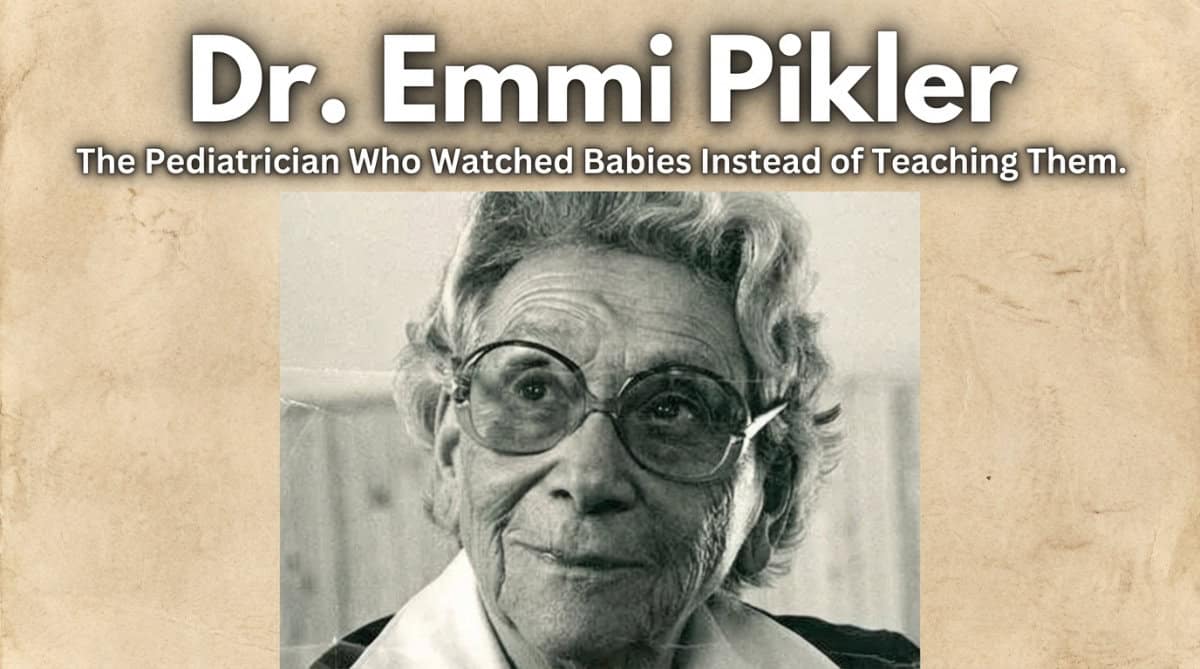
In 1920s Vienna, a young medical student named Emmi Pikler noticed something odd in the hospital’s accident statistics. Poor children who played freely in the streets had fewer broken bones than wealthy children raised by governesses. The rich kids were carefully supervised, positioned, propped. The poor kids fell, scrambled, climbed, tumbled—and somehow emerged tougher, more coordinated, less fragile.
That observation changed how we think about babies.
By the time Pikler died in 1984, she’d spent decades proving that babies don’t need to be taught to move. They need to be trusted to move. She demonstrated this not with her own children (though she started there), but with over 2,000 orphaned babies at an institution in Budapest that became world-famous for producing healthy, confident children where other orphanages produced developmental disasters.
For Singapore parents conditioned to believe that earlier is better—earlier enrichment, earlier milestones, earlier everything—Pikler’s philosophy feels almost dangerous: Do less. Observe more. Let your baby lead.
From Personal Tragedy to Revolutionary Insight
Emmi Pikler was born on January 9, 1902, in Vienna, the only child of a Viennese kindergarten teacher and a Hungarian craftsman. When Pikler was twelve, her mother died. The loss shaped everything that followed.
In 1908, her family had moved to Budapest. After her mother’s death in 1914, Pikler eventually returned to Vienna to study medicine, earning her medical degree in 1927 at age 25. Her pediatric training happened at Vienna University Children’s Hospital under two physicians who would profoundly influence her work: Clemens von Pirquet and Hans Salzer.
Von Pirquet taught her that preventing illness mattered more than curing it. Salzer showed her that medical examinations didn’t need to be impersonal—you could talk to a child, explain what you were doing, ask for cooperation. Both revolutionary ideas at the time.
But it was those accident statistics that gave Pikler her hypothesis: maybe children who develop movement naturally, without adult interference, develop better balance, better body awareness, better judgment about what they can and can’t do.
In 1931, Pikler and her husband György—a mathematician and high school teacher with progressive educational views—had their first child, Anna. They decided to test Pikler’s theory. No propping Anna to sit. No holding her hands to practice walking. No positioning her into shapes her body couldn’t achieve independently.
Just space, time, and trust.
Anna thrived. She moved confidently, gracefully, at her own pace. Pikler took careful notes. This wasn’t just parenting—it was research.
From Family Practice to Global Laboratory
In 1935, Pikler qualified as a paediatrician in Budapest and opened a private practice. For ten years, she worked with select families, making weekly home visits, spending hours observing babies, coaching parents to slow down and trust their children’s innate competence.
She published her first book in 1940: “Mit Tud Már a Baba?” (What Can the Baby Already Do? / Peaceful Babies—Contented Mothers). It became a standard text for Hungarian parents.
Then World War II made everything harder. Pikler’s family was Jewish. Her husband György was imprisoned from 1936 to 1945 for political reasons – nine years in prison and concentration camps. With help from the families she served, Pikler and her children survived the persecution. After the war, she gave birth to two more children.
She never reopened her private practice. Instead, in 1946, the Budapest city government asked her to run a residential nursery for babies orphaned or abandoned after the war. She agreed on one condition: she could hire and train her own staff.
The institution opened on Lóczy Street in Budapest. Everyone called it Lóczy.
Pikler’s goal: prove that institutional care didn’t have to damage children. At the time, orphanages were synonymous with “failure to thrive”—babies who didn’t die often became withdrawn, delayed, damaged. The research was grim. The expectations were low.
Pikler set about changing that.
The Lóczy Miracle
Lóczy housed up to 70 babies and toddlers at a time, ages birth to three (some stayed longer). Over 65 years, more than 2,000 children lived there before it transitioned to a daycare center in 2011.
What made Lóczy different:
Primary caregiving. Each baby had one consistent caregiver responsible for all personal care—feeding, diapering, bathing, dressing. Not whoever was available. One person. Predictable, reliable, present.
Unhurried care routines. Diaper changes weren’t tasks to rush through. They were relationship time. Caregivers narrated what they were doing, waited for the baby’s cooperation, treated each interaction as sacred. “I’m going to lift you now. Can you help by bending your knee?”
Complete freedom of movement. Babies were always placed on their backs on firm surfaces, never in containers, never propped. No walkers, no bouncy seats, no sitting them up before they could sit independently. They rolled when ready, crawled when ready, walked when ready – all on their own timeline.
Uninterrupted play. Babies spent large portions of the day playing alone or with other babies, exploring simple objects—wooden rings, fabric balls, household items. Caregivers watched from nearby but didn’t entertain, didn’t teach, didn’t intervene unless safety required it.
Visitors from around the world came to Lóczy expecting to find delayed, detached children. Instead they found babies who were alert, curious, physically coordinated, emotionally secure. A 1968 World Health Organisation study tracked Lóczy children into adulthood—they were functioning normally, holding jobs, forming relationships, raising families.
This should have been impossible.
Pikler documented everything. She filmed babies, tracked motor development, published research showing that babies who moved freely developed better posture, better coordination, fewer injuries. She wrote books, trained staff from other institutions, gave lectures internationally.
Her daughter Anna Tardos eventually joined Lóczy’s staff, worked alongside her mother, and after Pikler retired in 1978, continued the work. Anna is now in her 90s, still sharp, still teaching, still correcting misconceptions about her mother’s philosophy.
Pikler died on June 6, 1984, after a brief illness. She was 82. But her work didn’t end.
What Pikler Actually Taught
Pikler’s philosophy rests on two foundations:
1. Respectful care creates secure attachment.
Every diaper change, every meal, every bath is an opportunity to show a baby that their body belongs to them, that adults can be trusted, that cooperation feels better than compliance. Slow down. Make eye contact. Narrate. Wait. Involve the baby as an active participant, not an object to be processed.
This wasn’t just about being nice. Pikler understood—decades before attachment theory became mainstream—that security comes from predictable, responsive relationships. Orphaned babies at Lóczy formed secure attachments to their caregivers not despite institutional care, but because the care was deeply, consistently respectful.
2. Free movement develops capable, confident children.
Babies know what they’re ready to do. When you prop them into positions they can’t achieve themselves, you rob them of the struggle that builds strength, the problem-solving that builds intelligence, the mastery that builds confidence.
Pikler babies weren’t left alone to figure everything out. The environment was carefully designed—safe, interesting, appropriately challenging. Caregivers observed closely. But they didn’t teach sitting, standing, walking. They trusted the baby’s inner drive to move, to explore, to grow.
The result? Children with remarkable body awareness, balance, and judgment. Children who rarely fell or hurt themselves because they knew their limits. Children who played peacefully for extended periods because they’d learned to entertain themselves.
Why Singapore Parents Should Pay Attention
Singapore’s early childhood landscape is changing. Preschools like Rainbow Cove, First Steps Preschool, and Greentree Montessori have incorporated Pikler principles into their infant care programs. The approach is spreading quietly through parent workshops, training programs, early childhood educators discovering that what Pikler taught in 1940s Budapest still works in 2020s Singapore.
Here’s why it matters:
It contradicts everything you’ve been told about helping babies develop. No tummy time? No practising sitting? No baby walkers? Pikler says all of that interferes with natural development. Put your baby on their back. Give them space. Watch what happens.
It requires you to slow down in a culture that values speed. A proper diaper change, Pikler-style, takes five minutes. Not two. You’re building a relationship, not checking a task off a list. For time-starved Singapore parents, this feels impossible. Pikler would say: you don’t have time NOT to do it this way.
It values observation over intervention. When your baby struggles to reach a toy, every instinct says to hand it to them. Pikler says wait. They might figure it out. They might not. Either way, they’re learning. Can you sit there and do nothing while your baby works through frustration? That’s the hard part.
It trusts babies in a culture that doesn’t. Singapore parents fear falling behind. Pikler says children develop at their own pace and that’s exactly as it should be. The baby who walks at 10 months isn’t smarter than the one who walks at 15 months. They’re just different.
It works for institutional care – which means it works anywhere. If orphaned babies in 1940s Budapest could thrive using these principles, your baby with two loving parents and every advantage can definitely benefit.
The Pikler Triangle and Other Practical Tools
One visible symbol of Pikler’s philosophy: the wooden climbing triangle now called the “Pikler triangle.” It’s a simple A-frame structure with rungs that babies and toddlers can climb. No instructions. No “correct” way to use it. Just an invitation to explore.
You’ll see versions in Singapore preschools and increasingly in homes. The point isn’t the triangle itself—it’s what the triangle represents: trust that children will challenge themselves appropriately if given safe opportunities.
Other Pikler-inspired practices making their way into Singapore homes:
- Floor beds instead of cribs (once babies are mobile)
- Simple, open-ended toys instead of battery-powered entertainment
- Observation before intervention during play
- Involving babies in their own care from birth
- Predictable routines that help babies know what to expect
Rainbow Cove Preschool, with six locations across Singapore, explicitly adopts the Pikler approach. First Steps Preschool bases its curriculum on Pikler and Magda Gerber (Pikler’s student who brought these ideas to America). Greentree Montessori combines Pikler principles with Montessori methods in their infant programs.
Parents don’t need to enroll their children anywhere to apply Pikler’s wisdom. Just slow down during care routines. Stop propping and positioning. Let your baby move freely on a safe surface. Watch before you help.
What Critics Get Wrong
Some parents and professionals worry that Pikler’s approach is too passive. “What about tummy time? Don’t babies need that for development?”
Pikler would say: babies placed on their backs will roll to their tummies when they’re ready. Forcing them there before they can get there themselves doesn’t accelerate development—it creates frustration. Babies who develop movement naturally spend plenty of time on their tummies, just on their own schedule.
Others worry it’s too slow for modern life. Who has time to turn every diaper change into a five-minute relationship moment?
Pikler would answer: you’re already changing diapers. You can do it in two minutes while thinking about work, treating your baby like an object, teaching them their needs don’t matter. Or you can do it in five minutes with full presence, building trust, showing respect. Those three extra minutes compound over thousands of interactions.
The real criticism should be: this is incredibly hard in practice. Watching a baby struggle without jumping in to help goes against every parental instinct. Trusting a ten-month-old to know their physical limits feels reckless. Believing that doing less actually produces better outcomes contradicts decades of cultural messaging.
But the research backs Pikler. The WHO studies back her. The 2,000+ children raised at Lóczy back her. Modern attachment research backs her. Neuroscience backs her.
Her Quiet Revolution
Pikler never sought fame. She sought to improve the lives of babies, particularly the most vulnerable ones. She published in Hungarian medical journals, trained staff at other institutions, gave lectures to anyone who asked. But she stayed focused on the work at Lóczy, refining her approach, collecting data, proving that respect and trust could transform institutional care.
Magda Gerber brought Pikler’s ideas to America, founding Resources for Infant Educarers (RIE) in 1978. That’s how Pikler’s philosophy spread to the English-speaking world. But even now, many parents know about “RIE parenting” without realising it originated with a Hungarian paediatrician running an orphanage.
Pikler’s legacy lives in the thousands of children who passed through Lóczy. In the educators worldwide who train in the Pikler approach. In the preschools in Singapore and elsewhere incorporating these principles. In the parents who’ve discovered that slowing down and trusting their babies actually works.
Anna Tardos, now 93, continues teaching, correcting, and clarifying. The Pikler Institute (as Lóczy was renamed) still offers training to educators from around the world. The approach keeps spreading, quietly, parent by parent, educator by educator.
What We Can Learn
You don’t have to become a Pikler purist. You don’t have to throw out every baby seat or eliminate tummy time or change your entire parenting philosophy.
But you can borrow what makes sense:
Slow down during care. Those routine moments—feeding, changing, bathing—aren’t interruptions. They’re the relationship.
Trust before teaching. Before you show your baby how to do something, pause. Maybe they’ll figure it out themselves.
Create space for struggle. A baby working hard to reach a toy is a baby building capability. Don’t rob them of that.
Observe. Really watch your baby. What are they working on? What interests them? What are they capable of that you didn’t realise?
Question the rush. Does it matter if your baby sits at six months or eight months? Walks at ten months or fourteen? Or have you absorbed cultural anxiety about milestones that don’t actually matter?
Emmi Pikler lost her mother at age twelve—a loss that shaped her empathy for vulnerable children. She spent her career proving that orphaned babies could thrive if cared for with respect and trust. She died believing that all babies—not just the lucky ones with loving parents—deserve to be treated as competent human beings from birth.
In Singapore’s high-achievement parenting culture, that message feels both foreign and necessary. Maybe the baby who needs nothing but space, time, and respect will develop exactly as they should.
Further Resources
Organizations:
- Pikler/Lóczy USA: www.pikler.org
- Pikler UK Association: www.pikler.co.uk
- The Pikler Collection: thepiklercollection.weebly.com (comprehensive English-language resource)
Singapore Preschools Using Pikler Approach:
- First Steps Preschool – Inspired by Pikler and Magda Gerber (RIE)
- Greentree Montessori – Combines Montessori, RIE, and Pikler approaches