
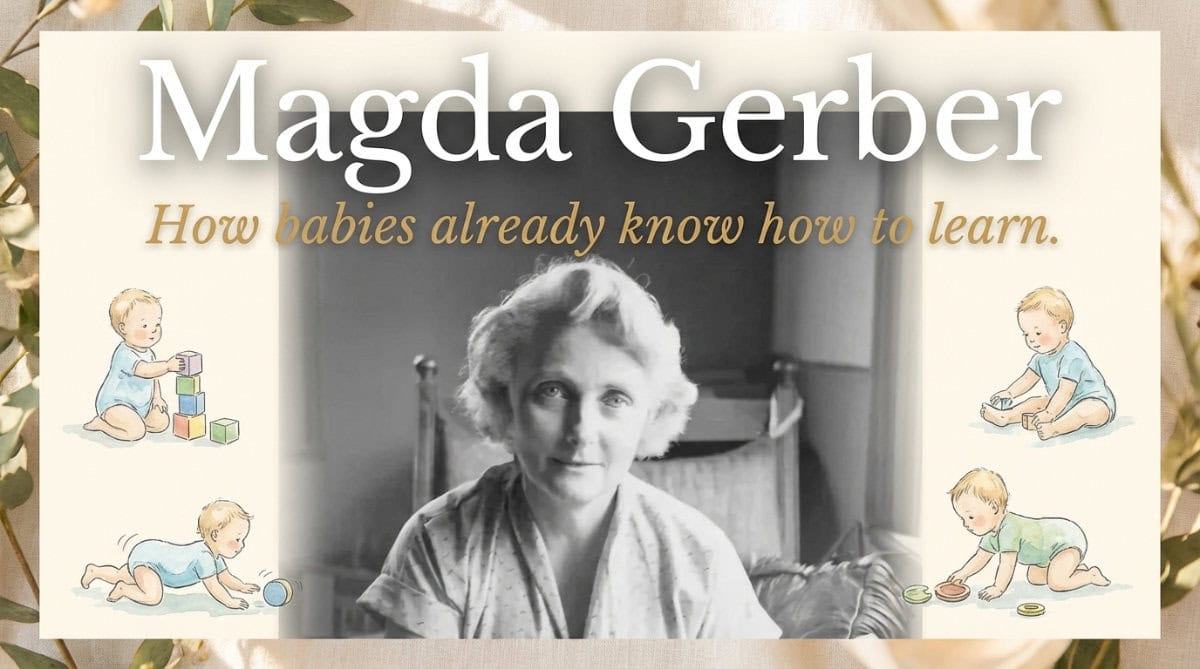
When a paediatrician came to check on Magda Gerber’s sick two-year-old daughter in 1940s Budapest, something unusual happened. The doctor spoke directly to the child. Not over her head to the mother. Not with baby talk. She explained what she was doing, waited for cooperation, and treated this toddler like a person who deserved respect.
Gerber never forgot that moment. The paediatrician was Emmi Pikler, and she would become Gerber’s mentor, collaborator, and the inspiration for a philosophy that would eventually challenge everything Western culture believed about babies.
By the time Gerber died in 2007 at age 96, she’d spent four decades teaching American parents something radical: babies don’t need to be entertained, stimulated, or taught. They need to be respected.
For Singapore parents drowning in enrichment class options and worried about falling behind the competition, Gerber’s message feels almost subversive. Stop doing so much. Start observing more. Your baby already knows how to learn.
From Budapest to Refugee Camp to Revolutionary
Magda Gerber was born November 1, 1910, in Budapest, into an upper-middle-class family. Her childhood was privileged—nannies who spoke French and German, a progressive kindergarten, parents who valued intellectual development. She studied linguistics at the Sorbonne in Paris, married young, and had three children.
Then Dr. Pikler walked into her life. Gerber was so impressed by Pikler’s respectful approach that she asked her to become the family’s regular paediatrician. Later, inspired by what she’d witnessed, Gerber earned a master’s degree in early childhood education in Budapest. She remained connected to Pikler’s work and philosophy, though the extent of her direct involvement at the Lóczy Institute (the residential nursery Pikler founded in 1946 for orphaned babies) remains debated among historians.
Lóczy became famous for something that seemed impossible: institutionalised babies who thrived. No “failure to thrive.” No developmental delays. These children were healthy, curious, confident—raised by caregivers who treated routine care moments as sacred time for building relationships.
But Hungary was changing. After the 1956 Hungarian Revolution, the Communist takeover made staying dangerous. Gerber’s husband was imprisoned as a political prisoner. Her teenage daughter was jailed after being caught trying to cross the border.
The family escaped to Austria, then emigrated to the United States in 1957. Gerber had worked as an interpreter at the American Embassy in Vienna while waiting to emigrate. They were placed at Camp Kilmer, a refugee camp in New Jersey, before moving to Boston for a year where Gerber worked as an interpreter at Harvard University. Eventually, they settled in Los Angeles, where Gerber started over at age 47.
She worked with children who had cerebral palsy at Children’s Hospital. Then spent seven years at the Dubnoff School with autistic children, developing relationships with kids nobody else could reach. According to her later writings, these extremely disturbed children responded to the same respectful approach she’d learned from Pikler.
In 1972, Thomas Forrest, a pediatric neurologist at Stanford, invited her to co-direct the Demonstration Infant Program in Palo Alto. They worked with at-risk infants and their families, teaching parents to observe and respond rather than constantly intervene.
In 1978, Gerber and Forrest founded Resources for Infant Educarers—RIE (pronounced “wry”) – in Los Angeles. She was 68 years old and just getting started.
The Philosophy: Babies as “Honoured Guests”
Gerber coined the term “Educaring”—a blend of educating and caring that captured her belief that every diaper change, every feeding, every bath is an opportunity for learning and connection.
Her core principles sound simple but feel revolutionary in practice:
Babies are competent from birth. Not helpless blobs waiting to be moulded. Not blank slates. Whole human beings who deserve the same respect you’d give any person.
Slow down during care routines. The average baby gets diapered about 7,000 times. Each one is a chance to build trust, teach cooperation, and show your baby that their experience matters. Or it’s a chance to rush through while scrolling your phone, treating your baby like an object to be processed.
Observe before you intervene. When your baby fusses, pause. When they struggle with a toy, wait. They might figure it out. They might not need you to swoop in. That moment of struggle—that’s learning.
Let babies move freely. No walkers. No bouncy seats. No propping them into positions they can’t get into themselves. Babies who develop movement naturally develop better balance, better body awareness, and better judgment about what they can and can’t do.
Create space for uninterrupted play. Put your baby in a safe space with simple objects. Then sit nearby and watch. Don’t entertain. Don’t teach. Let them explore. They’ll show you what they’re ready to learn.
The philosophy has a name that sounds almost passive: “selective intervention.” Gerber taught parents to think like a traffic light. Green light: your baby’s handling it, don’t interfere. Yellow light: watch closely, they might need help. Red light: someone’s about to get hurt, step in calmly.
What This Looks Like in Real Life
Here’s where Gerber’s approach gets practical—and where it either clicks or feels impossible.
During diaper changes: Instead of speed-racing through the task while your baby squirms, you narrate what’s happening. “I’m going to pick you up now. We’re going to change your diaper. Can you lift your bottom? Thank you.” You wait for cooperation. You involve them.
Yes, this takes longer. That’s the point. These aren’t interruptions to your day. They’re the relationship.
During play: You sit nearby with a book or your coffee. Your baby lies on their back on a mat, looking at their hands, mouthing a toy, rolling to their side. You watch. You don’t shake a rattle to “stimulate” them. You don’t flip them to tummy time. You trust that what they’re doing is exactly what they need to be doing.
When they’re frustrated: Your baby can’t quite reach a toy. They fuss. Every instinct says to hand it to them. Gerber says wait. “You’re trying to reach that ball. It’s hard. You’re working on it.” Maybe they get it. Maybe they don’t. Either way, they learn persistence, not helplessness.
During feeding: Even with a young baby, you ask for participation. “Are you ready for more? Open your mouth if you want another bite.” You wait. You watch their cues. You don’t distract them with screens or force another spoonful.
The Singapore parent reading this might think: “This sounds lovely in theory, but I have thirty minutes before I need to leave for work, my helper is off, and my toddler just threw his breakfast on the floor.”
Fair enough. Gerber herself acknowledged that nobody does this perfectly. The goal isn’t perfection. It’s intention.
Why This Matters for Singapore Parents
Singapore’s parenting culture runs hot. Enrichment classes at six months. Reading programs at a year. Swimming, music, language classes stacked before the child can walk. The fear of falling behind is real.
Gerber’s philosophy offers permission to step back. Not because ambition is wrong, but because the foundation matters more than the add-ons.
A baby who has spent thousands of interactions being treated as a competent person develops something enrichment classes can’t teach: a deep sense of self-worth. The belief that their actions matter. The confidence to try new things because they’ve been allowed to struggle and succeed (or fail) on their own terms.
This doesn’t mean no classes. It means the everyday moments—the diaper changes you’re already doing, the meals you’re already serving—become the primary curriculum.
It doesn’t mean passive parenting. RIE parents set clear boundaries. They say no. They keep children safe. They just do it respectfully, explaining rather than forcing whenever possible.
It doesn’t mean ignoring Asian values. Respect for elders and family harmony are central to Asian culture. Gerber’s approach adds respect for the youngest members too. When children feel respected, they learn to respect others—not through fear, but through modelling.
The gentle parenting movement gaining traction in Singapore—the workshops at Chapter Zero, the Respectful/Mindful Parenting Facebook groups—draws heavily from Gerber’s work. Parents are discovering that slowing down doesn’t mean falling behind.
The Hard Parts Nobody Mentions
Let’s be honest: this approach is harder than it looks.
It requires patience you might not have. Especially at 3 a.m. when your baby won’t sleep and you just want them to stop crying. Gerber never promised easy. She promised authenticity.
It requires going against cultural norms. When relatives visit and immediately start bouncing your baby, entertaining them, propping them to sit before they can sit independently, you’ll either need to explain your approach or bite your tongue.
It requires trusting that “doing less” is actually doing more. In a culture that values visible achievement, a baby playing quietly alone doesn’t look like learning. But it is.
It requires your full presence. Five minutes of distracted interaction while scrolling Instagram doesn’t count as respectful caregiving. Put the phone down during diaper changes. Actually, look at your baby during feeding. Be there.
For working parents, this is particularly challenging. You might have 90 minutes total with your baby before bedtime. Gerber would say: Make those 90 minutes count. One focused diaper change beats three rushed ones.
The Global Movement She Started
RIE continues in Los Angeles, offering parent-infant classes and professional training. There are RIE Associates worldwide – including in Singapore, where Aletheia Lee teaches Gerber’s Educaring approach.
Gerber’s books, “Dear Parent: Caring for Infants With Respect” and “Your Self-Confident Baby,” are still widely read. Her ideas have influenced countless parenting educators, paediatricians, and early childhood programs.
More importantly, her philosophy has shifted how we talk about babies. The idea that infants deserve respect—that they’re not objects to be molded but people to be honored—has moved from fringe to mainstream.
Not everyone agrees with her methods. Some parents find the approach too slow, too passive, too impractical for modern life. Some researchers question whether free movement alone produces the outcomes Gerber claimed.
But even critics acknowledge her impact. She challenged assumptions. She made parents think about why they do what they do with their babies. She elevated caregiving from a chore to a relationship.
What We Can Take From Her Legacy
You don’t have to become a RIE purist to benefit from Gerber’s wisdom. Here’s what translates:
Caregiving moments are relationship moments. Those 7,000 diaper changes? They’re teaching your baby whether their needs matter, whether they can trust you, whether cooperation feels good.
Babies can handle more than we think. When we constantly rescue, we rob them of competence. A little struggle builds capability.
Observation is a skill. Before you intervene, pause. What’s actually happening? What is your baby working on? They might not need you to fix it.
Respect isn’t just for older children. Even a newborn deserves to be told what’s happening to their body, asked for cooperation, treated as a person.
Slowing down isn’t falling behind. The baby who has secure attachment, body confidence, and self-direction has advantages no flashcard can provide.
Magda Gerber arrived in America as a middle-aged refugee who’d lost everything. She spent the next forty years teaching parents to see what she’d learned from Emmi Pikler: babies are remarkable when we give them the respect and space to show us who they already are.
In Singapore’s high-pressure parenting environment, that message might be exactly what the next generation needs.
Further Resources
Books:
- “Dear Parent: Caring for Infants With Respect” by Magda Gerber and Joan Weaver
- “Your Self-Confident Baby” by Magda Gerber with Allison Johnson
Organizations:
- Resources for Infant Educarers (RIE): www.rie.org
- The Respectful Way Singapore: therespectfulway.com (Aletheia Lee, RIE Associate)
- Chapter Zero Singapore: www.chapterzero.org (Respectful parenting workshops)
Local Support:
- Respectful/Mindful Parenting Singapore Facebook Group
- Chapter Zero workshops and community events