
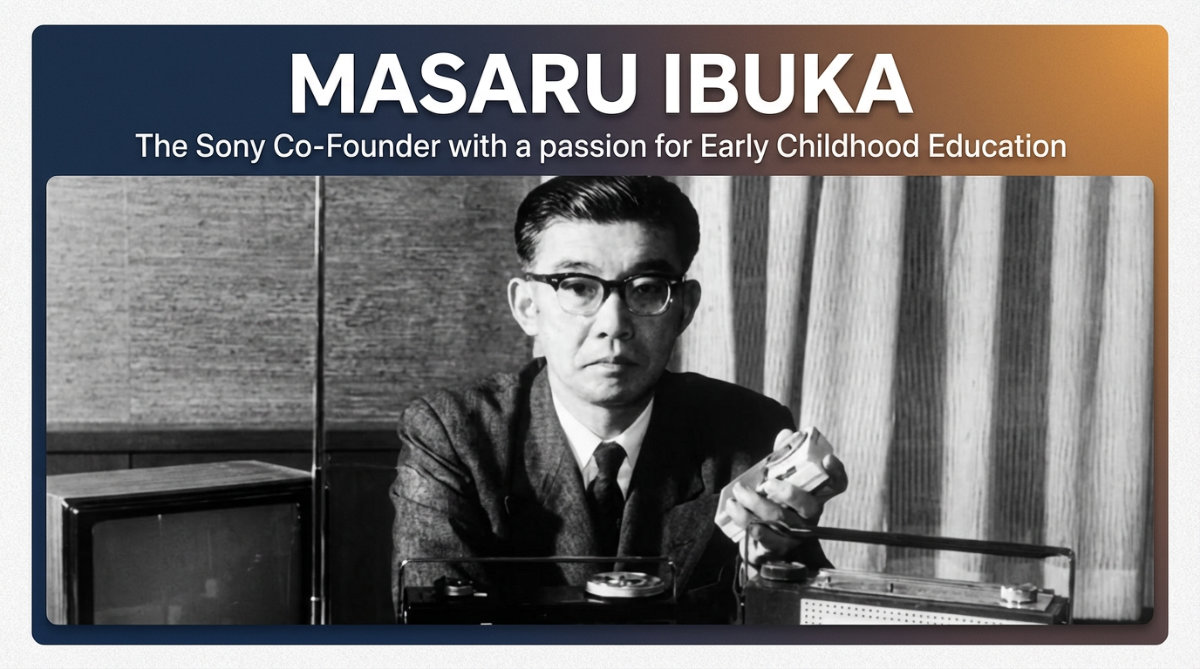
Masaru Ibuka built Sony. He also built something bigger: a worldwide movement that recognised what parents have always suspected—those first few years matter more than we ever imagined.
The co-founder of one of the world’s most innovative electronics companies dedicated the second half of his life to a different kind of innovation. While other corporate titans wrote memoirs about business strategy, Ibuka wrote “Kindergarten is Too Late!”, a book that challenged everything we thought we knew about when children should start learning. His message was simple but revolutionary: by the time a child reaches kindergarten, 70-80% of their brain’s neural pathways have already formed.
Here’s what makes Ibuka’s story remarkable for parents today. This wasn’t a psychologist theorising from an ivory tower or an educator with years of classroom experience. This was an engineer who applied the same problem-solving mind that revolutionised consumer electronics to understanding how children learn. He looked at brain development the way he looked at transistors—as systems that work best when you understand their optimal conditions.
His work founded the Early Development Association in Japan and inspired early childhood education programs worldwide. For parents navigating Singapore’s competitive education landscape, Ibuka’s philosophy offers something refreshing: the reminder that early doesn’t mean forced, and potential doesn’t equal pressure.
Early Life: Engineering a Future
Growing Up With Loss
Ibuka was born on April 11, 1908, in Nikko, Japan. His father died when he was just two years old. His grandfather took over his upbringing, and later his mother remarried, moving the family to Kobe.
That early loss shaped him in ways that would matter later. Children who experience significant change early often develop either resilience or rigidity. Ibuka chose resilience. When he passed the entrance exam to Hyogo Prefectural 1st Kobe Boys’ School, it wasn’t just another milestone—he felt genuine joy about this success, a feeling his biographers noted he carried throughout his life.
The Making of an Inventor
By the time Ibuka entered Waseda University in Tokyo, his peers had already nicknamed him “the genius inventor.” He wasn’t studying education or child psychology. He was studying electrical communications, tinkering with projection television systems using Kerr cells and carbon arc lights. His graduation thesis in 1933 won recognition at the Paris Exhibition.
This matters because Ibuka approached early childhood education the same way he approached engineering: by observing systems, testing assumptions, and building better solutions. He didn’t bring educational theory to the problem. He brought curiosity and a willingness to challenge conventional wisdom.
War and Rebuilding
After university, Ibuka worked at Photo-Chemical Laboratory on sound recording technology for films. During World War II, he served in the Imperial Japanese Navy’s Wartime Research Committee, where he met Akio Morita, a fellow defence engineer. When the war ended and Japan lay devastated by atomic bombs, Ibuka didn’t retreat into defeat. He opened a radio repair shop in the bombed-out Shirokiya Department Store in Nihonbashi, Tokyo.
Morita saw a newspaper article about this venture and joined him. In 1946, with funding from Morita’s father, they founded Tokyo Telecommunications Engineering Corporation. The company would later become Sony. They had 190,000 yen and a mission to help rebuild Japan’s economy through innovation.
Major Contributions: From Transistors to Toddlers
Building Sony’s Legacy
Ibuka secured licensing for transistor technology from Bell Labs in the early 1950s, making Sony one of the first companies to apply this technology to consumer products. The company released Japan’s first tape recorder in 1950, the first transistor radio in 1955, and the world’s first transistor television in 1960.
His proudest invention was the Trinitron colour television in 1967. Sony invested so heavily in this technology that failure could have destroyed the company. Instead, it became an industry standard for decades. The Sony Walkman followed in 1979—reportedly because Ibuka wanted to listen to music on long flights.
Ibuka served as Sony’s president from 1950 to 1971, then as chairman until his retirement in 1976. He received countless honours: the IEEE Founders Medal in 1972, the Order of Culture from the Emperor of Japan in 1992, and honorary doctorates from Sophia University, Waseda University, and Brown University.
But here’s the thing about successful people: they rarely stop at one success. And Ibuka’s next chapter would impact far more lives than any television ever could.
The Turn to Education
In the 1960s, Japan experienced student riots and widespread youth dissatisfaction. Ibuka gathered his closest friends—including his son Makoto—to understand why. They traced the problem backwards—past universities, past secondary schools, past elementary education—until they reached a conclusion that seemed obvious once stated but revolutionary in implication: the most important role is played by the upbringing mothers give their children up to age three.
What drove Ibuka’s passionate interest in early childhood development isn’t entirely clear from primary sources. He may have had personal experiences with child development challenges. What’s documented is his systematic approach: he read extensively, consulted with specialists across multiple disciplines, and observed successful educational programs like Shinichi Suzuki’s violin method with young children.
In 1969, Ibuka established the Early Development Association in Japan. In 1970, he published “The Zero-Year Child” and then in 1971, “Kindergarten is Too Late!”, which would eventually be translated into multiple languages and read by parents worldwide.
The Core Philosophy
Ibuka’s central claim: the key to developing intelligence is not heredity but a child’s experience during the first three years of life.
This wasn’t about creating child prodigies. Ibuka explicitly stated: “The main goal of early development is to prevent unhappy children.” He wanted children to develop their potential so there would be more joy in their lives and in the world. Not pressure. Joy.
The book’s foreword was written by Glenn Doman, founder of The Institutes for the Achievement of Human Potential. Doman called it “one of the most important books ever written” and urged all parents to read it. The two shared a conviction that the first years of life were vital for education—not testing, not drilling, but genuine learning through engagement and exploration.
Practical Applications: What Ibuka Means for Your Family
Understanding the Critical Window
Research has confirmed what Ibuka observed: during the first three years of life, the brain forms more than one million new neural connections every second. By age three, 70-80% of the neural connections between brain cells have been established.
This doesn’t mean you should panic if your child is already three. Brain development continues throughout life. But it does mean these early years offer unique opportunities. Children absorb languages, music, movement patterns, and social skills with an ease they’ll never quite match again.
Think of it like this: if you’re building a house, you can add rooms and renovations later. But the foundation gets poured once. Early childhood is foundation-pouring time.
What Early Development Actually Means
Ibuka was explicit about what early development is NOT:
- Not forcing facts and figures on infants
- Not creating genius children
- Not pushing academic achievement
- Not replacing kindergarten or formal schooling
What it IS:
- Creating a stimulating environment
- Responding to a child’s natural curiosity
- Teaching parents how to recognise and nurture their child’s interests
- Developing the capacity to think, reason, and evaluate
- Building character alongside skills
Here’s where parents often misunderstand his message. Ibuka watched children in Suzuki’s violin program. These weren’t specially selected gifted children. They were ordinary children whose parents created the right conditions for learning. The children learned because learning was presented as natural, joyful, and something everyone could do.
Practical Steps for Singapore Parents
1. Language Learning
Your child’s brain can distinguish sounds from any language during the first year. By age one, this ability begins narrowing to the sounds they hear regularly. This is why children in multilingual environments can switch between languages with ease while adults struggle with new accents.
Singapore parents already understand this intuitively. You speak to your child in multiple languages—English, Mandarin, Malay, Tamil—and they absorb it all. Ibuka would tell you to trust this process. Don’t worry about “confusing” the child. Their brains are built for this.
2. Music and Movement
Ibuka was inspired by Suzuki’s success teaching violin to very young children. But you don’t need violin lessons to apply the principle. Sing to your baby. Play different types of music. Dance with your toddler. The goal isn’t producing musicians. It’s building neural pathways that connect sound, rhythm, movement, and emotion.
When your two-year-old insists on the same song for the fifteenth time today, that’s not annoyance—that’s learning. Repetition builds the connections.
3. Physical Environment
Walk through your home as if you’re seeing it from knee-height. What can your child explore safely? What textures can they touch? What objects can they manipulate?
Ibuka advocated for environments that invite discovery without constant “no.” This doesn’t mean removing all boundaries. It means thinking strategically about what’s available. That pot and wooden spoon might annoy you, but they’re teaching cause and effect, rhythm, and the satisfying connection between action and sound.
4. Parent as First Teacher
Here’s the part that makes this work: you. Not expensive programs. Not the “right” enrichment class. You.
Ibuka emphasised that mothers (and we’ll expand that to all primary caregivers) play the critical role. Your responses to your baby’s babbling build language pathways. Your attention to what catches their interest teaches them that their curiosity matters. Your calm presence when they’re frustrated teaches emotional regulation.
This can feel overwhelming in Singapore’s competitive parenting culture. Everyone seems to be enrolling in something. But Ibuka’s message is actually freeing: the most important thing you can do happens in ordinary moments. Reading the same book. Explaining what you’re doing while you cook. Letting them “help” even when it makes everything take three times longer.
5. What About Formal Learning?
Ibuka isn’t against formal education—he founded schools based on these principles. But the Early Development Association’s approach focused on creating the conditions for learning, not drilling specific content.
If your two-year-old wants to recognise letters, that’s great. If they don’t, that’s also fine. The goal is building curiosity, persistence, and joy in discovering new things. Those qualities serve them in P1 and well beyond.
Timing and Realistic Expectations
Can you start at birth? Yes. Ibuka believed the learning process begins immediately—your newborn is already learning faces, voices, patterns of care.
Is it too late if your child is two? Not at all. Every interaction still matters. The window doesn’t slam shut at three; it just means the most rapid neural growth phase slows down.
Should you quit your job to focus on this? Only if you want to and can afford to. Quality matters more than quantity. An exhausted, resentful parent home all day creates worse conditions than a refreshed parent engaged for shorter periods.
Legacy and Ongoing Influence
The Spread of His Ideas
Ibuka’s work revolutionised early childhood education in Japan. His ideas spread to English-speaking countries after the 1977 translation of his book. By 1991, when Russian translations appeared, educators worldwide were discussing optimal windows for learning.
The Early Development Association he founded continues its work. Shinichi Suzuki’s Talent Education programs, which inspired Ibuka, now operate in 46 countries with approximately 400,000 students. His friend Masaru Ibuka served as chairman of the Early Development Association, bridging the worlds of business innovation and educational reform.
Modern Research Validates His Vision
Contemporary neuroscience has confirmed Ibuka’s central insights. Harvard’s Center on the Developing Child reports that the brain forms more than one million new neural connections per second during early childhood. The National Scientific Council on the Developing Child emphasises that early experiences shape brain architecture in ways that affect learning, behaviour, and health throughout life.
The World Health Organization and UNICEF have both adopted early childhood development as priority areas, recognising that investment in these years produces better outcomes than interventions at any later stage.
What Ibuka observed about language learning has been validated: babies can distinguish sounds from any language, but by 12 months, they’ve begun specialising in the sounds they hear regularly. The “serve and return” interactions he advocated—responding to a baby’s sounds and gestures—are now recognised as building blocks of brain architecture.
Organisations Building on His Foundation
Beyond the Early Development Association in Japan, Ibuka’s philosophy influenced early childhood programs globally. The approach emphasises:
- Starting education from birth
- Parent involvement as primary educators
- Joy and natural curiosity over forced learning
- Character development alongside cognitive skills
- Environment and experience over genetic predisposition
The Sony Fund for the Promotion of Science Education, which Ibuka founded in 1959, continues supporting hands-on science programs for elementary and junior high students across Japan. His belief that all children can learn well in the right environment remains the foundation’s guiding principle.
Singapore Connection: Applying Ibuka’s Vision Locally
Singapore’s Early Childhood Framework
Singapore’s Early Childhood Development Agency (ECDA) would likely earn Ibuka’s approval. The Early Years Development Framework (EYDF) guides educators working with children from birth to three in centre-based childcare settings. It emphasises holistic development across cognitive, communication and language, physical, and social-emotional domains.
The framework’s five principles—captured in the acronym C.H.I.L.D. – mirror Ibuka’s philosophy: learning happens through exploration, play, and meaningful relationships with caregivers. It’s not about pushing academic content earlier. It’s about creating conditions where learning happens naturally.
Local Resources Aligned With His Approach
Several Singapore organisations embody Ibuka’s principles:
Singapore Brain Development Centre (SBDC) offers early intervention programs that recognise the critical window Ibuka identified. Their holistic approach—combining occupational therapy, speech and language therapy, and early childhood education—reflects his view that development happens across multiple dimensions simultaneously.
Infant and childcare centres across Singapore increasingly recognise that quality interactions during routine care (feeding, changing, playing) are the curriculum for infants. This aligns perfectly with Ibuka’s emphasis on parents and caregivers as first teachers.
Music and movement programs drawing on Suzuki principles—the same principles that inspired Ibuka—are available at various centres. These aren’t about creating musicians; they’re about building neural pathways through joyful engagement with sound and rhythm.
Adapting to Singapore’s Context
Singapore parents face unique pressures. The education system is competitive. Kiasu culture pushes early enrichment. HDB living means less space for sprawling play areas. Extended family often lives nearby with strong opinions about child-rearing.
Ibuka’s philosophy offers a counterbalance. Yes, start early. But early doesn’t mean flashcards at six months. It means:
- Talking to your baby during every diaper change
- Singing during the inevitable waits for buses and trains
- Letting them explore hawker centers with all their sights, smells, and sounds
- Reading the same book seventeen times because that repetition builds connections
- Responding to their babbling as if it’s conversation
You don’t need a car to drive to expensive classes. You need presence, patience, and the understanding that ordinary moments are extraordinary opportunities.
The Bilingual (or Multilingual) Advantage
Singapore’s language policies align beautifully with Ibuka’s findings. Children here grow up with multiple languages from birth. Code-switching between English and Mandarin, or English and Malay, or any combination, isn’t confusing—it’s exactly what young brains excel at.
Ibuka would tell you not to worry about “language confusion” or delaying introduction of second languages. The first three years are precisely when multiple languages become embedded most naturally.
Conclusion: The Engineer’s Gift to Parents
Masaru Ibuka died on December 19, 1997, at age 89. He received the Order of Culture from the Emperor of Japan, honorary doctorates from three universities, and recognition from scientific bodies worldwide. Sony became a global powerhouse, and the Walkman changed how humans experience music.
But his deepest legacy might be this: he helped parents see their children differently.
Not as blank slates waiting for kindergarten to begin. Not as geniuses requiring intensive training. As capable beings whose brains are building the architecture for everything that follows, and who learn best through joy, curiosity, and connection with the adults who love them.
The message for today’s parents is both simple and profound: those first three years matter. But they matter because of what you’re already doing—responding to your child, talking to them, showing them the world, letting them explore, celebrating their discoveries.
You don’t need to be an engineer who built Sony. You just need to be present, engaged, and trusting that your child’s brain is doing exactly what it was designed to do: learning everything, all the time, from you.
Further Resources
Books:
- Kindergarten is Too Late! by Masaru Ibuka
- Nurtured by Love: The Classic Approach to Talent Education by Shinichi Suzuki (the educator who inspired Ibuka)
Organizations:
- Early Childhood Development Agency (ECDA) Singapore: www.ecda.gov.sg
- Singapore Brain Development Centre: www.brain.com.sg
Local Support:
- Beanstalk Portal – ECDA’s resource for parents and educators
- KidSTART Programme – supporting families with young children
- Community-based early intervention centers across Singapore