
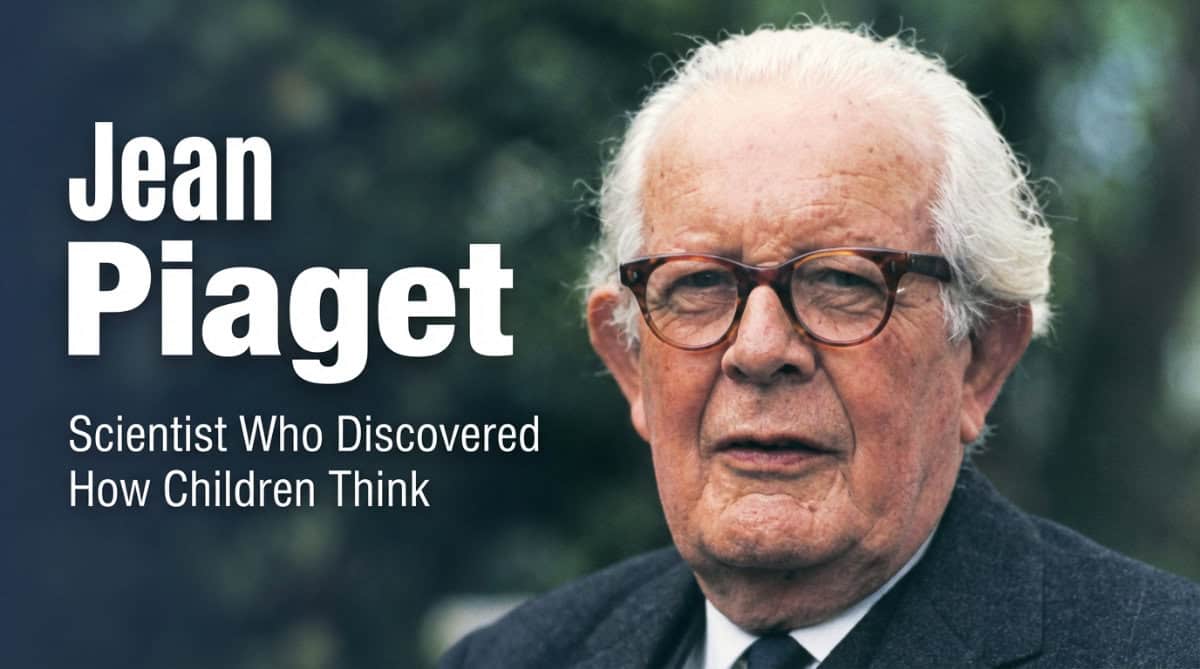
Jean Piaget didn’t set out to study children. He was a biologist. Molluscs fascinated him—their shells, their adaptation, their evolution. But in 1920, he needed work. He took a job in Paris, testing children’s intelligence.
The work was simple. Ask questions. Mark answers right or wrong. Move to the next child.
Piaget couldn’t do it.
He noticed something the test designers missed. Children of the same age made identical wrong answers. Not random mistakes. Systematic errors that followed patterns.
A five-year-old watches water pour from a short, wide glass into a tall, thin glass. “Which has more water?” the researcher asks. The child points to the tall glass. Every five-year-old points to the tall glass.
They’re not guessing. They’re not careless. They genuinely believe the tall glass holds more water, even though they watched the same amount pour from one to the other.
Piaget asked why. His supervisors told him to stop wasting time and score the tests. He quit instead.
For the next sixty years, he studied those wrong answers. He discovered that children aren’t small adults who simply know less. They think differently. Their minds follow different logic. They see a different world.
His four stages of cognitive development changed how we understand learning. For Singapore parents navigating pressure to push academic concepts early, his work offers both reassurance and warning: children’s brains develop on their own schedule. You can’t rush understanding any more than you can rush height.
Early Life & Background
The Child Prodigy Who Studied Sparrows
August 9, 1896. Neuchâtel, Switzerland. Jean Piaget was born into an academic family. His father taught medieval literature at the university. His mother struggled with mental health. Young Jean noticed her moods, her unpredictability, her difficulties. He wondered why minds worked differently.
But first, he fell in love with nature.
At age ten, he watched an albino sparrow in a park. Most boys would have chased it. Jean observed it. He noted its behaviour, its appearance, its interaction with normal sparrows. He wrote a one-page scientific paper describing what he saw.
He submitted it to a natural history journal. They published it.
The museum director, Paul Godet, was impressed. A ten-year-old who could write publishable scientific observations? Rare. Godet invited Jean to help catalogue the museum’s mollusc collection.
Jean spent his teenage years in museum backrooms, classifying shells. He published papers on molluscs. European malacologists, scientists who study molluscs, began corresponding with him. They assumed he was an adult researcher. Several offered him curator positions.
Then they discovered their colleague was still in secondary school.
The Biologist Who Couldn’t Stop Asking Why
At twenty-one, Piaget earned his PhD in natural sciences. His dissertation examined molluscs and adaptation. Solid work. Publishable. Forgettable.
But Piaget couldn’t stop thinking about bigger questions. How do we know what we know? How does knowledge develop? A baby knows nothing about the world. An adult reasons about abstract concepts, plans for unseen futures, understands invisible forces. What transforms one into the other?
He studied philosophy. He read psychology. He tried psychoanalysis under Carl Jung in Zurich. The unconscious mind intrigued him. But he wanted something more rigorous, more observable, more scientific.
In 1920, he moved to Paris. Alfred Binet had developed the first intelligence tests there. Piaget took a job in Binet’s laboratory, standardising test questions for Parisian children.
Ask the question. Record the answer. Mark it right or wrong. Repeat.
Mind-numbing work. But Piaget noticed something.
The Wrong Answers That Changed Everything
“Which is more, four flowers or four daisies?”
Four-year-olds consistently answered “four daisies.” Every single one. They couldn’t grasp that daisies belonged to the larger category “flowers.”
This wasn’t ignorance. It was a different way of thinking.
Piaget started asking follow-up questions. Why did they think that? How did they arrive at their answer? His supervisors grew irritated. Stop wasting time. Just score the tests.
But Piaget saw something revolutionary in those wrong answers. Children weren’t defective adults who simply lacked information. They were fundamentally different thinkers. Their logic operated by different rules.
He had found his life’s work.
Major Contributions
The Revolution in Two Glasses of Water
Pour water from a short, wide glass into a tall, thin glass. Ask a four-year-old which has more water.
They point to the tall glass. Every time.
“But you watched me pour it. The same water went from this glass to that glass.”
They nod. The tall glass still has more.
“Let’s pour it back.”
You pour the water back into the short, wide glass.
“Now, which has more?”
They point to the short glass.
Before Piaget, adults assumed children were simply wrong. Teach them the right answer. Move on.
Piaget asked: What if they’re not wrong? What if they’re thinking logically within a different system?
The child focuses on height. Taller means more. They can’t consider height and width simultaneously. They can’t mentally reverse the pouring to understand that the quantity stayed constant. These aren’t failures. They’re the natural limitations of a four-year-old mind.
This understanding that children think differently, not poorly, changed education forever.
Four Stages of Thinking
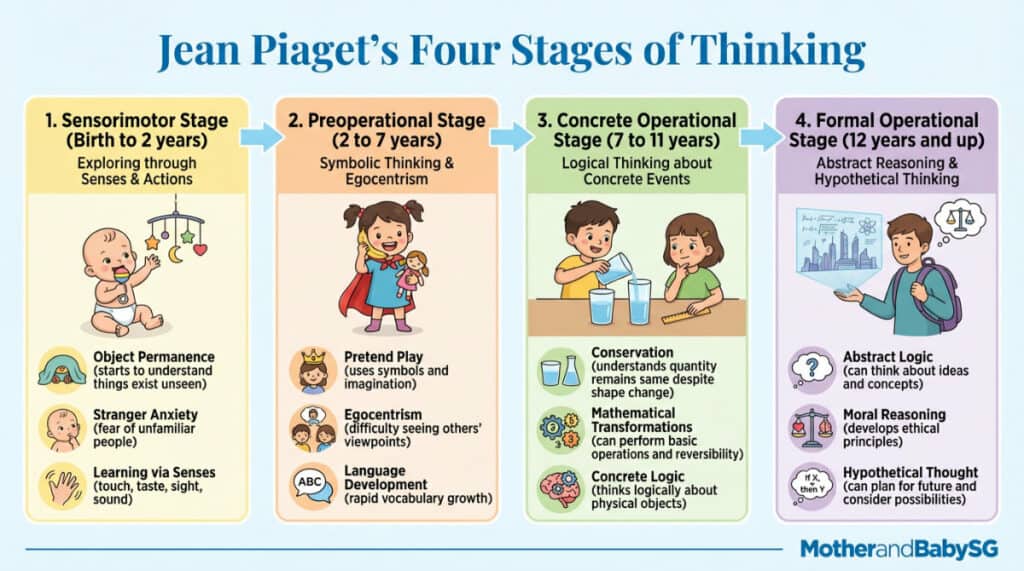
Stage One: The World Through Mouths and Hands
Birth to two years. Everything goes in the mouth. Parents think babies are messy. Piaget knew they were scientists.
A six-month-old watches you hide a toy under a blanket. They don’t search for it. They don’t even look puzzled. The toy ceased to exist.
Show them the toy again. Hide it again under the same blanket. They still don’t search. Out of sight means gone forever.
This isn’t stupidity. This is life without object permanence, the understanding that objects exist independently of our perception.
Around eight months, something shifts. Hide the toy, and the baby pulls the blanket away. They’ve discovered object permanence. The world just became more stable and predictable.
Piaget documented six sub-stages within these first two years. From simple reflexes to purposeful experimentation. The one-year-old who drops their spoon from the high chair seventeen times isn’t misbehaving. They’re testing gravity. They’re asking: does it fall every time? Does it make the same sound? Do you always pick it up?
Stage Two: Symbols Without Logic
Around age two, something magical happens. A banana becomes a telephone. A box becomes a rocket ship. Children develop symbolic thinking—the ability to let one thing represent another.
Language explodes. Pretend play emerges. They can think about objects that aren’t present. This is the foundation for everything that follows reading, writing, math, abstract thought.
But their logic has severe limitations.
Egocentrism dominates. They genuinely can’t imagine how things look from another perspective. Piaget showed children a model with three mountains. He asked them to choose a picture showing what the mountains looked like from the opposite side. They chose the picture matching their own view. Every time.
They weren’t being selfish. They literally couldn’t mentally rotate the scene.
Conservation is impossible. Change the appearance, and they believe you changed the quantity. Spread coins out in a longer row, and they insist there are more coins, even though they just counted both rows and found the same number.
Animism is normal. The sun is alive because it moves. The moon follows them when they walk. Trees feel pain when branches break. They’re not confused. They’re making sense of a complex world with the tools they have.
Stage Three: Logic Arrives
Around seven years old; Primary 1 in Singapore, children enter concrete operational thinking.
Pour water between glasses, and they finally understand the amount doesn’t change. Spread coins out, and they know the number stays constant. Show them the mountains from different angles, and they can select the correct view.
Logic works now. But only for concrete, tangible objects.
Ask them: “If all bleeps are blue, and some blue things are heavy, are all bleeps heavy?”
They can’t do it. They need real bleeps they can see and touch. Abstract logic still eludes them.
This stage explains so much about Primary school learning. Give a child blocks to manipulate, and they grasp mathematical concepts. Use only abstract symbols, and they struggle. Their brains work with concrete objects, not pure abstractions.
Stage Four: Abstract Thinking Emerges
Around twelve years old, some children begin thinking abstractly. They can reason about hypothetical situations. They can test variables systematically. They can think about their own thinking.
“Imagine a world where everyone told the truth all the time. What would be different?”
A concrete operational child looks confused. A formal operational adolescent can explore the question, considering implications and exceptions.
Piaget found that not everyone reaches this stage. It requires education, practice with complex problems, and environments that demand abstract thought. It’s not automatic.
How Knowledge Builds
Piaget proposed that children build mental frameworks called schemas. A baby develops a “graspable things” schema. Everything small gets grasped the same way.
Then they encounter a large ball. The one-handed grasp doesn’t work. Their schema must change.
This happens through two processes.
Assimilation: fitting new information into existing schemas. The toddler calls all four-legged animals “doggie.” They’re assimilating cats and cows into their dog schema.
Accommodation: changing schemas to fit reality. When told that cows aren’t dogs, the child creates a new schema. Their understanding becomes more accurate.
Equilibration drives the process. When new experiences don’t fit existing schemas, children feel cognitive discomfort. This motivates adaptation. They reach a new equilibrium at a higher level of understanding.
Every stage transition follows this pattern. Build schemas. Encounter information that doesn’t fit. Adapt. Reach new equilibrium. Repeat.
Practical Applications
Supporting the Baby Scientist
Your eight-month-old drops food from the high chair. Again. And again. And again.
You’re exhausted. You’ve picked up the same piece of bread seventeen times.
Piaget would say: your baby is conducting physics experiments. They’re asking: does bread fall every time? Does it make different sounds on different surfaces? How far can I throw it? Do you always retrieve it?
This is cognitive development. This is how babies learn about gravity, object permanence, cause and effect, social responses.
You don’t need to enable seventeen drops. But occasionally join the experiment. Drop the spoon yourself. Say “Down!” Watch it fall together. You’re supporting their learning while setting gentle limits.
Play peek-a-boo. This classic game teaches object permanence. Your face disappears. Your face reappears. The baby learns that things continue existing when hidden.
Hide toys under blankets. Encourage searching. When they find the hidden toy, they’re practising object permanence.
Provide objects with different textures, sounds, and weights. Babies learn through sensory exploration. That’s why everything goes in their mouths. Keep choking hazards away. Let them safely explore how objects feel, taste, sound, and move.
Singapore parents often worry about “productive” activities. Flashcards. Educational videos. Structured learning time.
Piaget’s research suggests the opposite. Sensorimotor babies need freedom to touch, manipulate, drop, and mouth safe objects. A wooden spoon and metal bowl teach cause-effect, sound properties, and object permanence as effectively as expensive educational toys.
When Pretend Play Builds Real Intelligence
Your three-year-old feeds their stuffed animals breakfast. They scold the teddy bear for not finishing their vegetables. They put on a cape and become a superhero fighting invisible villains.
This isn’t wasted time. This is symbolic thinking development.
Pretend play requires holding two ideas simultaneously: this banana is a banana AND it’s a telephone. This is the foundation for all abstract thought. Reading relies on symbolic thinking—marks on paper represent sounds and meanings. Math requires understanding that numerals represent quantities.
Provide props. Dolls. Play food. Dress-up clothes. Empty boxes that become anything children imagine.
Join their play sometimes. If the couch is a boat, ask where you’re sailing. This extends their thinking without controlling it.
Don’t expect logical consistency. Your four-year-old knows their stuffed rabbit isn’t alive. But they’ll be upset if you forget to buckle it into the car seat. They move fluidly between magical thinking and reality. Both are developmentally appropriate.
And please don’t try to teach conservation.
Your five-year-old insists the tall glass has more water. You explain that you poured the same amount. You pour it back to demonstrate. You ask again.
The tall glass has more water.
Their brain hasn’t developed conservation yet. No amount of explaining will create neural pathways that don’t exist. Accept their answer. Trust that development will come.
The Concrete Operational Child
Around Primary 1, something shifts. Children begin thinking logically about concrete objects.
Now hands-on math manipulatives work beautifully. Counting bears let children see addition and subtraction. Pattern blocks demonstrate geometric relationships. Base-ten blocks make place value tangible.
They can classify flexibly now. Sort buttons by colour. Then by size. Then by number of holes. This cognitive flexibility underlies understanding that 8 can be grouped as 5+3, 4+4, 6+2, or 10-2.
Provide real-world problems. “We need six apples for the recipe. We have four. How many more should we buy?” This is easier than the same problem with abstract numbers because apples are concrete.
Singapore’s Primary math curriculum works well when taught with manipulatives and visual models. Problems arise when schools push abstract concepts before children are ready.
The Primary 2 child struggling with abstract fraction concepts isn’t slow. They may need more time with concrete materials—cutting actual pizzas into pieces, dividing real chocolate bars, pouring water between measuring cups.
When Abstract Thinking Develops
Piaget found formal operational thinking emerges around twelve years old. But not for everyone. And not all at once.
Singapore parents sometimes expect it earlier. The Primary 4 child who can’t explain their mathematical reasoning isn’t being difficult. They can solve problems with concrete examples. Articulating abstract principles requires formal operational thinking they may not have yet.
Expose older children to hypothetical questions. “What would happen if gravity stopped?” “How would society change if everyone could read minds?” These questions exercise emerging abstract thinking.
But accept that concrete thinking works too. Even adults often think concretely, using examples and analogies rather than pure abstraction. The Secondary 2 student who draws diagrams to understand physics isn’t deficient. They’re using concrete operational thinking to support developing formal operational abilities.
Legacy & Ongoing Influence
The Education Revolution
Before Piaget, education looked the same regardless of age. Lecture. Expect memorisation. Test. Repeat.
After Piaget, educators recognised that teaching must match developmental stages.
Discovery learning emerged. Children learn best by exploring and discovering concepts themselves rather than passively receiving information. The science classroom where students conduct experiments before learning principles? That’s Piaget.
Child-centered education gained theoretical support. Children aren’t empty vessels to fill with knowledge. They’re active thinkers constructing understanding. The teacher’s role shifted from information-giver to facilitator.
These weren’t just nice ideas. They were grounded in rigorous research showing how children’s minds actually work.
The Researchers Who Refined His Work
Lev Vygotsky, working in Soviet Russia at the same time, emphasised what Piaget underemphasized: the social nature of learning. Where Piaget saw the child as a lone scientist, Vygotsky saw learning as fundamentally social, happening through interaction with more knowledgeable others.
Both were right. Children do construct knowledge individually. They also learn through guidance and collaboration.
Neo-Piagetian theorists refined stage theory. Robbie Case and Kurt Fischer showed that development is more gradual and context-dependent than Piaget suggested. A child might show formal operational thinking in familiar domains while remaining concrete operational in unfamiliar ones.
Modern research has found that Piaget underestimated infant and preschool capabilities. Babies develop object permanence earlier than he thought, though the full ability takes time. Preschoolers aren’t as completely egocentric as his tests suggested.
But his core insight stands: children think differently than adults in systematic, predictable ways. Understanding these differences transforms parenting and teaching.
Piaget’s Presence Today
The International Bureau of Education in Geneva houses the Jean Piaget Archives. The Jean Piaget Society, founded in 1970, continues promoting research on knowledge and cognitive development.
When teachers talk about “hands-on learning” or “inquiry-based instruction,” they’re applying Piagetian principles, even if they don’t mention his name.
Contemporary neuroscience has begun identifying brain changes corresponding to Piaget’s stages. Prefrontal cortex development during adolescence aligns with formal operational thinking emergence. Brain imaging shows different neural patterns when children succeed versus fail at conservation tasks.
His work bridges psychology, education, and neuroscience. The biologist who studied molluscs ended up mapping the human mind.
Singapore Connection
When Systems Ignore Development
Singapore’s education system sometimes expects cognitive abilities before children develop them.
Teaching abstract algebraic concepts to Primary 4 students assumes formal operational thinking that many ten-year-olds lack. They memorise procedures without understanding. They pass tests without genuine comprehension.
Piaget’s research suggests waiting until children show readiness. The child who can’t grasp abstract concepts at nine might understand them easily at eleven. Pushing earlier doesn’t accelerate development. It creates frustration and math anxiety.
The recent MOE emphasis on “learning for life” aligns with Piagetian principles. Giving children concrete experiences and time to construct understanding produces deeper learning than rushing through abstract concepts.
But pressure remains. Parents see neighbours enrolling four-year-olds in advanced math classes. Anxiety builds. Are we falling behind?
Piaget’s work says: probably not. The four-year-old memorising abstract math procedures isn’t building genuine understanding. The four-year-old playing with blocks, sorting objects, and having pretend tea parties is building the cognitive foundations that make later math learning easier.
Play-Based Learning Under Pressure
Singapore’s Nurturing Early Learners (NEL) framework for preschools incorporates Piagetian insights. The emphasis on learning through play recognises that preoperational children learn through active exploration, not worksheets.
The NEL framework’s focus on hands-on activities aligns with how young children actually learn. When preschools resist parent pressure for academic worksheets, they’re protecting developmentally appropriate practice.
But some kindergartens still push reading and math early. Parents request it. Competition demands it. But Piaget’s research suggests this may create problems.
The five-year-old who isn’t interested in letters isn’t “behind.” They may be focused on developing symbolic thinking through pretend play. This is the foundation for literacy. Forcing letter recognition before symbolic thinking develops fully can create resistance rather than enthusiasm for reading.
Multi-Cultural Development
Piaget developed his tasks with Swiss children. Later research found that children from different cultures develop abilities at different ages, not because of cognitive differences but because cultural practices emphasise different skills.
Singapore children might show conservation understanding earlier with money, they encounter it frequently in hawker centres and shops. They might develop it later with liquid volume if they don’t help with cooking.
This doesn’t invalidate Piaget’s stages. It shows that experience and culture influence when abilities emerge within the broader developmental framework.
The emphasis on academic achievement in Singapore sometimes leads parents to view play and exploration as wasted time. But Piaget’s research shows these activities build cognitive structures that make later academic learning possible.
The five-year-old building with blocks is developing spatial reasoning, trial-and-error learning, and reversibility—foundations for geometry and problem-solving. The pretend play that looks like silliness is developing symbolic thinking necessary for reading and math.
Local Resources
The Science Centre Singapore offers hands-on exhibits that support concrete and formal operational thinking. Children learn scientific concepts through direct manipulation and experimentation. Pure Piagetian principles.
The National Library Board organises children’s sections partly by age, reflecting the understanding that different ages need different books and learning materials. Board books for sensorimotor babies. Picture books for preoperational preschoolers. Early readers for concrete operational children.
Many Singapore preschools apply Piagetian principles without advertising them that way. Inquiry-based learning centres that emphasise discovery and hands-on exploration align with his constructivist theory.
What Piaget Means for Your Parenting
Jean Piaget proved you can’t rush cognitive development.
The three-year-old who insists the moon follows them home isn’t being silly. They’re thinking exactly as three-year-olds think. Your explanations won’t change their developmental stage.
This matters when everyone around you enrols their four-year-old in advanced classes. When relatives question why your kindergartener plays all day instead of doing worksheets. When you wonder if you’re falling behind.
Piaget’s work says: early academic pressure on preoperational thinkers often creates anxiety without building genuine understanding. The kindergartener who spends their time playing with blocks and having tea parties with stuffed animals isn’t falling behind. They’re building symbolic thinking and classification skills that make Primary 1 math easier to grasp.
His stage theory also explains why the same teaching approach doesn’t work for all ages. Your Primary 2 child needs concrete examples to understand multiplication. Your Secondary 2 child can handle abstract algebraic reasoning. This isn’t about intelligence. It’s about developmental stage.
Most liberating: Piaget showed that children actively construct knowledge. You don’t need to teach your baby that dropped objects fall. You don’t need to lecture your toddler about object permanence. Given safe environments and opportunities to explore, children discover these concepts themselves.
Your job isn’t pouring knowledge into their heads. It’s providing experiences that let them build understanding.
Understanding Piaget won’t stop your toddler from pouring water from container to container for the fifteen-thousandth time. But it will help you see they’re not making a mess. They’re conducting scientific experiments about volume, pouring speed, and liquid properties.
The mess is cognitive development in action.
When your child’s teacher says they’re “not ready” for certain concepts, that’s Piaget’s legacy. Readiness isn’t about trying harder. It’s about developmental stage. No amount of effort will create neural pathways that don’t exist yet.
Wait. Provide concrete experiences. Trust development.
For more on early development, explore how Emmi Pikler researched infant motor development, or learn how Ruth Wong adapted developmental principles to Singapore’s educational context. Each pioneer understood that children develop according to internal timetables that external pressure cannot accelerate.
Further Resources
Books:
- “The Psychology of the Child” by Jean Piaget and Bärbel Inhelder – Concise overview of cognitive development theory
- “Play, Dreams and Imitation in Childhood” by Jean Piaget – How symbolic thinking develops through play
- “The Construction of Reality in the Child” by Jean Piaget – How infants build understanding of object permanence
Singapore Resources:
- Science Centre Singapore – Hands-on exhibits supporting all cognitive stages
- National Library Board – Age-appropriate collections and programs
- MOE Nurturing Early Learners Framework – Singapore’s play-based preschool approach
Online Resources:
- Jean Piaget Society – Current research on cognitive development
- KK Women’s and Children’s Hospital – Developmental milestone information organised by Piagetian stages