
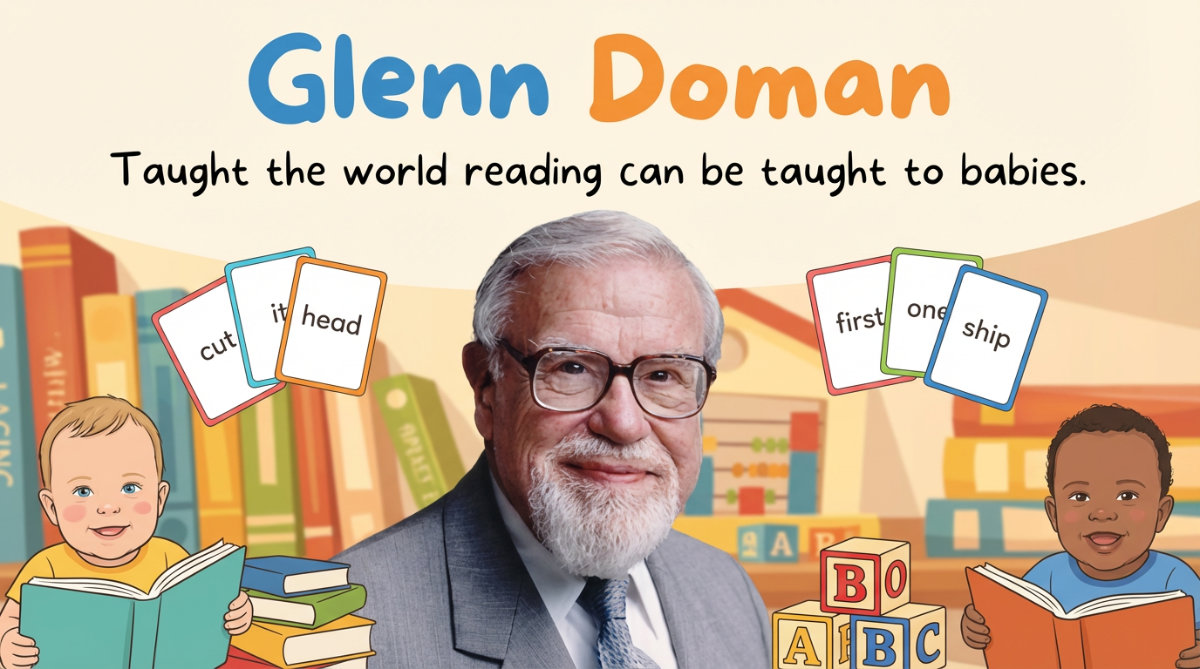
In 1940, a young physical therapist at Temple University Hospital encountered a sight that would change his life. An eleven-year-old boy with severe hydrocephalus lay in the pediatric ward, a child the medical establishment had written off as hopeless. Glenn Doman felt horror, then anger, then something else entirely: a fierce determination that would carry him through battlefields in Europe and into fifty years of pioneering work that challenged everything the world believed about brain-injured children—and about babies.
What makes Doman’s story different is this: He didn’t just theorise from ivory towers. He earned his stripes leading men through the bloodiest battles of WWII, earning the British Military Cross, the Distinguished Service Cross, and a nomination for the Congressional Medal of Honor. That same relentless courage he brought to rehabilitating the “unrehabilitatable” and teaching parents something doctors said was impossible: their babies could learn to read before they turned two.
Today, his methods remain controversial in medical circles yet beloved by millions of parents worldwide. His bestselling book “How to Teach Your Baby to Read” has sold over five million copies in 22 languages. Whether you think he was a visionary or a provocateur, one thing is undeniable: Glenn Doman fundamentally changed how we think about infant potential.
From Hilltown to the Battlefields of Europe
Born August 26, 1919, in Hilltown, Pennsylvania, Glenn was the eldest of three children. His father, Joseph H. Doman, and mother, Helen (Gould) Doman, created what Glenn described as a “kid-oriented home where there was a great deal of love.” The Depression years didn’t feel like deprivation to young Glenn, who spent his time exploring nature and dreaming of becoming a forester.
The Boy Scouts shaped him profoundly. “It taught me ethics,” he explained years later, “a feeling of comradeship and decency and respect for your fellow man.” These values would become the bedrock of his later work with families and children.
In 1940, Glenn graduated from the University of Pennsylvania School of Physical Therapy. On December 8, 1941—the morning after Pearl Harbor—he enlisted in the U.S. Army Medical Corps as a private. He was 22 years old.
A Quaker Goes to War
Glenn’s decision to enlist wasn’t simple. He’d become a Quaker, a pacifist faith. But as Hitler’s atrocities became undeniable, Glenn couldn’t stand on the sidelines. “Those people who cared to know had understood what Jews were going through,” he said. His hero Winston Churchill spoke out against Hitler, and Glenn agreed: some evils demanded action.
He transferred from the Medical Corps to Infantry and attended Officer Candidate School at Fort Benning, Georgia. The training was brutal. Many candidates dropped out. Glenn graduated as a second lieutenant and was assigned to Patton’s Third Army, 87th Infantry Division, 346th Regiment, Company K.
The Crucible of War
Company K sailed to Great Britain on the RMS Queen Elizabeth, the fastest ship on the seas. Glenn served as gunnery officer during the crossing. Once in Europe, his company moved into France, then into the frozen hell of the Battle of the Bulge.
Glenn rose to command a full rifle company—187 men and 6 officers. He led them through Luxembourg, Holland, across Germany, through assaults over the Moselle and Rhine rivers, and into Czechoslovakia itself. Of that original company, Glenn was reduced to remnants three times over. The casualties were staggering.
His Division Commander, Major General Culin, once told him: “Doman, I have been a soldier for 35 years. I’ve often wondered why. Now I know. I stood and watched your boys take that Hill. My 35 years in the Army were spent waiting for an attack like that.”
Glenn emerged as a Lieutenant Colonel, decorated by multiple nations. The British awarded him the Military Cross for outstanding heroism—the highest honour Britain gives to a foreigner. Luxembourg’s Grand Duchess Charlotte decorated him for his service during the Battle of the Bulge. Belgium gave him the Croix de Guerre. The United States awarded him the Distinguished Service Cross, the Silver Star, and the Bronze Star. General Patton himself nominated Glenn for the Congressional Medal of Honor.
War changed him. It taught him what mattered and what didn’t. It made him intolerant of excuses and devoted to the mission. But most of all, it gave him a motto he would carry into his next battle: “Leave no injured behind.”
Meeting the Man Who Would Change Everything
Before the war, in 1940, Glenn had met Dr. Temple Fay at Temple University Hospital. Fay was the Dean of Neurosurgery, one of the most innovative minds in medicine. He’d established the Department of Neurosurgery at Temple in 1930 and pioneered therapeutic hypothermia—packing patients in ice to slow metabolism and protect the brain during surgery.
But Dr. Fay’s most radical idea was simpler: “Brain injury is in the brain.”
It sounds obvious now. But in the 1940s, physical therapy for brain-injured patients focused on limbs, on symptoms. Paralysed arm? Work the arm. Can’t walk? Work the legs. Fay understood that these approaches missed the point entirely. The problem wasn’t in the limbs. The problem was in the brain that controlled those limbs.
When Glenn returned from war in 1945, he reconnected with Dr. Fay. Together, they began revolutionary work with adult stroke patients. Instead of letting these men and women languish in bed, they got them up. They moved them. They stimulated them. The goal: reactivate brain function.
It worked.
The Children Who Taught Him Everything
In the late 1940s, Glenn encountered his first severely brain-injured child—that eleven-year-old with hydrocephalus who’d been abandoned by the medical system. The experience shook him. “I shall never forget my first sight of a severely involved child,” he wrote.
But unlike others, Glenn didn’t turn away. He leaned in.
In 1955, Glenn, Dr. Fay, Glenn’s wife Katie (a nurse), his brother Robert (a physiatrist), speech pathologist Martin Palmer, and educator-psychologist Carl Delacato formed The Rehabilitation Center at Philadelphia (later renamed The Institutes for the Achievement of Human Potential in 1962).
Their first patients were children everyone else had given up on. Children with cerebral palsy. Down syndrome. Severe brain injuries from accidents or birth complications. Children who couldn’t move, couldn’t speak, couldn’t think—according to conventional medical wisdom.
Glenn’s team didn’t accept that wisdom. They studied how normal children developed. They travelled to remote corners of the world—the Arctic, the Kalahari Desert, the Mato Grosso in Brazil—observing how children in vastly different cultures hit the same developmental milestones. They identified the vital steps of neurological development and the sequence in which they occurred.
Then they created programs to help brain-injured children move through those same developmental stages, even if their brains were damaged.
The Discovery That Shocked the Medical World
One day in the late 1950s, a severely brain-injured three-year-old named Tommy did something impossible. His father, Mr. Lunski, announced—as he often did—that Tommy could read. The staff were skeptical. They’d heard this before from hopeful parents.
Mr. Lunski wrote on a piece of paper: “Glenn Doman likes to drink tomato juice and eat hamburger.” Tommy, not yet five years old, read it perfectly with proper inflection and accent.
A brain-injured child. Reading. Before kindergarten.
The implications hit Glenn like lightning. If a severely brain-injured child could learn to read at three or four, what did that say about so-called “normal” babies? Everyone assumed babies couldn’t learn to read because they couldn’t speak yet, because their eyes couldn’t focus on small print, because reading was too abstract for young minds.
Glenn had a different theory: Babies couldn’t read because nobody taught them correctly.
How It Started
Glenn’s mother had taught him to read at age three. It had worked then. Why not now? He began experimenting with brain-injured children, creating large flashcards with big, bold, red letters. The red colour and large size compensated for visual development issues. The method bypassed phonics entirely—which required motor skills and verbal abilities these children didn’t have—and went straight to whole-word recognition.
It worked spectacularly.
Children who couldn’t speak were reading the Reader’s Digest. Children diagnosed with cerebral palsy, whose doctors said they’d never accomplish anything cognitive, were reading at second and third-grade levels before they turned four. One child, Matthew, started reading at 19 months. He went on to become a National Merit Scholar and attended MIT and Wharton.
Glenn realised he had stumbled onto something bigger than rehabilitation. He had discovered that the infant brain was far more capable than anyone imagined.
The Book That Launched a Revolution
In 1962, Glenn took a “vacation” to write a book. His colleagues warned him not to use the word “baby” in the title. Too controversial. Too inflammatory. People would think he’d lost his mind.
Glenn ignored them. He wrote “How to Teach Your Baby to Read” in two weeks.
The book became a New York Times bestseller. It has sold over five million copies in 22 languages. It launched what Glenn called the “Gentle Revolution” – millions of parents around the world teaching their babies to read, do math, and acquire encyclopedic knowledge in the years before school began.
The Method Explained
The Doman reading method is deceptively simple:
Start with single words. Create flashcards with words in large (5 inches tall), bold, red letters on white cardboard. Begin with familiar words: “Mommy,” “Daddy,” body parts, household objects.
Flash them quickly. Show each card for just one second while saying the word aloud. Do this three times per day, introducing five new words every few days. The quick presentation keeps babies engaged and treats reading like what it is: a brain function, not a subject to be studied.
Keep it joyful. Never test the baby. Never push. Stop before they get bored. The moment it stops being fun, you stop. Learning should feel like play.
Progress naturally. Move from single words to two-word combinations (“red ball”), then simple sentences (“Daddy is tall”), then short books created specifically for beginning readers.
The method works because it taps into the visual word form area of the brain – the part that recognises patterns. Babies’ brains are wired to learn language. They soak up spoken words effortlessly. Glenn proved they could do the same with written words if the words were big enough to see and presented in a way that matched how babies actually learn.
Beyond Reading: A Philosophy of Potential
Glenn didn’t stop at reading. He developed programs for teaching babies mathematics using red dot flashcards that developed number sense. He created “Bits of Intelligence” – flashcards teaching encyclopedic knowledge about everything from birds to composers to flags of nations. He pioneered physical development programs to help babies achieve mobility milestones earlier and more effectively.
But the real revolution wasn’t in the flashcards. It was in the philosophy.
Glenn believed every child born has greater potential intelligence than Leonardo da Vinci ever used. He believed that tiny children—especially in the first six years—have an extraordinary capacity to learn. He believed the brain grows by use, like a muscle. He believed parents, not professionals, were the best teachers for their own children.
Most radically, he believed that babies and brain-injured children weren’t that different. Both had brains capable of remarkable growth if given the right stimulation, the right environment, and the right opportunity.
The Controversy That Never Left
The medical establishment never embraced Glenn Doman’s work. The American Academy of Pediatrics issued statements cautioning against his therapies for brain-injured children. Critics pointed out that his research lacked rigorous controls and peer review. His only peer-reviewed publication appeared in JAMA in 1960, and the methodology was later criticised.
The theoretical foundation—recapitulation theory, which suggested infant brains evolved through stages similar to evolutionary development—has been largely discredited in biology. Neurologists argued his understanding of brain anatomy was flawed. Cost-benefit analyses concluded his intensive programs were expensive and unproven.
Yet millions of parents swear by his methods. Online forums overflow with stories of children reading at two and three years old. Brain-injured children whose parents were told to expect nothing are walking, talking, reading. Are these successes due to Doman’s specific techniques or simply increased attention and stimulation? The debate continues.
What’s undeniable is this: Glenn Doman gave desperate parents hope when the medical system offered none. He empowered families to become active participants in their children’s development instead of passive recipients of expert pronouncements. He challenged assumptions about what babies could achieve.
What This Means for Your Child Today
You don’t need to follow Glenn Doman’s program exactly to benefit from his core insights. Here’s what Singapore parents can take from his work:
Babies are more capable than we think. Don’t underestimate your child’s ability to absorb information. The first six years are golden years for learning. Your toddler’s brain is forming millions of neural connections every day.
Learning should be joyful. Whether you’re teaching colours, numbers, or words, keep it playful. The moment your child loses interest, stop. Forced learning creates resistance. Playful learning creates enthusiasm.
Big, bold, clear. Young children’s eyes are still developing. If you’re using visual materials—flashcards, books, charts—make them large and high-contrast. It’s not about dumbing things down. It’s about adapting to their visual capabilities.
Parents are powerful teachers. You don’t need expensive enrichment classes to stimulate your child’s development. You are your child’s first and most important teacher. Your attention, your engagement, your joy in teaching them—that’s the secret ingredient.
Start early, but don’t stress. The window for early learning is wide, not a razor-thin deadline. A child who learns to read at two has advantages, but a child who learns at five can catch up quickly. The goal isn’t to create pressure. It’s to create opportunity.
A Singapore Adaptation
Singapore’s culture already values education deeply—sometimes too deeply. The enrichment class industrial complex can make parents feel like they’re failing if their toddler isn’t in three different programs by age two.
Glenn Doman’s approach offers a counterbalance. You don’t need expensive classes. You need large flashcards, consistency, and fifteen minutes a day. You don’t need certified teachers. You need your own enthusiasm and attention. The program is home-based, parent-delivered, and relationship-centred.
For Singapore families living in HDB flats without storage for elaborate equipment, the simplicity is appealing. Flashcards are flat. They stack. They’re portable. You can teach your baby on the MRT, in a coffee shop, during breakfast.
The method also respects family time. Most enrichment classes require schlepping across the island, parking nightmares, and paying hundreds of dollars per month. Doman’s program happens at home, on your schedule, for the cost of cardboard and markers (or printer ink).
The Later Years and Lasting Legacy
Glenn directed The Institutes until 1980, when his daughter Janet Doman took over as director. But Glenn never stopped working. He taught courses, counselled families, and refined his programs until five months before his death at age 93 on May 18, 2013.
His wife Katie, who’d been with him from the beginning, continued teaching until her death in 2017. Both devoted their final years to the mission they’d started in 1955: proving that hurt children could get well and well children could be extraordinary.
Today, The Institutes for the Achievement of Human Potential continues in Philadelphia. Glenn’s grandchildren founded Doman Learning to modernise his methods for digital-age parents. His books remain in print and continue to sell. Parents from 100+ nations have attended courses at The Institutes.
The Brazilian government knighted him in 1966 for services to the children of the world. Malaysia, Japan, Spain, and Italy honoured him with awards and recognition. But Glenn’s real legacy isn’t in the medals. It’s in the millions of families who learned a simple truth: their children were capable of far more than anyone told them was possible.
A Few Closing Thoughts
Glenn Doman’s methods aren’t for everyone. Some families try the flashcard routine and their baby couldn’t care less. Other families find their toddler asking for “reading time” like it’s dessert. Every child is different.
The value in Glenn Doman isn’t following his program like scripture. The value is in his core message: Your baby is brilliant. Your involvement matters. Learning should be joyful. The first years are precious.
In a world that often tells parents to stand back and let the experts handle it, Glenn Doman said the opposite: You are the expert on your child. Trust yourself. Engage. Teach. Play. The bond you build while teaching your toddler—whether it’s reading flashcards or building blocks or singing songs – that’s what shapes a brain. That’s what builds a life.
He was a war hero who came home and fought a different battle: the battle to give every child a fighting chance. Agree with all his methods or not, that mission deserves respect.
Further Resources
Books by Glenn Doman:
- “How to Teach Your Baby to Read“
- “What To Do About Your Brain-Injured Child“
- “How to Teach Your Baby Math“
- “How to Multiply Your Baby’s Intelligence“
- “How to Give Your Baby Encyclopedic Knowledge“
Organizations:
- The Institutes for the Achievement of Human Potential (Philadelphia, USA) – iahp.org
- Doman International (Family-run organisation continuing Glenn’s work) – https://www.domaninternational.org/
- Doman Learning (Digital courses by Glenn’s grandchildren) – https://www.domanlearning.com/
Singapore Resources: While there are no official IAHP centers in Singapore, parents can access Doman methods through online courses, books, and parent-led home programs. Several Singapore parent groups on Facebook share experiences and resources for early learning methods including Doman-inspired approaches.