
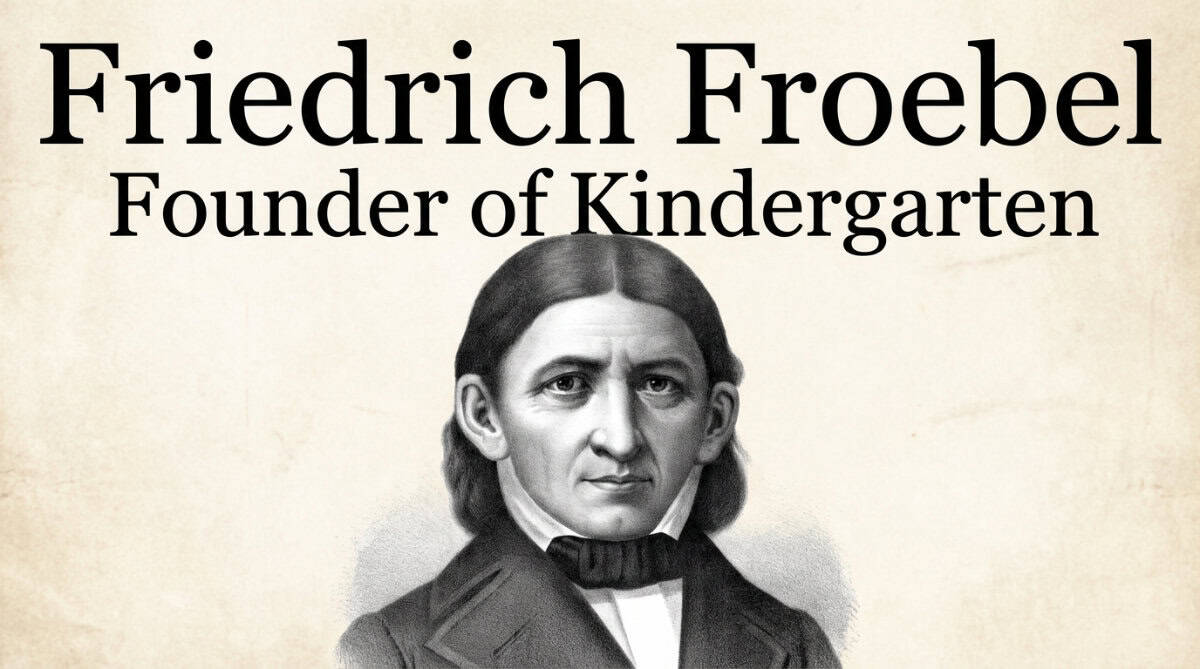
The word slips off our tongues so easily today. “My child starts kindergarten next year,” we say, planning those precious early education years. But 200 years ago, this concept didn’t exist. Young children under seven weren’t considered ready for school. They were left to their own devices, their early years seen as wasted time before “real” education could begin.
One man disagreed. A motherless child who found comfort wandering German forests, Friedrich Froebel saw something adults had missed for centuries: children aren’t empty vessels waiting to be filled with knowledge. They’re growing beings with their own needs, their own ways of learning, their own right to play. He created the kindergarten—literally “children’s garden”—and changed childhood education forever.
His influence reaches Singapore parents today in ways you might not expect. Every time your child stacks blocks, explores shapes, or learns through play, you’re witnessing Froebel’s vision. Understanding his work helps you see why play isn’t frivolous—it’s how young brains actually develop.
Early Life & Background
A Childhood Shaped by Loss
Friedrich Wilhelm August Froebel was born on April 21, 1782, in Oberweißbach, a small village in Thuringia, Germany. His father served as the local Lutheran pastor, a busy man devoted to his parish duties.
Nine months after Friedrich’s birth, his mother died. This loss would shape everything that followed.
When Friedrich was four, his father remarried. The stepmother showed little warmth to the youngest boy. Friedrich felt neglected, unwanted in his own home. His father, consumed by parish work, barely noticed the lonely child.
At age ten, his maternal uncle took him in. Living with Uncle Hoffman in Stadt-Ilm gave Friedrich breathing room, some kindness, a chance at normalcy.
Finding Solace in Nature
During these difficult years, Friedrich found comfort outside. The dense Thuringian forests became his refuge. He wandered among trees, studied plants, collected specimens. Nature didn’t judge him. Nature didn’t reject him. Nature simply grew, according to its own patterns and rhythms.
This childhood spent observing how things grow would later become central to his educational philosophy. He learned to see development as natural unfolding, not forced instruction.
Early Career Wanderings
At fifteen, Friedrich became an apprentice to a forester. Perfect fit—he already loved nature. He learned surveying, geometry, the mathematical precision of land measurement.
In 1799, while visiting his brother, he took courses at the University of Jena. Mathematics and botany captured his interest. But when his father fell ill in 1801, Friedrich returned home. After his father’s death in 1802, Friedrich worked as a clerk in the forestry department.
From 1804 to 1805, he served as a private secretary to several noblemen. Nothing stuck. He tried various paths, searching for purpose. Architecture tempted him briefly—his skills in drafting and geometry would have served him well.
Then, in 1805, everything changed.
The Teaching Revelation
At age twenty-three, Froebel went to Frankfurt intending to become an architect. Instead, he ended up teaching at the Frankfurt Model School, run by Anton Gruner. The school followed ideas developed by Swiss educator Johann Heinrich Pestalozzi, who believed children learn through activity and experience.
Gruner saw something in young Froebel. He arranged for him to train with Pestalozzi at his institute in Yverdon, Switzerland. Froebel spent two intensive years there, absorbing Pestalozzi’s respect for children’s dignity and his methods of creating emotionally secure learning environments.
But Froebel also saw weaknesses. Pestalozzi’s work lacked organisation. The methods needed refinement. Froebel began developing his own ideas about how young children truly learn.
After teaching at Gruner’s school, he served briefly in the Prussian army during the Napoleonic Wars. During the 1813 campaign, he formed lasting friendships with H. Langenthal and W. Middendorff. These men would later become his devoted followers.
Major Contributions
Creating a New Type of School
In 1816, Froebel opened a school at Griesheim in Thuringia, joined by his army friends Langenthal and Middendorff. Two years later, the school moved to Keilhau, where Froebel began implementing his revolutionary theories. The educators and their wives formed a kind of educational community. The school flourished.
In 1826, Froebel published “The Education of Man,” his most important philosophical work. In it, he outlined ideas that shocked the educational establishment:
- All existence originates with God
- Each child possesses an internal spiritual essence—a life force seeking expression through self-activity
- Child development follows natural unfolding of what’s already present inside the child
- Education must provide conditions for growth without excessive interference
Froebel believed children aren’t born as sinful beings needing correction. They’re born good, with innate potential waiting to unfold like a seed becoming a plant.
The Kindergarten Revolution
After time in Switzerland founding another educational institution, Froebel returned to Germany in 1837 with a new mission: educating the youngest children.
He opened the Child Nurture and Activity Institute in Blankenburg, Prussia, for children aged three and four. The school integrated play and activity into learning—a radical concept when play was considered idle waste of time.
Then came his moment of inspiration. In 1840, he renamed his school “Kindergarten”—children’s garden.
The name captured his philosophy beautifully. Children are like flowers or plants. They need nurturing, proper conditions, room to grow at their own pace. Teachers are gardeners who tend the young plants, providing what they need without forcing unnatural growth.
The kindergarten wasn’t about drilling facts into children’s heads. It was about creating an environment where natural development could happen through play, exploration, and self-directed activity.
Inventing Educational Toys: The Froebel Gifts
Froebel’s genius wasn’t just philosophical. He created practical tools.
He developed a series of play materials called “Froebel Gifts”—carefully designed objects that taught through hands-on exploration. These weren’t random toys. Each Gift built on the previous one, teaching increasingly complex concepts:
Gift 1: Six soft yarn balls in different colours, introducing colour, shape, and motion. Even babies six weeks old could engage with these.
Gift 2: A wooden sphere, cylinder, and cube on a hanging apparatus. Froebel called this “the children’s delight.” Kids discovered how these shapes differed—the sphere always looks the same from any angle and rolls easily, while the cube has flat sides and stays put. When spun on a stick, the cylinder reveals a spherical shape. Simple physics. Pure wonder.
Gifts 3-6: Increasingly complex wooden blocks—cubes divided into smaller cubes, rectangular blocks, triangular prisms. Children could build, create, explore spatial relationships and mathematical concepts through play.
Later educators added more Gifts—tablets, sticks, rings, points—extending Froebel’s system.
You may want to read our review on toys similar to Froebel Gifts for young children here.
The Occupations
Beyond the Gifts, Froebel developed “Occupations”—activities using malleable materials like paper, clay, straw, and wood:
- Paper folding and cutting
- Weaving
- Clay modeling
- Drawing
- Woodwork
These activities developed fine motor skills, creativity, and problem-solving abilities. They moved from exploring solid forms (the Gifts) to creating with raw materials (the Occupations).
Songs, Stories, and Gardens
Froebel’s kindergarten included singing, dancing, storytelling, and actual gardening. Children tended plants and vegetables, watching things grow, learning responsibility.
In 1843, he published “Mother’s Songs, Games and Stories”—a collection of action songs and finger plays with musical notation and instructions. The book became immensely popular, translated into many languages.
Practical Applications
Why Play Matters: The Science Froebel Discovered
Froebel made a breakthrough discovery: the most dramatic brain development happens between birth and age three. This was revolutionary for the 1830s. He recognised that early childhood isn’t a waiting period before “real” learning begins—it’s the foundation for everything that follows.
He understood play isn’t frivolous. It’s how children:
- Make sense of their world
- Develop spatial reasoning
- Learn cause and effect
- Build motor skills
- Express inner thoughts and feelings
- Practice social interaction
When your toddler stacks blocks repeatedly, they’re not wasting time. They’re learning physics, geometry, problem-solving, and persistence.
Applying Froebel’s Principles at Home
You don’t need special training to use Froebel’s insights:
Provide Open-Ended Materials
Blocks, building materials, clay, paper, and art supplies beat electronic toys. Simple materials allow endless exploration. A wooden block can be a car, a building, a bridge, a tower. A flashing plastic toy that plays pre-recorded songs? It only does one thing.
Singapore parents can find quality wooden toys at stores like Scanteak, ToTT, or online at Lazada and Shopee. Look for natural wood blocks in various shapes and sizes.
Create Space for Self-Directed Play
Froebel emphasised “free self-activity.” Children need time to pursue their own interests without adult direction. Your job isn’t to teach every moment. Sometimes it’s simply to provide materials and space, then step back.
In Singapore’s achievement-focused culture, this can feel uncomfortable. Your neighbour’s toddler might be doing flashcards while yours stacks blocks. Trust the process. Froebel’s approach builds deeper understanding than rote memorisation.
Connect with Nature
Make time for outdoor exploration, even in urban Singapore. Visit parks like the Botanic Gardens, Fort Canning, or your neighbourhood playground. Let your child touch leaves, watch ants, collect stones. These experiences develop observation skills and wonder.
If you have balcony space, create a small garden. Even growing herbs in pots gives children hands-on experience watching things grow.
Value Process Over Product
When your child builds with blocks, don’t worry if the result looks messy. The value lies in the building process—the thinking, planning, problem-solving, and adjusting. When they draw, focus on their enjoyment and effort, not whether it “looks like” something.
Use Songs and Movement
Froebel incorporated music and movement. Sing together. Make up action songs. Let your child dance to music. These aren’t extras—they’re part of holistic development.
Choosing Froebel-Inspired Preschools in Singapore
Many Singapore play-based preschools incorporate Froebel-influenced approaches even without calling them by name. When evaluating preschools, look for:
- Emphasis on play and self-directed activity
- Use of blocks and open-ended materials
- Outdoor time and nature exploration
- Balance between structure and freedom
- Teachers who observe and guide rather than constantly direct
Legacy & Ongoing Influence
The Kindergarten Spreads Worldwide
Froebel’s kindergarten idea found immediate appeal, but tragedy struck before he could see its full impact.
In 1851, Prussian Minister of Education Karl von Raumer banned kindergartens, calling them centres of “atheistic and socialist subversion.” The ban appears to have been a case of mistaken identity—von Raumer confused Friedrich Froebel with his nephew Karl Froebel, who had written about women’s education and kindergartens in ways the conservative government found threatening.
Friedrich Froebel died on June 21, 1852, at age seventy, while the ban still stood. He never saw it lifted in 1860.
But his ideas couldn’t be stopped.
Champion: Baroness Bertha von Marenholtz-Bülow
One woman refused to let Froebel’s work die. Baroness Bertha von Marenholtz-Bülow, one of his most dedicated supporters, embarked on an ambitious campaign. She brought kindergarten to England, France, Belgium, and Italy, opening schools and training teachers. After the Prussian ban lifted, she returned to Berlin to establish charity kindergartens and a training school.
Through her tireless efforts, kindergarten became an international movement.
Coming to America
German immigrants brought kindergarten to the United States. In 1856, Margarethe Meyer Schurz—a Froebel student—established the first American kindergarten in Watertown, Wisconsin, for German-speaking children.
Elizabeth Peabody opened the first English-language kindergarten in Boston in 1860. She became a passionate advocate, though she later grew concerned about commercialisation corrupting Froebel’s simple, purposeful approach.
By the late 1800s, kindergartens had spread throughout Europe and North America.
Influence on Other Educators
Froebel’s work influenced major educational thinkers:
Maria Montessori adapted his ideas about hands-on learning and carefully designed materials, creating her own system of child-sized furniture and self-directed activities.
Rudolf Steiner built on Froebel’s emphasis on holistic development and connection with nature in developing Waldorf education.
John Dewey embraced Froebel’s principles of experiential learning and the importance of the child’s environment at his experimental school at the University of Chicago.
Impact on Art and Architecture
Here’s something unexpected: Froebel’s Gifts influenced modern art and architecture.
In 1876, Anna Wright visited the Centennial Exhibition in Philadelphia and bought her nine-year-old son Frank a set of Froebel Gifts. That boy—Frank Lloyd Wright—would become America’s most famous architect.
Wright never forgot those blocks. At age eighty-eight, he reflected: “The maple-wood blocks… are in my fingers to this day. For several years I sat at the little kindergarten table-top… and played upon these ‘unit-lines’ with the square, the circle, and the triangle—these were smooth maple-wood blocks. All are in my fingers to this day.”
Wright’s architectural style—geometric forms, spatial relationships, the interplay of solid and void—grew from those childhood hours playing with Froebel blocks on a gridded table.
Other modernist pioneers also had Froebel educations: Le Corbusier, Buckminster Fuller, and artists like Piet Mondrian and Wassily Kandinsky. The geometric abstraction of modern art owes a debt to those simple wooden blocks.
Singapore Connection
Play-Based Learning in Singapore Context
While Froebel worked in 19th-century Germany, his insights matter for Singapore families today. His emphasis on early childhood education through play aligns with the Singapore Ministry of Education’s Kindergarten Curriculum Framework, which emphasises learning through play and exploration, holistic development, and child-initiated activities.
But here’s where it gets tricky for Singapore parents: the pressure to start academic enrichment early. Tuition centres offer classes for toddlers. Neighbours compare whose two-year-old knows more numbers.
Froebel’s approach offers perspective. Your child doesn’t need flash cards at eighteen months. They need blocks, space to build, time to explore. The cognitive development happens through play, not drills.
This doesn’t mean rejecting all structure. Froebel’s Gifts were carefully sequenced and purposeful. But the learning came through the child’s own exploration, not passive reception of facts.
Nature in Urban Singapore
Froebel grew up in forests. Singapore children grow up in high-rises. But the principle remains: connection with nature supports healthy development.
Despite urbanisation, Singapore offers nature access: the Botanic Gardens, Gardens by the Bay, MacRitchie Reservoir, and neighbourhood parks. Make these visits regular, not rare treats. Let your child touch, observe, and question.
If you have balcony space, create a small garden. Even growing herbs in pots gives children hands-on experience watching things grow—Froebel’s garden principle adapted to HDB life.
Conclusion
Friedrich Froebel never had children of his own. Both his marriages were childless. Yet he fathered an idea that changed childhood for millions.
He saw what others missed: young children aren’t miniature adults waiting to be filled with information. They’re unique beings with their own developmental needs. Play isn’t the opposite of learning—it’s the engine of learning.
Today, when your child stacks blocks higher and higher, they’re engaging with the same geometric principles Froebel built into his Gifts nearly 200 years ago. When they dig in sand at East Coast Park, they’re connecting with nature the way he did in Thuringian forests. When they create with clay or paper, they’re experiencing the Occupations he designed.
His greatest gift wasn’t the wooden blocks or the songs. It was a shift in perspective: seeing children as growing gardens needing the right conditions, not empty vessels needing to be filled.
In Singapore’s high-pressure academic environment, that perspective matters more than ever. Your preschooler doesn’t need earlier academics. They need time to play, explore, build, create, and grow at their own pace.
Trust the garden. The flowers will bloom when they’re ready.
Further Resources
Books by Froebel
- “The Education of Man” – His foundational philosophical work
- “Mother’s Songs, Games and Stories” – Practical activities for young children
Books About Froebel
- “Inventing Kindergarten” by Norman Brosterman – Explores Froebel’s influence on modern art and design
- “Friedrich Froebel and English Education” edited by Evelyn Lawrence
Organizations
- The Froebel Trust (UK-based, online resources): https://www.froebel.org.uk
- Froebel USA: Resources and training in Froebelian principles : https://froebelusa.com/
- International Froebel Society : Promoting Child-Centred Kindergarten & Early Education Worldwide: https://international-froebel-society.org/
Singapore Resources
- Early Childhood Development Agency (ECDA): Singapore government agency with resources on play-based learning
- National Library Board: Story times and programs for young children incorporating songs and activities
Materials
- Froebel Gifts: Available online at specialised educational toy stores. We have a curation of our own toys similar to Froebel Gifts for young children here.
- Community Chest Preschools: Affordable options incorporating play-based learning
- Singapore Botanic Gardens: Jacob Ballas Children’s Garden for hands-on nature exploration